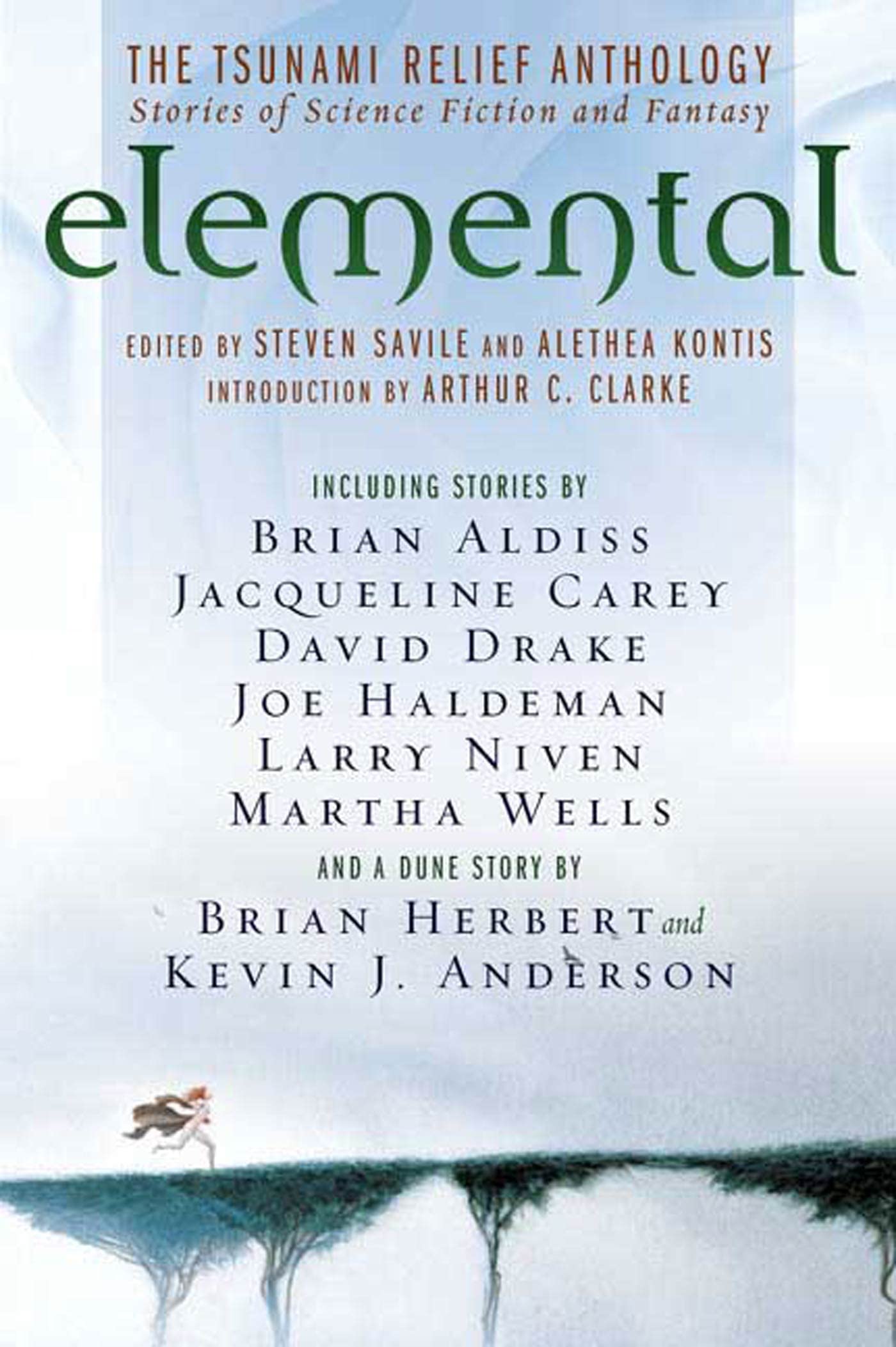
Elemental: The Tsunami Relief Anthology: Stories of Science Fiction and Fantasy
$12.79
by Steven Savile



"The entire collection constitutes thought-provoking entertainment for a good cause, with all publisher and author profits earmarked for the Save the Children Tsunami Relief Fund."-- Booklist In the winter of 2005, after the horrifying natural disaster of the tsunami in Southeast Asia, Steve Savile and Alethea Kontis joined forces to raise money to help the distressed survivors and have created Elemental. They solicited SF and fantasy stories, all new and never published elsewhere, from many of the top writers in the genres today, and received immediate responses in the form of the excellent stories here in this book. Elemental has an introduction by Arthur C. Clarke and more than twenty stories by Jacqueline Carey, Martha Wells, Larry Niven, Sherrilyn Kenyon writing as Kinley MacGregor, and a Dune story by Brian Herbert & Kevin J. Anderson, and many others. They created in Elemental one of the most important genre anthologies of the year, but more than that: in giving real value for the purchase price, everyone who sells this book can be proud, and everyone who buys it will be richly rewarded for supporting the tsunami relief effort. Steven Savile has twice been nominated for the British Fantasy Society Award for best short story and best original fiction collection, and was runner up in 2000 for his editorial work on Redbrick Eden, Scaremongers 2 , which raised funds for the homeless charity SHELTER in the UK. He is the author of Glass Town and Silver , and lives in Stockholm, Sweden, where he also teaches. Alethea Kontis lives in Murfreesboro, Tennessee. She is a contributor to the Apex Science Fiction and Horror Digest. Elemental: The Tsunami Relief Anthology Stories of Science Fiction and Fantasy By Steven Savile Tor Books Copyright © 2006 Steven Savile All right reserved. ISBN: 9780765315632 ELEMENTAL: THE TSUNAMI RELIEF ANTHOLOGY Report from the Near Future: Crystallization BY DAVID GERROLD David Gerrold started writing professionally in 1967. His first sale was the "Trouble with Tribbles" episode of Star Trek . Within five years, he had published seven novels, two books about television production, three anthologies, and a short story collection. He was nominated for the Hugo and Nebula Awards six times in four years. Since 1967, he has published more than forty books. Several of his novels are considered classics, including The Man Who Folded Himself , When HARLIE Was One , and the four books in The War Against the Chtorr .Gerrold has written episodes for more than a dozen different television series, including Star Trek , Star Trek Animated , Twilight Zone , Land of the Lost , Babylon 5, Sliders , Logan's Run, and Tales from the Darkside. He has had columns in six different magazines and two Web sites, including Starlog , Galileo , Profiles , PC-Techniques , Visual Developer , Yahoo , and GalaxyOnline . In 1995, he won the Hugo and Nebula awards for "The Martian Child," an autobiographical tale of his son's adoption.David Gerrold lives with his son in Northridge, California. Learn more about Gerrold at his Web site: www.gerrold.com. It's that moment when a liquid solidifies, when the temperature drops or the pressure rises and the substance finally stops flowing, it slows down, it turns to slush--to mud, it hardens, it finally becomes impenetrable ... .For the first few hours after the Los Angeles freeway system crystallized, most people believed the problem was temporary and that traffic would eventually start flowing again. Even for the first few days, they believed they could eventually chip their way out of the concretized arteries.The slush of Los Angeles traffic had been slower than sluggish for years, churning through looped spaghetti concrete channels in a lumpy stream of metal and plastic peristalsis, in a persistent state of uncertainhesitation, punctuated only occasionally by forward-jerking movements and uneven painful surges, a textbook demonstration of socio-technical constipation and definitely no place for a stick shift.The city engineers had been aware of the potential for crystallization for nearly two decades, but no one had ever taken the warnings seriously, and eventually even they began to assume that their own projections of crystallization were situational artifacts occurring whenever the simulators reached the limits of their ability to process the rapid flows of data.Unfortunately, only the data was flowing rapidly. One desperate afternoon, even that stopped. The air-conditioning broke down in the central monitoring station. The temperature rose uncomfortably. Fans didn't help. The computers began shutting down in self-defense. The screens went blank, or declared, "No signal." Blind and deaf, the traffic engineers could neither monitor nor prescribe.The rest was inevitable.Outside, in the place where the facts didn't care about simulation, events took on a terrifying momentum of their own. It was Friday