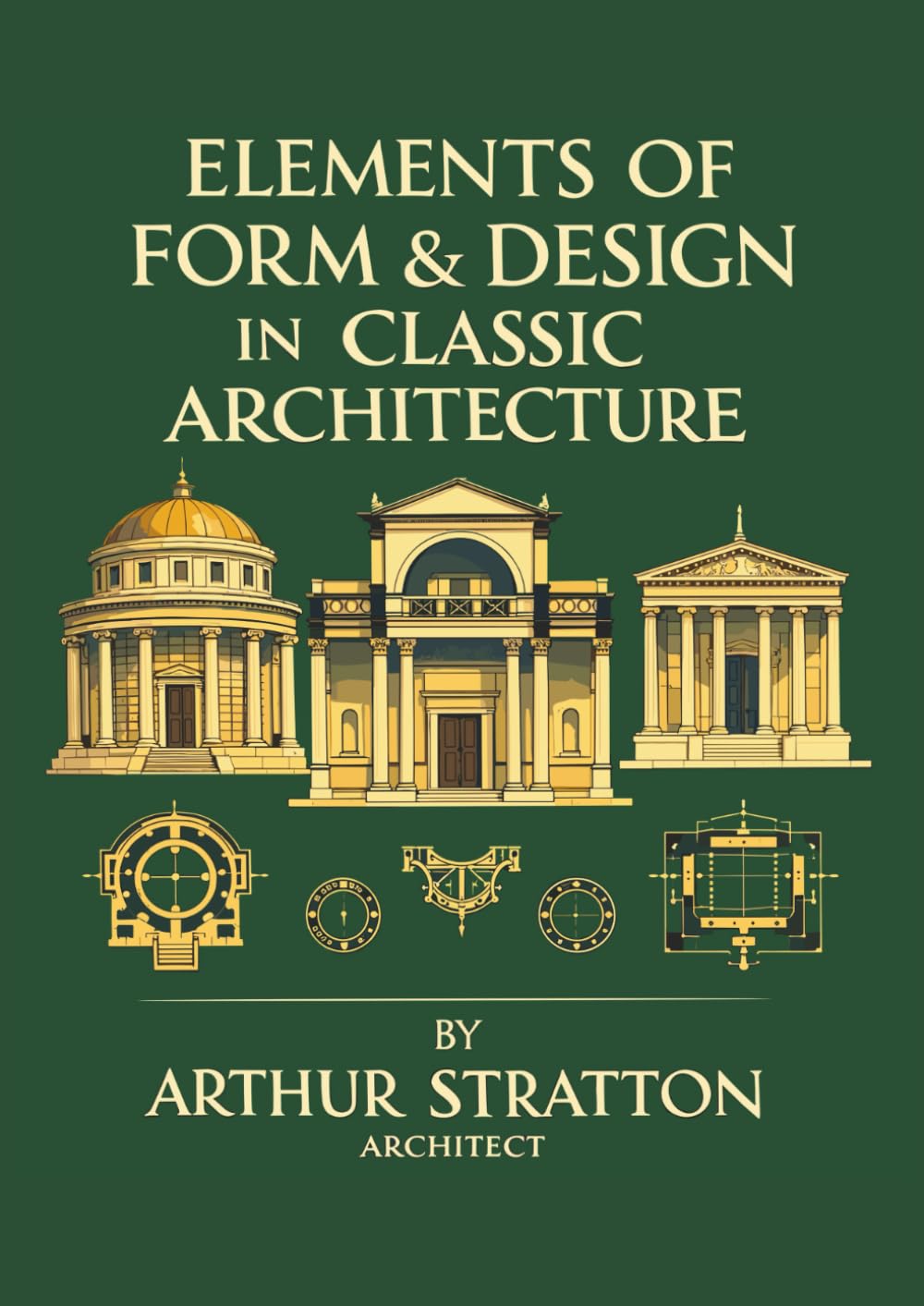



A Definitive Guide to the Geometric Principles of Classical Architecture First published in 1925 by Charles Scribner's Sons and B.T. Batsford, Elements of Form and Design in Classic Architecture stands as one of the most comprehensive and systematic explorations of classical architectural geometry ever produced. Arthur Stratton, a distinguished British architect and architectural historian who pioneered the serious study of Baroque architecture in the English-speaking world, created this masterwork as both scholarly reference and practical teaching tool during the final flowering of Beaux-Arts architectural education. Unlike conventional architectural histories organized chronologically or by region, Stratton's innovative approach arranges material by geometric form —circular, square, elliptical, semi-circular (D-plan), and octagonal plans—demonstrating how fundamental mathematical principles unified classical architecture across 2,000 years. Through approximately 100 plates of meticulously measured drawings, plans, sections, and elevations, the book reveals the sophisticated geometric problem-solving that characterized classical design from ancient Greece and Rome through the Renaissance and Baroque periods. What's Inside: Comprehensive analysis of circular plans, from the Temple of Vesta at Tivoli to the Radcliffe Library at Oxford, demonstrating the versatility of domed structures with peristyles and coffered ceilings - Detailed examination of square planning, including cross vaults, cloister vaults, and domical coverings by masters like Christopher Wren and Nicholas Hawksmoor - Technical exploration of combining circular and rectangular forms using pendentives—the sophisticated structural solution for placing domes on square bases - Analysis of elliptical and semi-circular (D-plan) geometries used in Roman exedrae, legislative chambers, and theatrical spaces - Systematic coverage of architectural elements including vestibules, staircases, pavilions, facades, porticoes, and arches - Examples spanning from ancient Greek temples to 19th-century neoclassical monuments, including works by Bramante, Michelangelo, Palladio, Bernini, Borromini, and Schinkel Who Should Read This Book: This volume is essential for architecture students learning classical design principles, practicing architects seeking authoritative guidance on proportions and forms, architectural historians studying the continuity of classical traditions, preservationists working with historic buildings, and anyone fascinated by the mathematical beauty underlying Western architectural heritage. Stratton's pedagogical approach—moving from theoretical principles to measured documentation of exemplary buildings—makes complex geometric concepts accessible while maintaining scholarly rigor. Published at the peak of Beaux-Arts influence in 1925, just as modernism began challenging classical assumptions, this book represents both a comprehensive summation of centuries of design knowledge and an invaluable preservation of architectural wisdom that might otherwise have been lost. Its enduring value is demonstrated by multiple republications, including editions by Dover Publications and Jeremy Mills Publishing nearly a century after its original appearance. Elements of Form and Design in Classic Architecture reveals classical architecture not as a collection of historical styles to imitate, but as a coherent intellectual tradition unified by geometric and proportional principles—a living system of design thinking that remains relevant for understanding architectural beauty, harmony, and structural logic.