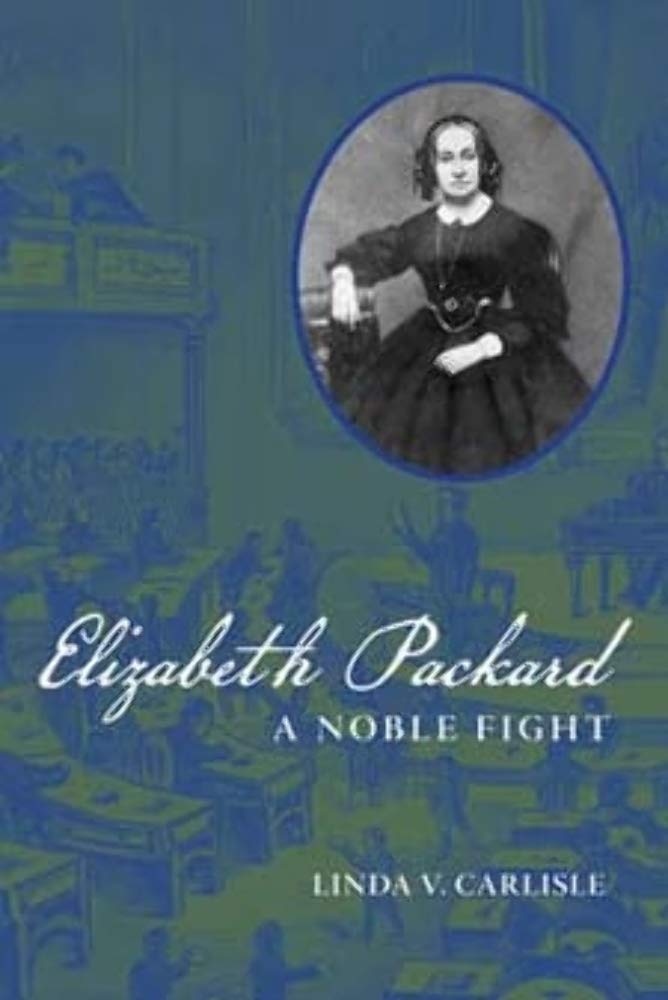



Elizabeth Packard's story is one of courage and accomplishment in the face of injustice and heartbreak. In 1860, her husband, a strong-willed Calvinist minister, committed her to an Illinois insane asylum in an effort to protect their six children and his church from what he considered her heretical religious ideas. Upon her release three years later (as her husband sought to return her to an asylum), Packard obtained a jury trial and was declared sane. Before the trial ended, however, her husband sold their home and left for Massachusetts with their young children and her personal property. His actions were perfectly legal under Illinois and Massachusetts law; Packard had no legal recourse by which to recover her children and property. This experience in the legal system, along with her experience as an asylum patient, launched Packard into a career as an advocate for the civil rights of married women and the mentally ill. She wrote numerous books and lobbied legislatures literally from coast to coast advocating more stringent commitment laws, protections for the rights of asylum patients, and laws to give married women equal rights in matters of child custody, property, and earnings. Despite strong opposition from the psychiatric community, Packard's laws were passed in state after state, with lasting impact on commitment and care of the mentally ill in the United States. Packard's life demonstrates how dissonant streams of American social and intellectual history led to conflict between the freethinking Packard, her Calvinist husband, her asylum doctor, and America's fledgling psychiatric profession. It is this conflict--along with her personal battle to transcend the stigma of insanity and regain custody of her children--that makes Elizabeth Packard's story both forceful and compelling. "Linda Carlisle's comprehensive history makes a significant contribution to the field of psychiatry and the study of women's rights. Using a large mass of primary sources that hitherto remained unexamined, Carlisle sheds a great deal of light on the life of an individual who has not been taken seriously in much of the historical literature--until now."--Gerald N. Grob, Henry E. Sigerist Professor of the History of Medicine Emeritus, Rutgers University "This engaging book shows the fluid nature of what constitutes mental illness, and the evolving role of women in the household."-- History of Psychiatry Linda V. Carlisle is an associate professor in Library & Information Services at Southern Illinois University Edwardsville. She holds a Ph.D. in history from Southern Illinois University Carbondale. ELIZABETH PACKARD A Noble Fight By Linda V. Carlisle UNIVERSITY OF ILLINOIS PRESS Copyright © 2010 Board of Trustees of the University of Illinois All right reserved. ISBN: 978-0-252-03572-2 Contents LIST OF ILLUSTRATIONS................................................ixACKNOWLEDGMENTS......................................................xiIntroduction.........................................................11 "All the Love His Bachelor Heart Could Muster".....................162 "New Notions and Wild Vagaries"....................................243 Breaking the Mold..................................................354 Free Love and True Womanhood.......................................445 "The Forms of Law".................................................576 Andrew McFarland and Mental Medicine...............................687 "A World of Trouble"...............................................788 "An Unendurable Annoyance".........................................919 From Courtroom to Activism.........................................10410 "My Pen Shall Rage"...............................................11811 Shooting the Rattlesnakes.........................................13212 Vindication and "Virtuous Action".................................14513 Triumph and Disaster..............................................15514 Working in Her Calling............................................16515 "Great and Noble Work"............................................17716 Final Campaigns...................................................190NOTES................................................................201BIBLIOGRAPHY.........................................................233INDEX................................................................251 Introduction IN THE SPRING OF 1875, a distraught Mary Todd Lincoln, wife of the slain president, was involuntarily committed to a private mental hospital in Batavia, Illinois, by a court order requested by her son, Robert Lincoln. Fifteen years earlier, an unknown Illinois woman named Elizabeth Packard was also involuntarily committed to a state mental hospital in Jacksonville. There are remarkable connections between the two cases. Both women contested their confinement, both were examined and declared insane by Dr. Andrew McFarland,