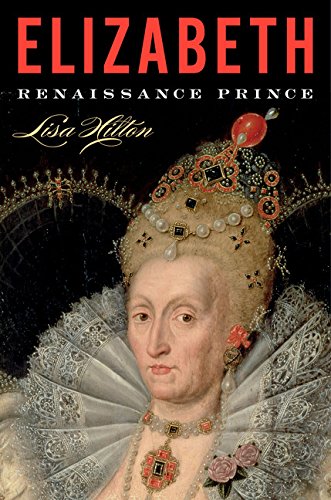



A new portrait that casts the queen as she saw herself: not as an exceptional woman, but as an exceptional ruler Queen Elizabeth I was all too happy to play on courtly conventions of gender when it suited her &;weak and feeble woman&;s body&; to do so for political gain. But in Elizabeth , historian Lisa Hilton offers ample evidence why those famous words should not be taken at face value. With new research out of France, Italy, Russia, and Turkey, Hilton&;s fresh interpretation is of a queen who saw herself primarily as a Renaissance prince and used Machiavellian statecraft to secure that position. A decade since the last major biography, this Elizabeth breaks new ground and depicts a queen who was much less constrained by her femininity than most treatments claim. For readers of David Starkey and Alison Weir, it will provide a new, complex perspective on Elizabeth&;s emotional and sexual life. It&;s a fascinating journey that shows how a marginalized newly crowned queen, whose European contemporaries considered her to be the illegitimate ruler of a pariah nation, ultimately adapted to become England&;s first recognizably modern head of state. Praise for Elizabeth: Renaissance Prince “Game-changing . . . How history should be written.” — Andrew Roberts , author of Napoleon: A Life “It is refreshing to be confronted by challenging arguments instead of tired anecdotes. This biography is also full of unusual and interesting insights . . . What I am left with above all are haunting images of a scented room and a face dusted with alabaster—the living cameo of a most exceptional prince.” — Leanda de Lisle, author of The Sisters Who Would be Queen , for the Spectator “Hilton provides us with an accomplished evocation of a remarkable ruler. Her book is as elegantly fashioned and ingeniously contrived as those pieces of Renaissance jewelry that Elizabeth loved to wear.” — Anne Somerset , author of Queen Anne , for the Mail on Sunday 1 When the infant Princess Elizabeth awoke in her nursery on 20 May 1536, the landscape of her childhood was imperceptibly but irrevocably changed. Her mother, Queen Anne, had died the previous morning in the Tower precincts, her head struck from her body by the dancing blade of a French swordsman imported from Calais for the task. So many corpses, so many ghosts. Elizabeth's path to the throne was littered with 150 years' worth of bodies. Since 1400, when the two strands of the great Plantagenet dynasty which had ruled England since 1154 divided and turned against one another, the preoccupation of the English crown had been heirs. The childless Richard II (with whom Elizabeth was later to identify herself) lost his throne to Henry Bolingbroke, subsequently Henry IV. The death of his son Henry V, the second Lancastrian king, in 1422, left the nation under the nominal leadership of a tiny baby, inaugurating the second phase of the Wars of the Roses, the dynastic conflict which dominated English politics until Henry Tudor seized the throne from Richard III in 1485. With Henry's accession and celebrated reunion of the two strands of the dynasty in his marriage to Elizabeth of York, the succession seemed assured, though it passed to another Duke of York, Henry VIII, rather than his elder brother, Arthur, Prince of Wales. It was hardly surprising, given this legacy of treachery, death, and devastating insecurity that when Henry married his brother's widow, Katherine of Aragon, he should have been even more concerned than his ancestors with the getting of a male heir, yet this was the one thing which, in his view, God denied him. Henry's struggles to release himself from his first marriage and wed Elizabeth's mother, Anne, precipitated the greatest confessional schism Europe had yet seen and set England on the course to Protestant isolation which became such a self-declared part of the emerging nationalist identity of his daughter's state. Elizabeth was the product of that schism, and for two years, officially at least, she was his petted darling, the first child of that godly marriage which would people the courts of Europe with Tudor blood. Yet on 20 May 1536, all the small certainties of her world were severed. Historians have been arguing ever since about the effect this had on Elizabeth, but we cannot know how and when the two-year-old girl was informed of her mother's death or what her reaction was. This has not prevented generations of writers from imaginatively constructing the consequences of Elizabeth's loss, but statements such as 'Unresolved grief continued through Elizabeth's childhood .?.?. for Anne Boleyn's name could not be mentioned without provoking a fearful reaction from Henry VIII. Such a situation often leads to excessive mourning reactions on occasions of loss and later melancholia," are merely speculative and without authority, though not uninteresting. That Elizabeth was nurturing a secret guilt at having fulfilled the desire of h