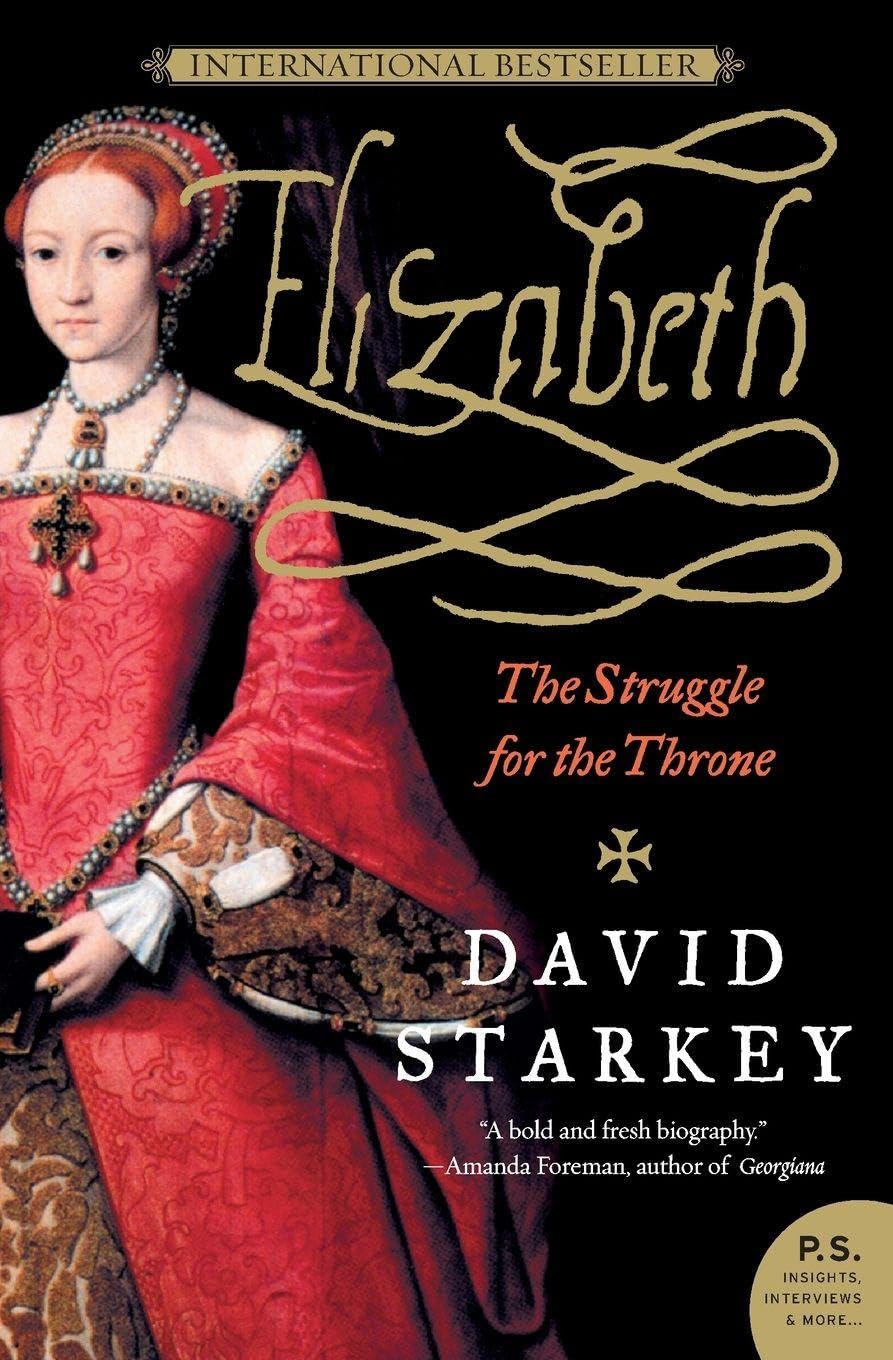



An abused child, yet confident of her destiny to reign, a woman in a man's world, passionately sexual—though, as she maintained, a virgin—Elizabeth I is famed as England's most successful ruler. David Starkey's brilliant new biography concentrates on Elizabeth's formative years—from her birth in 1533 to her accession in 1558—and shows how the experiences of danger and adventure formed her remarkable character and shaped her opinions and beliefs. From princess and heir-apparent to bastardized and disinherited royal, accused traitor to head of the princely household, Elizabeth experienced every vicissitude of fortune and extreme of condition—and rose above it all to reign during a watershed moment in history. A uniquely absorbing tale of one young woman's turbulent, courageous, and seemingly impossible journey toward the throne, Elizabeth is the exhilarating story of the making of a queen. "Unpredictable, harrowing, and engrossing."Jim Harrison, author of Legends of the Fall and The Road Home An abused child, yet confident of her destiny to reign, a woman in a man's world, passionately sexual—though, as she maintained, a virgin—Elizabeth I is famed as England's most successful ruler. David Starkey's brilliant new biography concentrates on Elizabeth's formative years—from her birth in 1533 to her accession in 1558—and shows how the experiences of danger and adventure formed her remarkable character and shaped her opinions and beliefs. From princess and heir-apparent to bastardized and disinherited royal, accused traitor to head of the princely household, Elizabeth experienced every vicissitude of fortune and extreme of condition—and rose above it all to reign during a watershed moment in history. A uniquely absorbing tale of one young woman's turbulent, courageous, and seemingly impossible journey toward the throne, Elizabeth is the exhilarating story of the making of a queen. David Starkey is the Bye Fellow of Fitzwilliam College, Cambridge, and winner of the W. H. Smith Prize and the Norton Medlicott Medal for Services to History presented by Britain's Historical Association. He is best known for writing and presenting the groundbreaking and hugely popular series Elizabeth and The Six Wives of Henry VIII . He lives in London. Elizabeth The Struggle for the Throne By David Starkey HarperCollins Publishers, Inc. Copyright © 2007 David Starkey All right reserved. ISBN: 9780061367434 Chapter One Birth Elizabeth, daughter of Henry VIII and Anne Boleyn, was born on Sunday, 7 September 1533 at 3 o'clock in the afternoon. It was an easy birth: mother and daughter were well and the child took after her father with his fair skin and long nose. But she had her mother's coal-black eyes. These are the ordinary, human details that might characterize the birth of any baby. But Elizabeth was royal. That meant that her entry into the world was vested with ceremony and hopes that went far beyond the ordinary. Indeed, as far as the hopes were concerned, they went far beyond what was usual even for a royal birth. Royal births, like other royal events, great and small, from marriages and deaths to dressing and dining, were the object of an elaborate ceremonial. This was set out in the handbook of court etiquette known as The Royal Book. The ceremonies were already old when the Tudors came to the throne, though with his love of display, Elizabeth's grandfather, Henry VII, had added a few finishing touches. The result combined religious and courtly ceremony; it hid the pregnant queen like a mystery and it paraded the new-born infant like a pageant. For successive generations of Plantagenets, Yorkists and Tudors, this entry into the world had lent a little magic to even the briefest royal lives. In the case of Elizabeth, it formed a magnificent prologue to the superb royal performance that was to be her reign. The preparations had got underway in earnest in early August when it was decided that the birth would take place at Greenwich. This was the lovely, Thames-side palace where, forty-two years before, Elizabeth's father, Henry VIII, had been born. It was the favourite palace of his mother, Elizabeth of York, and it was to become his and his daughter's favourite too. First, the Queen's bedchamber was prepared for her confinement. The walls and ceiling were close hung and tented with arras--that is, precious tapestry woven with gold or silver threads--and the floor thickly laid with rich carpets. The arras was left loose at a single window, so that the Queen could order a little light and air to be admitted, though this was generally felt inadvisable. Precautions were taken, too, about the design of the hangings. Figurative tapestry, with human or animal images, was ruled out. The fear was that it could trigger fantasies in the Queen's mind which might lead to the child being deformed. Instead, simple, repetitive patterns were preferred. The Queen's richly hung and canopied bed was to match or be