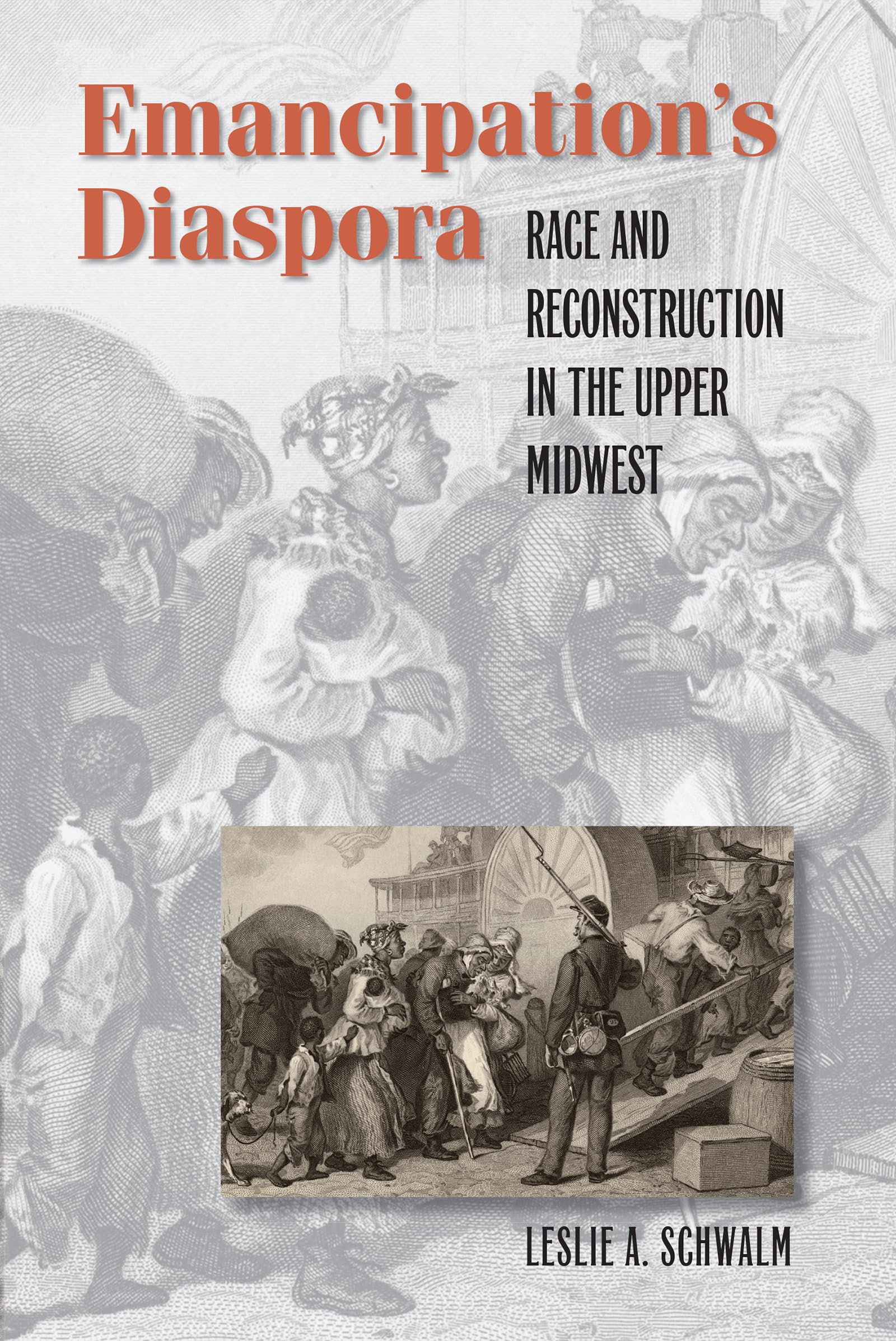
Emancipation's Diaspora: Race and Reconstruction in the Upper Midwest (The John Hope Franklin Series in African American History and Culture)
$21.79
by Leslie A. Schwalm



Most studies of emancipation’s consequences have focused on the South. Moving the discussion to the North, Leslie Schwalm enriches our understanding of the national impact of the transition from slavery to freedom. Emancipation’s Diaspora follows the lives and experiences of thousands of men and women who liberated themselves from slavery, made their way to overwhelmingly white communities in Iowa, Minnesota, and Wisconsin, and worked to live in dignity as free women and men and as citizens. Schwalm explores the hotly contested politics of black enfranchisement as well as collisions over segregation, civil rights, and the more informal politics of race — including how slavery and emancipation would be remembered and commemorated. She examines how gender shaped the politics of race, and how gender relations were contested and negotiated within the black community. Based on extensive archival research, Emancipation’s Diaspora shows how in churches and schools, in voting booths and Masonic temples, in bustling cities and rural crossroads, black and white Midwesterners — women and men — shaped the local and national consequences of emancipation. “ Emancipation’s Diaspora successfully demolishes the insistence of some authors that emancipation really did not change anything, but it is also exquisitely sensitive to the very complicated nature of emancipation’s impact on ideas about race in the United States. . . . It is impossible to finish this book and not see slavery, race, and emancipation as truly national questions whose repercussions continued to reverberate throughout the entire nineteenth century and beyond.” — Journal of Illinois History “Expand[s] our historical understanding of black migration and presence in the Midwest after the Civil War. . . . [The] diversity of sources . . . creates an especially rich base of evidence that tells the story of Iowa, but also of the region and the country as a whole. . . . An important book for all scholars of midwestern history.” — Annals of Iowa “[A] remarkable book. . . . Relying on an impressive array of manuscript collections, newspapers, census data, diaries, letters, army records, and memoirs, Schwalm makes a case that is undeniable. . . . The book is especially strong in bringing into focus the lives of black women.” — Minnesota History “Confirms US Reconstruction’s national dimensions. . . . Recommended.” — CHOICE “An engaging analysis of a region that historians of race have neglected. . . . [An] important book.” — Journal of Southern History “[Schwalm] has done historians of race, slavery, and Reconstruction a great service by locating her study in a veritable no-man’s land [the Midwest]. . . . Impressive.” ― H-Net Reviews “Breadth and ingenuity in research, historiographical sophistication, and a lucid prose style make this study a major contribution.” — American Historical Review “ Emancipation’s Diaspora is ambitious and rewarding, making tangible the personal and political impact of slavery beyond the South and beyond 1865. . . . Although other historians have studied northern states during Reconstruction, none begins with the insight that they too faced emancipation. . . . Schwalm achieves a geographical and chronological reorientation through her remarkable rendering of the grief, joys, and longings of ordinary people.” — Journal of the Gilded Age and Progressive Era “A much needed addition to the growing historiography on emancipation and Reconstruction. . . . Innovative. . . . Persuasively demonstrates that historians would be remiss to ignore the consequences of emancipation and its subsequent diaspora in regions outside of the slave South — specifically, the Upper Midwest.” — Indiana Magazine of History “This book’s regional focus and its attention to gender and women’s experiences make it a crucial contribution to an ongoing reevaluation of black history, racial politics, and sectional identity in the nineteenth-century North. . . . Schwalm deftly uses archival and published military records. . . . An invaluable entry in a growing body of scholarship on the impact of slavery and its legacies outside the South.” — Civil War History Schwalm convincingly demonstrates that northern racial constructions and social organization drew their meaning from southern slavery and thus underwent a fundamental change in the postemancipation era. She makes excellent use of pension records to uncover details about the personal lives of people who otherwise left few records. Emancipation's Diaspora offers a valuable new perspective on the Civil War and Reconstruction.--Louis Gerteis, University of Missouri-St. Louis Reconstruction-era struggles for civil rights and citizenship Leslie A. Schwalm is associate professor of history, women’s studies, and African American studies at the University of Iowa. She is author of A Hard Fight for We: Women’s Transition from Slavery to Freedom in South Carolina . Used Book in Good