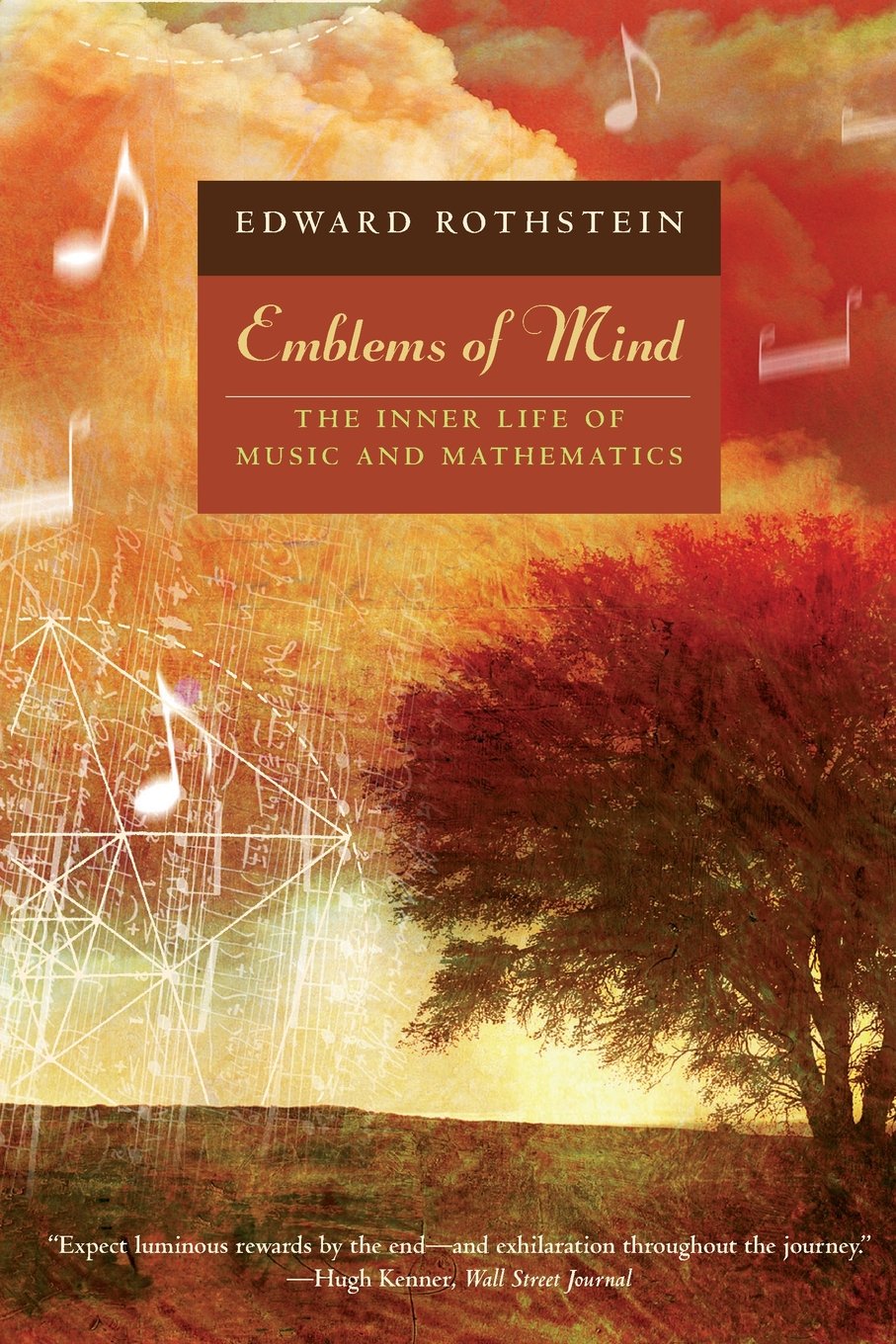



One is a science, the other an art; one useful, the other seemingly decorative, but mathematics and music share common origins in cult and mystery and have been linked throughout history. Emblems of Mind is Edward Rothstein’s classic exploration of their profound similarities, a journey into their “inner life.” Along the way, Rothstein explains how mathematics makes sense of space, how music tells a story, how theories are constructed, how melody is shaped. He invokes the poetry of Wordsworth, the anthropology of Lévi-Strauss, the imagery of Plato, and the philosophy of Kant. Math and music, Rothstein shows, apply comparable methods as they create their abstractions, display similar concerns with ratio and proportion, and depend on metaphors and analogies to create their meanings. Ultimately, Rothstein argues, they reveal the ways in which we come to understand the world. They are images of the mind at work and play; indeed, they are emblems of Mind itself. Jacques Barzun called this book “splendid.” Martin Gardner said it was “beautifully written, marvelous and entertaining.” It will provoke all serious readers to think in new ways about the grand patterns in art and life. “Lovely, wistful. . . . Rothstein is a wonderful guide to the architecture of musical space, its tensions and relations, its resonances and proportions. . . . His account of what is going on in the music is unfailingly felicitous.”— New Yorker “Provocative and exciting. . . . Rothstein writes this book as a foreign correspondent, sending dispatches from a remote and mysterious locale as a guide for the intellectually adventurous. The remarkable fact about his work is not that it is profound, as much of the writing is, but that it is so accessible.”— Christian Science Monitor Edward Rothstein is cultural critic-at-large for the New York Times . He also has served as chief music critic for the Times and as music critic for the New Republic . The recipient of a Guggenheim fellowship, Rothstein has written for Commentary , Vanity Fair , and the New York Review of Books . EMBLEMS OF MIND The Inner Life of Music and Mathematics By Edward Rothstein The University of Chicago Press Copyright © 2006 Edward Rothstein All right reserved. ISBN: 978-0-226-72954-1 Contents Preface to the 2006 Edition........................................ixAcknowledgments....................................................xiiIntroduction.......................................................xvI PRELUDE: THE NEED FOR METAPHOR...................................3II PARTITA: THE INNER LIFE OF MATHEMATICS..........................33III SONATA: THE INNER LIFE OF MUSIC...............................81IV THEME AND VARIATIONS: THE PURSUIT OF BEAUTY.....................135V FUGUE: THE MAKING OF TRUTH.......................................191VI CHORALE: THE TEXTURE OF THOUGHT.................................229Selected Bibliography..............................................243Index..............................................................249 Chapter One PRELUDE: THE NEED FOR METAPHOR Ten ... This number was of old held high in honor, for such is the number of fingers by which we count. OVID INTENT ON SEEING THE SUN RISE FROM THE TOP OF MT. SNOWDON, the young William Wordsworth set out on a climb one evening two centuries ago with a friend and a shepherd guide. It was a close, warm summer night, the fog hanging low, air dripping with moisture. Beginning from a cottage at the mountain's base, the trio climbed in silence as the mists surrounded them. The poet's head was bent earthward, as if, he writes, it were set against an enemy. He was lost in thought, negotiating rocks and paths, panting breathlessly, leading the way through the midnight hours. Gradually, though dawn had not yet come, the ground at the poet's feet began to brighten. With each step the light increased. There was hardly time to ask or learn the cause, when suddenly—"Lo!" the poet cries in biblical fashion—he looked up and there was the moon hung naked in a firmament Of azure without cloud, and at my feet Rested a silent sea of hoary mist. From the mountain peak, the poet saw a vast sea of vapors below him, stretching out to the ocean, while the sky above was unclouded, the full moon illuminating the "ethereal vault." All was silent, save for a breach in the mist, a blue chasm not far off, a "breathing-place" whence came a "roar of waters, torrents, streams / Innumerable, roaring with one voice!" heard over the whole earth and sea and seemingly felt by the starry heavens. When the scene dissolved and the poet thought about what he had seen, it seemed to him to be an image, the type Of a majestic intellect, its acts And its possessions, what it has and craves, What in itself it is, and would become. The moon hanging over the mists, the light above, the sound below, the dark abyss and the silent sky—"There I beheld," the poet writes