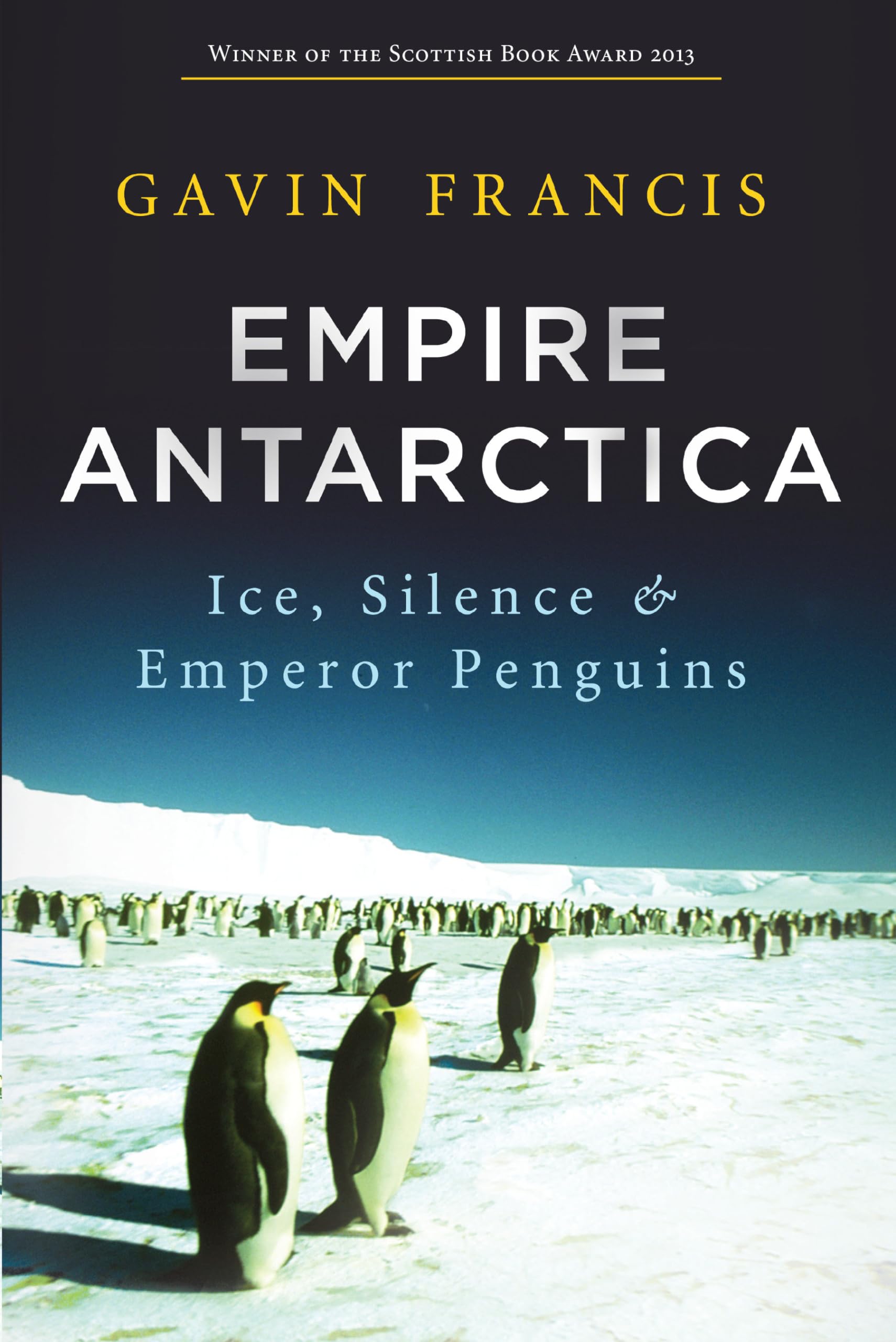



Gavin Francis fulfilled a lifetime's ambition when he spent fourteen months as the basecamp doctor at Halley, a profoundly isolated British research station on the Caird Coast of Antarctica. So remote, it is said to be easier to evacuate a casualty from the International Space Station than it is to bring someone out of Halley in winter. Antarctica offered a year of unparalleled silence and solitude, with few distractions and very little human history, but also a rare opportunity. Throughout the year -- from a summer of perpetual sunshine to months of winter darkness -- Gavin Francis explores the world of great beauty conjured from the simplest of elements, the hardship of living at 50 c below zero and the unexpected comfort that this penguin community brings, for this is the story of one man and his fascination with the world's loneliest continent, as well as the emperor penguins who weather the winter with him. Combining an evocative narrative with a sublime sensitivity to the natural world, this is travel writing at its very best. "It is difficult to read this engaging memoir without a smile on one's face, such is the author's enthusiasm for the world's southernmost continent and its endemic penguin species, the Emperor…Francis's descriptions of his visits to this spot, where 60,000 Emperors live in a 'great penguin jamboree,' add moments of sheer joy to this mesmerizing and memorable book."— The Economist "A highly readable, enjoyable account of one man's year serving as a doctor at Halley Research Station
A keen observer of his surroundings, the author writes vividly of auroras, clouds, stars, sunlight, darkness, ice and snow
A literate, stylish memoir of personal adventure rich in history, geography and science." — Kirkus Gavin Francis was born in 1975 and brought up in Fife, Scotland. After qualifying from medical school in Edinburgh he spent ten years traveling, visiting all seven continents. He has worked in Africa and India, made several trips to the Artic, and crossed Eurasia and Australia by motorcycle. His first book, True North was published in 2008. He has lectured at the Scott Polar Research Institute in Cambridge and the Edinburgh Book Festival, and is a regular speaker at the Royal Scottish Geographical Society. He lives in Edinburgh. It is said to be one of our oldest stories, embedded in humanity’s DNA, when a young man goes to a far-off land in search of a terrible or wondrous beast. The Epic of Gilgamesh, Jason and the Golden Fleece, Beowulf they all fit the template. Bruce Chatwin added his Patagonian journey to the list. For years the idea of Antarctica had murmured in my ambition; a desire to go to the remotest land on our planet, to see one of the most wondrous beasts alive. I wanted to live alongside emperor penguins in Antarctica. As a boy my most cared-for possession was a copy of Gerald Durrell’s The Amateur Naturalist. I was a diligent member of the Young Ornithologists Club and had memorised my Children’s Illustrated Book of Birds. When the thrill of local birdwatching waned I read about birds that never entered the seas or skies of Scotland. On a trip to Edinburgh Zoo I became fascinated by penguins’ waddling, boisterous gregariousness. There were glass cutaways in the penguins’ tank, it was possible to watch their underwater transformation from ungainly waddlers into lithe muscular hunters. They were so different from any kind of bird I knew that they captured my attention and my imagination. Later I travelled in the High Arctic and loved the bright true purity I saw in the landscape there. But the Arctic is a ceaselessly roiling frozen ocean where birds and mammals shun mankind (or, in the case of polar bears, hunt them). I learned that penguins, on the other hand, showed no fear of human beings. I was enthralled by the idea of Antarctica, its solidity, silence, enormity, the mythical space it grew to occupy in my imagination, and wanted to meet for myself the birds that lived in it. I saw photographs of orni¬thologists sitting in rookeries surrounded by thousands of emperor penguins, relief on their faces, as if they felt accepted at last into avian society. I wondered if there at the end of the earth I might learn something from the emperors, of the purity of living in the physical senses, of a life without tangles of motives or the radio-chatter of the mind. They seemed to offer a welcome all too rare in the natural world, perhaps even a kind of forgiveness. As I learned more about Antarctica I became captivated too by the stories of the early expeditions, particularly those of Scott, Shackleton, and the US Navy admiral, Richard Byrd. In the lush green afternoons of Scottish summers I read of Scott’s march to death on the Ross Ice Shelf, of Shackleton’s miraculous survival against all the odds, of Byrd’s winter alone, manning a meteoro¬logical station through months of polar darkness. Edward Wilson, Scott’s doctor and chief scientist, held a special fascination