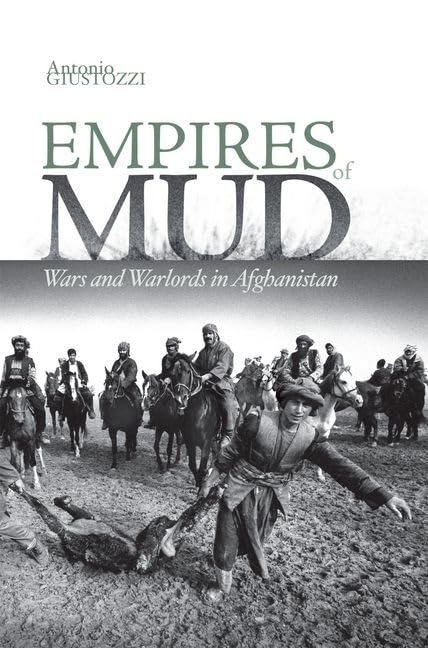



Warlords, namely charismatic military leaders who exploit the weakness of central authorities to seize control of and autonomously rule a sub-national area, have earned much notoriety in recent years on account of the excesses of civil wars in Liberia, Somalia and Afghanistan. But notwithstanding their bad reputation, warlords have often participated in state formation. In Empires of Mud , Giustozzi analyses the dynamics of warlordism in Afghanistan within the context of such debates. He approaches this complex task by first analysing aspects of the Afghan environment that might have been conductive to the fragmentation of central authority and the emergence of warlords and then accounts for the emergence of warlordism in the 1980s and subsequently the lion's share of this book consists of an in-depth analysis of the systems of rule--political, economic, military--which developed under Afghanistan's two foremost warlords, Ismail Khan and Abdul Rashid Dostum, both of whom still wield considerable power even after the intervention of Allied forces in Afghanistan in 2001. Their two systems are compared, highlighting convergences and divergences, in order to explain how warlords administer the areas that they control within so-called "failed states", in the process challenging much of the received wisdom in scholarly and policy circles about warlordism. The author also discusses Ahmad Shah Massoud, whose "system" incorporated elements of rule not dissimilar from that of the warlords. Giustozzi concludes that although charismatic leaders play a key role in shaping the specific characteristics of each warlord polity, there are some common elements that underlie the emergence of warlordism. In particular, the role of local military leaders and their gradual acquisition of a form of "class consciousness" appear to be key processes in allowing the formation of warlord polities, while the latter have repeatedly shown the ability over time to evolve in to more sophisticated, state-like, or political party-like, structures. "Giustozzi assesses the dynamics of warlordism...a chilling prognosis for those who believe that the solution to stabilising Afghanistan will come only from the top down--by building strong central government institutions. Although creating a strong centralised state, assuming it ever happens, may help ensure long-term stability, it is not sufficient in Afghanistan. The current top-down state-building and counterinsurgency efforts must take place alongside bottom-up programs, such as reaching out to legitimate local leaders to enlist them in providing security and services at the village and district levels. Otherwise, the Afghan government will lose the war"-- Foreign Affairs "A masterful account of the dilemmas of state-building in Afghanistan and his concluding words should be heeded when he warns that he doubts that strong national leadership will emerge in a context of external intervention in Afghanistan."-- International Affairs "The first book to provide a political sociology of warlordism in Afghanistan; its purpose is to understand in detail how warlord polities work, expand and disintegrate. Empires of Mud will become required reading, both for academics and policy-makers studying the phenomenon of warlordism, and for those with a specialist interest in Afghanistan."--Jonathan Goodhand, School of Oriental and African Studies Antonio Giustozzi is a Research Fellow at IDEAS, London School of Economics.