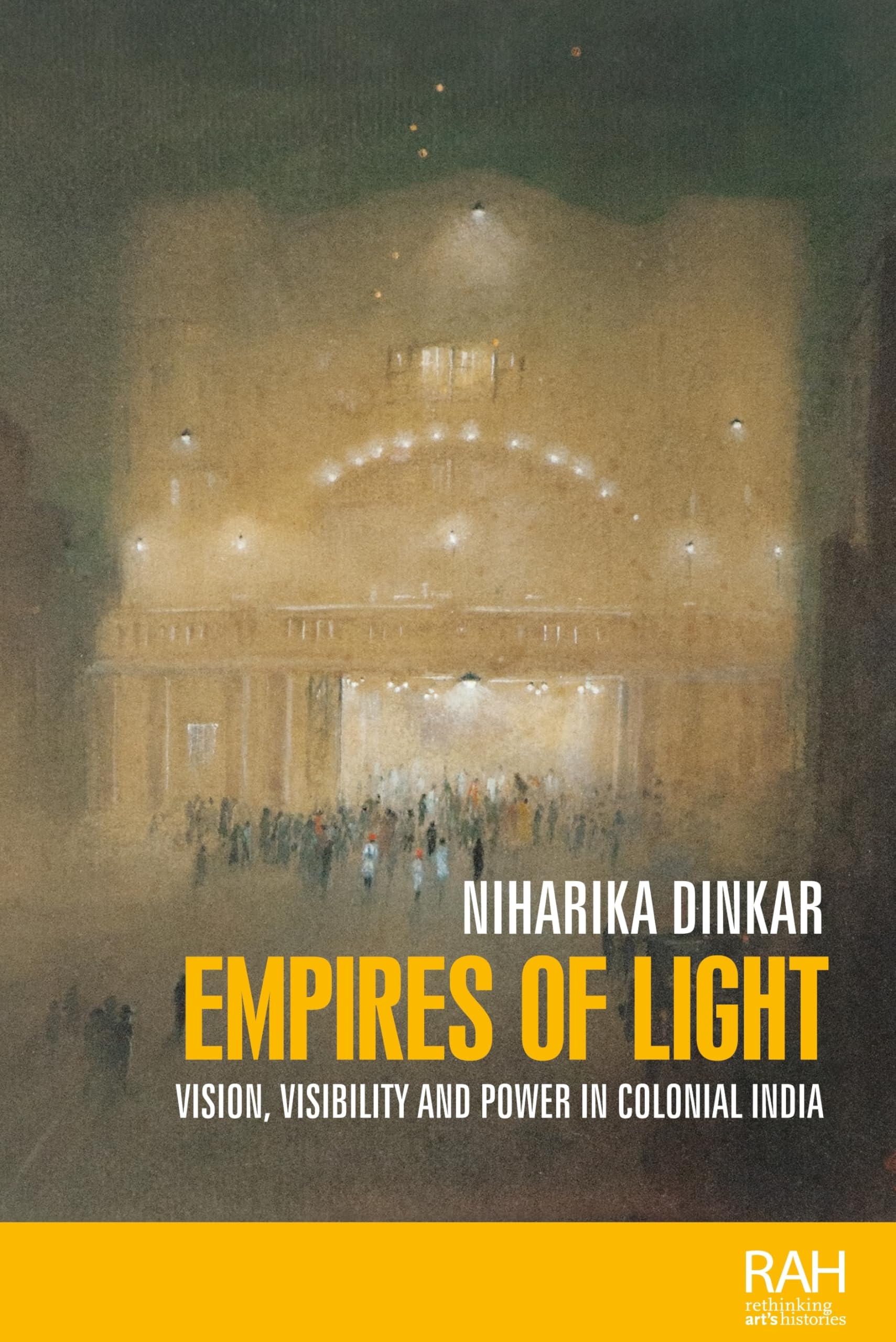
Empires of light: Vision, visibility and power in colonial India (Rethinking Art's Histories)
$87.46
by Niharika Dinkar



Light was central to the visual politics and imaginative geographies of empire, even beyond its role as a symbol of knowledge and progress in post-Enlightenment narratives. This book describes how imperial mappings of geographical space in terms of ‘cities of light’ and ‘hearts of darkness’ coincided with the industrialisation of light (in homes, streets, theatres) and its instrumentalisation through new representative forms (photography, film, magic lanterns, theatrical lighting). Cataloguing the imperial vision in its engagement with colonial India, the book evaluates responses by the celebrated Indian painter Ravi Varma (1848–1906) to reveal the centrality of light in technologies of vision, not merely as an ideological effect but as a material presence that produces spaces and inscribes bodies. Empires of light is a study of light, vision and power in colonial India. It examines the material cultures of light within imperial networks, drawing the colonial experience into contemporary debates on vision and optics to provide an art historical account of how a modern consciousness was forged amidst these dramatic transformations. In his Reflections on the Revolution in France , Edmund Burke discerned a ‘new conquering empire of light and vision’ that he associated with the rhetoric of Enlightenment thought. This book expands on Burke’s protean metaphor, examining the role of light in imperial optics through a study of nineteenth-century Indian visual practices. Light was central to the visual politics and imaginative geographies of empire, beyond its simplistic valorisation as a symbol of knowledge and progress in post-Enlightenment narratives. Geographical spaces were mapped in terms of ‘cities of light’ and ‘hearts of darkness’, and ‘the civilising mission’ frequently employed iconographies of torches or the lifting of the veil to indicate a passage into rationality. Empires of light describes how an imperial regime deployed light and visibility as technologies of colonial control. Taking in the industrialisation of light (in homes, streets, theatres) and its instrumentalisation through an industry of representation (photography, film, magic lanterns, theatrical lighting), the book examines the works of celebrated painter Ravi Varma (1848–1906) and the colonial subjects – from elite artists to subalterns – produced by the encounter with imperial technologies of vision. Theoretically sophisticated and richly illustrated with many previously unpublished images, Empires of light makes a substantial contribution to our understanding of visual culture in colonial India. It is essential reading for students and scholars of South Asian art history, film and media studies. Niharika Dinkar is Associate Professor of South Asian Art History and Visual Culture at Boise State University