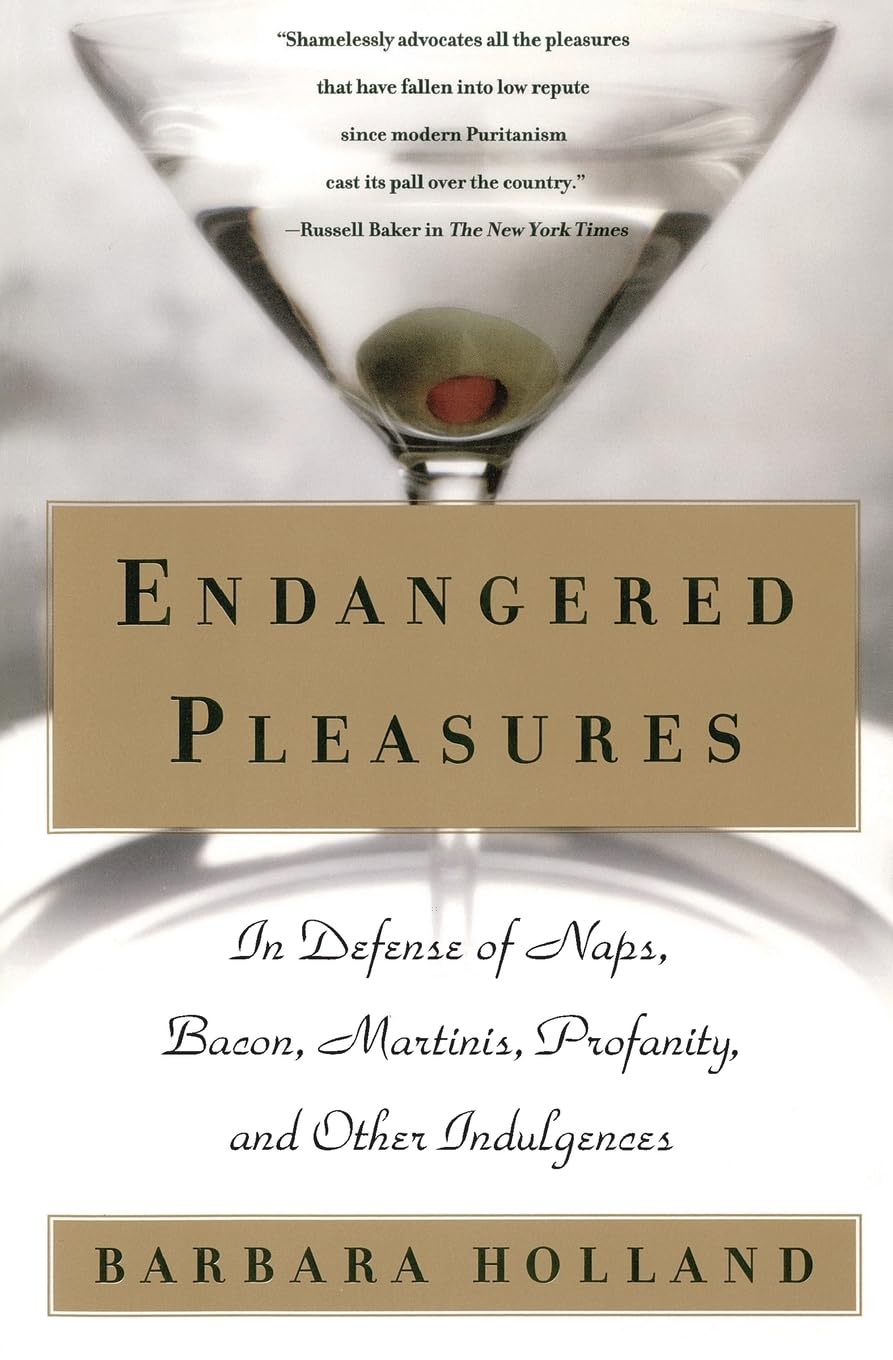
Endangered Pleasures: In Defense of Naps, Bacon, Martinis, Profanity, and Other Indulgences
$11.99
by Barbara Holland



Here is a refreshing look at life as it ought to be. Bare feet, gardening, dawdling over the newspaper, oversleeping, and idle summer vacations are infinitely more satisfying than counting fat grams, eating only vegetables, and sitting behind that desk every day. So toss out the guilt and rebel. Don't just stop and smell the flowers--call in sick and lie among them, preferably with a good friend, a bottle of wine, and a handful of chocolates. Endangered Pleasures is a delightful reminder that rest and relaxation are more rewarding than a job performance review. After all, life's too short. Why not have some fun while you're supposed to be living it? "An engaging reminder of...the simple plasures of life that are slipping away as we move faster and work harder." -- -- Boston Globe "Shamelessly advocates all the pleasures that have fallen into low repute since modern Puritanism cast its pall over the country." -- --Russell Barker in The New York Times "[Laugh] in marvel at the degree to which Ms. Holland captures on paper the many delights in life." -- -- Raleigh News and Observer Here is a refreshing look at life as it ought to be. Bare feet, gardening, dawdling over the newspaper, oversleeping, and idle summer vacations are infinitely more satisfying than counting fat grams, eating only vegetables, and sitting behind that desk every day. So toss out the guilt and rebel. Don't just stop and smell the flowers--call in sick and lie among them, preferably with a good friend, a bottle of wine, and a handful of chocolates. Endangered Pleasures is a delightful reminder that rest and relaxation are more rewarding than a job performance review. After all, life's too short. Why not have some fun while you're supposed to be living it? Barbara Holland's books include Secrets of the Cat, Hail to the Chief, and One's Company. Her articles have appeared in Arts and Entertainment, Country Journal, and Smithsonian. She lives in Bluemont, Virginia. "So pleasingly subversive that the reader falls into a reverie of his own remembered pleasures." Chapter One Obviously the best possible time to wake up is in the June of our tenth year, on the first day of summer vacation. Failing that, another good time is in winter, facing east on the only bright morning in a long string of dark ones. I did it recently, while visiting a country friend. She'd thoughtfully put me to bed in a tiny southeastern room with deep windows, so the bed was at sill level, and I woke up covered all over with the low yellow winter sunlight, as if Zeus had descended in a shower of gold and I would presently give birth to a minor goddess. Never underestimate the power of daylight in December. In a window is a good place to wake up. For years in the city I lived in a small old rowhouse with low windows and slept at the windowsill, twelve feet straight up from the sidewalk. In the morning I could check the day from my pillow; the state of the sky; whether the people across the street had raised their upstairs blinds yet; whether the pedestrians wore their coats open or buttoned tightly. A window is the world's threshold, or vestibule. Some misguided hearties claim to enjoy waking up outdoors, completely in the world, participants instead of spectators, but this is too much responsibility for me at that hour. Too much sky. The room around us is our cave and protection -- our sleep, so to speak -- and the window is the world and the day ahead, or the waking state, and we lie there balanced at the transition between them. This is a good and gentle way to reenter the daily life, Which brings up the subject of how to wake painlessly at the appointed hour. The same country friend, who has virtuously given up eating eggs, keeps chickens around anyway because she likes to hear the roosters crowing. A rooster is the classic and one of the pleasanter ways to be dragged out of sleep, or would be if he were more reliable. Some roosters don't crow until noon, and then keep it up till dinnertime. Most of them, in May and June, carry on hysterically at the first gray of dawn, which is no time for sane folk to be abroad. You can't count on a rooster, and many of us aren't in a position to keep one in the apartment anyway. We have alarm clocks, or clock radios. Those who are seriously anti-pleasure go for a loud, angry, relentless ringing or buzzing sound to rend the soft rosy fabric of sleep and yank them into the day. This satisfies their masochism and leaves their nerves twitching till noon. A modern variation on this produces a thin electronic whine that can easily be silenced by the sleeper and then, five minutes later, another, more insistent whine. This has the advantage of letting us slip back into sleep -- one of life's purer pleasures -- over and over, with the disadvantage of being a thoroughly mean and hateful sound. Why not bells, for heaven's sake? Distant church bells, or chimes, or a far-off trumpet solo, or a mockingbird, or a fife-and-drum c