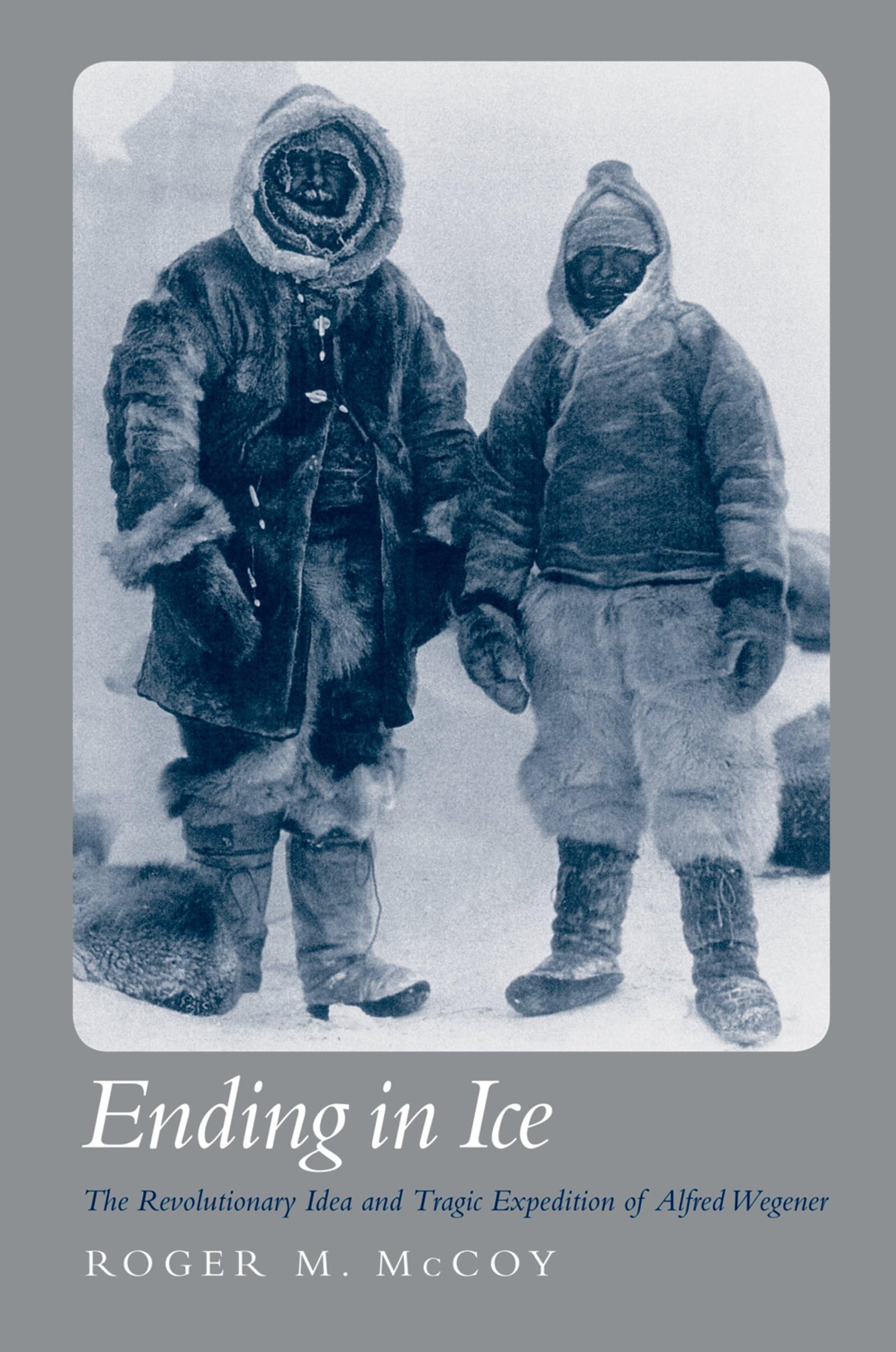
Ending in Ice: The Revolutionary Idea and Tragic Expedition of Alfred Wegener
$51.77
by Roger M. McCoy



An old truism holds that a scientific discovery has three stages: first, people deny it is true; then they deny it is important; finally, they credit the wrong person. Alfred Wegener's "discovery" of continental drift went through each stage with unusual drama. In 1915, when he published his theory that the world's continents had once come together in a single landmass before splitting apart and drifting to their current positions, the world's geologists denied and scorned it. The scientific establishment's rejection of continental drift and plate tectonic theory is a story told often and well. Yet, there is an untold side to Wegener's life: he and his famous father-in-law, Wladimir Köppen (a climatologist whose classification of climates is still in use), became fascinated with climates of the geologic past. In the early 20th century Wegener made four expeditions to the then-uncharted Greenland icecap to gather data about climate variations (Greenland ice-core sampling continues to this day). Ending in Ice is about Wegener's explorations of Greenland, blending the science of ice ages and Wegener's continental drift measurements with the story of Wegener's fatal expedition trying to bring desperately needed food and fuel to workers at the central Greenland ice station of Eismitte in 1930. Arctic exploration books with tragic endings have become all too common, but this book combines Wegener's fatal adventures in Greenland with the relevant science--now more important than ever as global climate change becomes movie-worthy ("The Day After Tomorrow"). McCoy tells the story of Alfred Wegener, the German meteorologist who developed the continental drift theory based on the existence of a single landmass he called Pangaea. Wegener fought his entire life for acceptance among the scientific community and in 1930 led an expedition to Greenland to conduct measurements critical to proving his work. His death there was a sad blow to geology and it was only decades later that his theories became widely accepted. McCoy clearly has a great deal of admiration for his subject and has created a wonderful book that combines both the weighty science that Wegener developed and a gripping story of Arctic tragedy. Initially, McCoy cogently explains how and why Wegener came to believe the continents were once joined. His subsequent chapters on Greenland are particularly outstanding as he reveals the many difficulties in maintaining scientific bases in the Arctic. Ultimately, Ending in Ice proves to be not only a superb tribute to a forgotten scientific trailblazer but also a worthy addition to the catalog of polar exploration titles. Colleen Mondor Copyright © American Library Association. All rights reserved "McCoy has written a narrative that nimbly links a story of brilliant scientific intuition and amazing physical courage that illuminates both the intrigues of the early modern scientific research establishment as well as the sacrifices scholars willingly made to expand the boundaries of knowledge. Geographers, geologists, earth scientists, meteorologists and those interested in great stories of intellectual and physical courage will all love this book." --David Lanegran, Macalester College "McCoy gives us an engrossing account of Alfred Wegener's struggle with the scientific community's rejection of his ideas about drifting continents, which included personal as well as professional attacks. No less gripping is McCoy's detailed treatment of the tragic Greenland expedition that ends Wegener's life decades before his continental movement idea is vindicated."--Dwight Brown, University of Minnesota "Wegener's life was one of both triumph and tragedy, and McCoy's book captures those moods well. The Wegener associated with plate tectonics is well known, however, Wegener the Arctic Explorer especially resonates in this work. A compelling narrative of the hardships of Arctic exploration in the early 20th Century, with fascinating historical photographs of Wegener's life (and death) in Greenland. I learned a lot from this book."--David R. Butler, Texas State University at San Marcos Roger M. McCoy is Emeritus Professor of Physical Geography at the University of Utah.