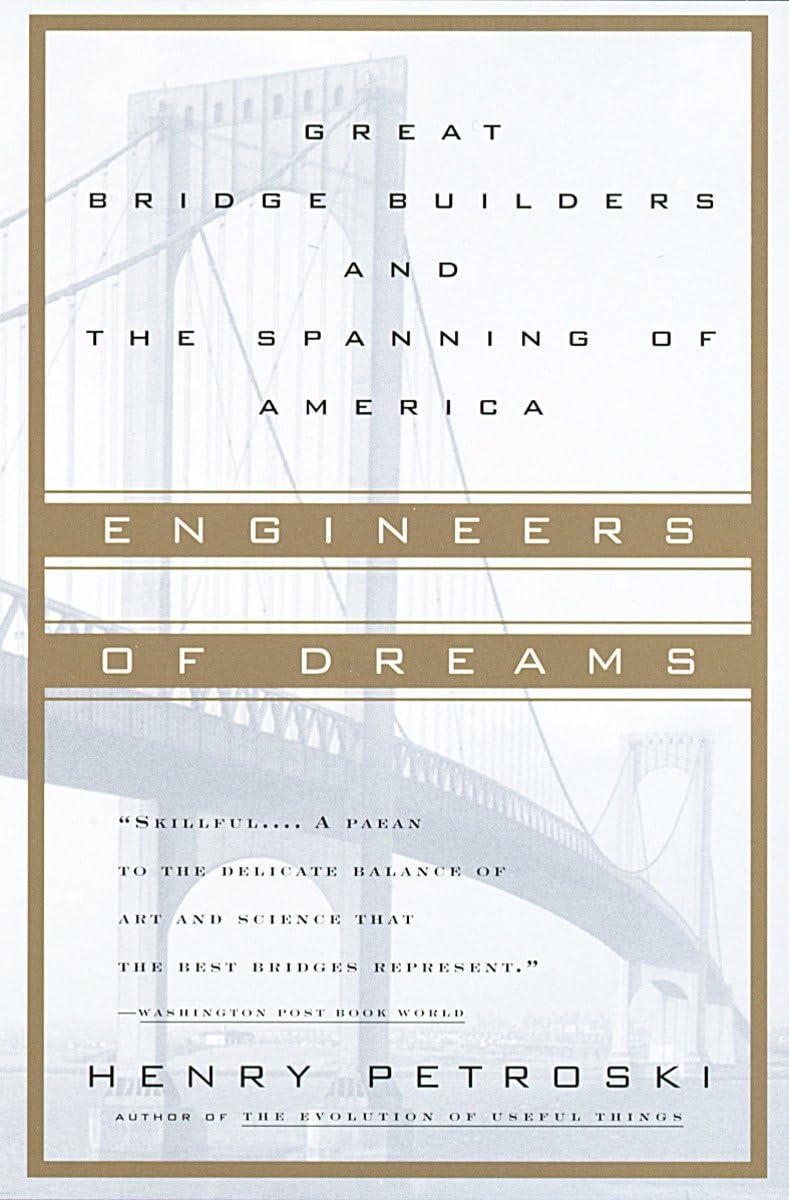
Engineers of Dreams: Great Bridge Builders and the Spanning of America
$15.35
by Henry Petroski



Petroski reveals the science and engineering--not to mention the politics, egotism, and sheer magic--behind America's great bridges, particularly those constructed during the great bridge-building era starting in the 1870s and continuing through the 1930s. It is the story of the men and women who built the St. Louis, the George Washington, and the Golden Gate bridges, drawing not only on their mastery of numbers but on their gifts for persuasion and self-promotion. It is an account of triumphs and ignominious disasters (including the Tacoma Narrows Bridge, which literally twisted itself apart in a high wind). And throughout this grandly engaging book, Petroski lets us see how bridges became the "symbols and souls" of our civilization, as well as testaments to their builders' vision, ingenuity, and perseverance. "Seamlessly linked...With astonishing scope and generosity of view, Mr. Petroski places the tradition of American bridge-building in perspective."--New York Times Book Review Henry Petroski's lyrical history of bridge builders in America is organized around five engineers: James Eads (inventor of the diving bell, which bridged Mississippi at St. Louis); Theodore Cooper (railroad bridge engineer and designer of the ill-fated Quebec Bridge); Gustav Lindenthal (Hell Gate Bridge, New York); Othmar Ammann (George Washington and Verrazano-Narrow bridges); and David Steinman (Mackinac bridge). Petroski's opening and closing chapters, "Imagine" and "Realize," remind us how a bridge starts out as a dream of engineering, but ends as a reality of compromise and maintenance. Edward Tenner says that "The profound contribution of Engineers of Dreams is to remind us that communication across generations may be the most important bridge of all." . . . [written with] astonishing scope and generosity . . . -- The New York Times Book Review, M.R. Montgomery Petroski reveals the science and engineering--not to mention the politics, egotism, and sheer magic--behind America's great bridges, particularly those constructed during the great bridge-building era starting in the 1870s and continuing through the 1930s. It is the story of the men and women who built the St. Louis, the George Washington, and the Golden Gate bridges, drawing not only on their mastery of numbers but on their gifts for persuasion and self-promotion. It is an account of triumphs and ignominious disasters (including the Tacoma Narrows Bridge, which literally twisted itself apart in a high wind). And throughout this grandly engaging book, Petroski lets us see how bridges became the "symbols and souls" of our civilization, as well as testaments to their builders' vision, ingenuity, and perseverance. "Seamlessly linked...With astonishing scope and generosity of view, Mr. Petroski places the tradition of American bridge-building in perspective."--New York Times Book Review Henry Petroski is the Aleksandar S. Vesic Professor of Civil Engineering and a professor of history at Duke University, where he also serves as chairman of the Department of Civil and Environmental Engineering. The author of more than 15 books, he has received grants from the National Science Foundation and fellowships from the National Endowment for the Humanities and the National Humanities Center. Used Book in Good Condition