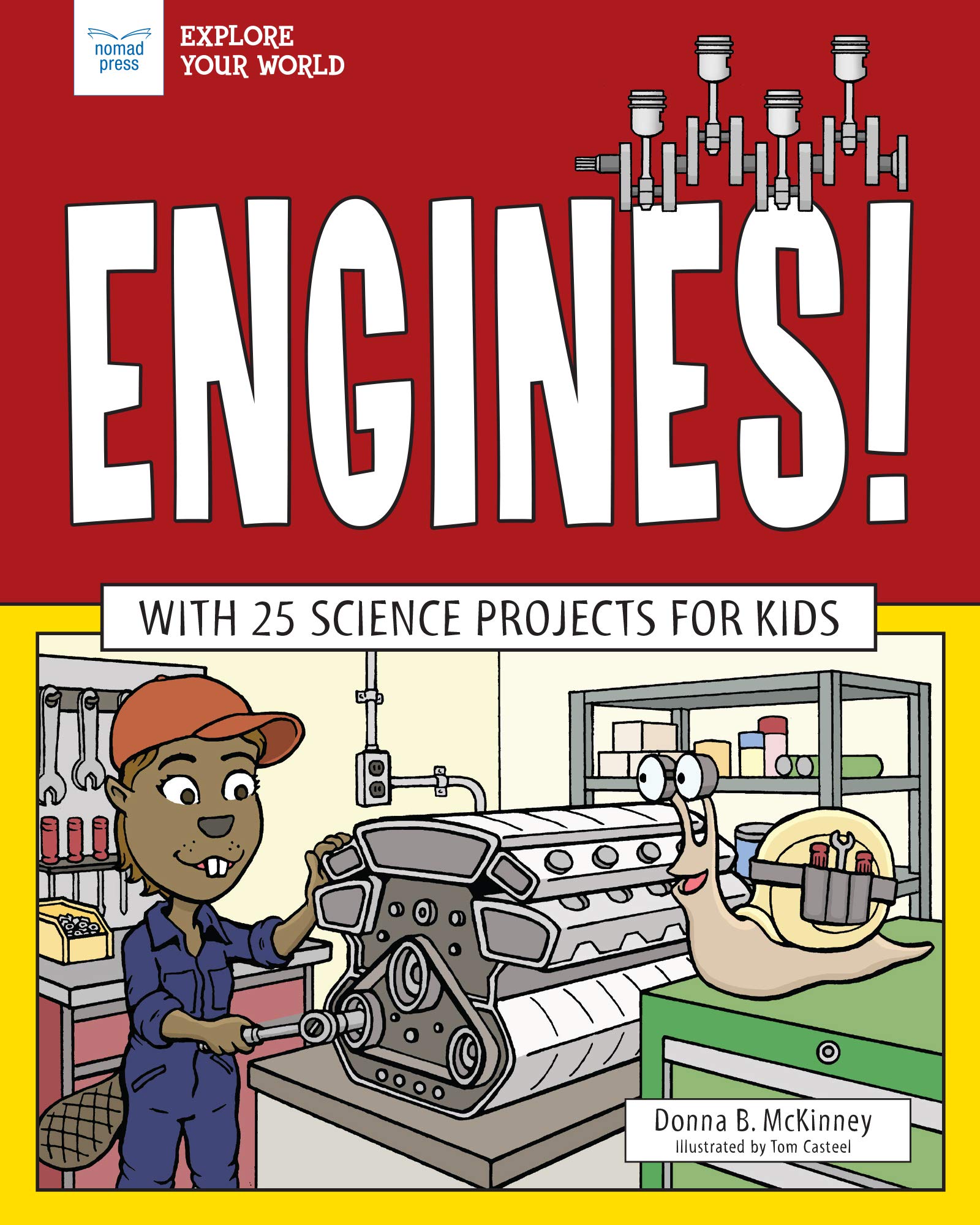



A full-color introduction to the engines that power our world, packed with STEM activities and text-to-world connections that invite kids ages 7 to 10 to discovery the wonderful world of engines and motors! From ancient times to now, engines have powered the activities of people’s lives. Engines! With Science Projects for Kids invites readers ages 7 to 10 to explore engines through hands-on STEM projects that deepen their understanding of engines, what makes them hum, and all the special jobs they do for humans. Interact with engaging text that’s reinforced with 25 hands-on, science-minded projects, including building a catapult, a milk-carton conveyor belt, and a magnet-powered car, while fascinating trivia, essential questions, links to online resources, text-to-world connections, and even jokes help support deeper learning! About the Explore Your World series and Nomad Press Nomad Press books in the Explore Your World series integrate content with participation, encouraging readers to engage in student-directed learning. Combining content with inquiry-based projects stimulates learning and makes it active and alive. Nomad’s unique approach simultaneously grounds kids in factual knowledge while allowing them the space to be curious, creative, and critical thinkers. All books are leveled for Guided Reading level and Lexile and align with Common Core State Standards and Next Generation Science Standards. All titles are available in paperback, hardcover, and ebook formats. Gr 3-5-An anthropomorphic beaver and snail provide a brief history of engines and 25 hands-on activities that demonstrate the concepts presented. A time line at the beginning of the text spotlights key advancements in engine engineering. An introductory chapter quickly explains the use of catapults and siege engines, the earliest steam engines, and modern engines. Subsequent chapters focus on clockwork motors, heat, electric, pneumatic, and hydraulic engines. Sprinkled throughout each chapter are illustrations and photographs, definitions of key terms, QR codes to access video content, additional fact boxes, and jokes and riddles provided by the snail. Each chapter ends with several projects that, as the topics progress, become more challenging and will require adult assistance in addition to trips to the hardware store, pharmacy, and possibly the grocery store. Concepts are presented succinctly with real-world applications, but the activities could benefit from continuity in the supply list (sometimes only a science notebook is listed, other times it is a science notebook and a pencil; matches are not always listed for candles) and clarity on when adult assistance is required. The final activity feels disconnected in its discussion of atoms and molecules. A glossary, metric conversions, additional books and websites, and an index can be found in the back matter. VERDICT An additional purchase where STEM materials are in high demand.-Meaghan Darling, Sparta P.L., NJα(c) Copyright 2011. Library Journals LLC, a wholly owned subsidiary of Media Source, Inc. No redistribution permitted. School Library Journal Gr 3-5–An anthropomorphic beaver and snail provide a brief history of engines and 25 hands-on activities that demonstrate the concepts presented. A time line at the beginning of the text spotlights key advancements in engine engineering. An introductory chapter quickly explains the use of catapults and siege engines, the earliest steam engines, and modern engines. Subsequent chapters focus on clockwork motors, heat, electric, pneumatic, and hydraulic engines. Sprinkled throughout each chapter are illustrations and photographs, definitions of key terms, QR codes to access video content, additional fact boxes, and jokes and riddles provided by the snail. Each chapter ends with several projects that, as the topics progress, become more challenging and will require adult assistance in addition to trips to the hardware store, pharmacy, and possibly the grocery store. Concepts are presented succinctly with real-world applications, A glossary, metric conversions, additional books and websites, and an index can be found in the back matter. VERDICT An additional purchase where STEM materials are in high demand. Praise for Explore Electricity! National Science Teachers Association Recommends “ Explore Electricity is written for an elementary age level, but middle school students would enjoy learning about historical background on electricity while completing the electricity projects. The contents of this book will captivate students with the electrifying topics. This book is a well-written resource for classroom teachers, students, and parents.” Praise for Explore Simple Machines! National Science Teachers Association “This is not your usual activity book. Written for the student, with inquiry in mind, the explanations are simple and easy to follow, and there is an explanation of what is happening and questions to extend th