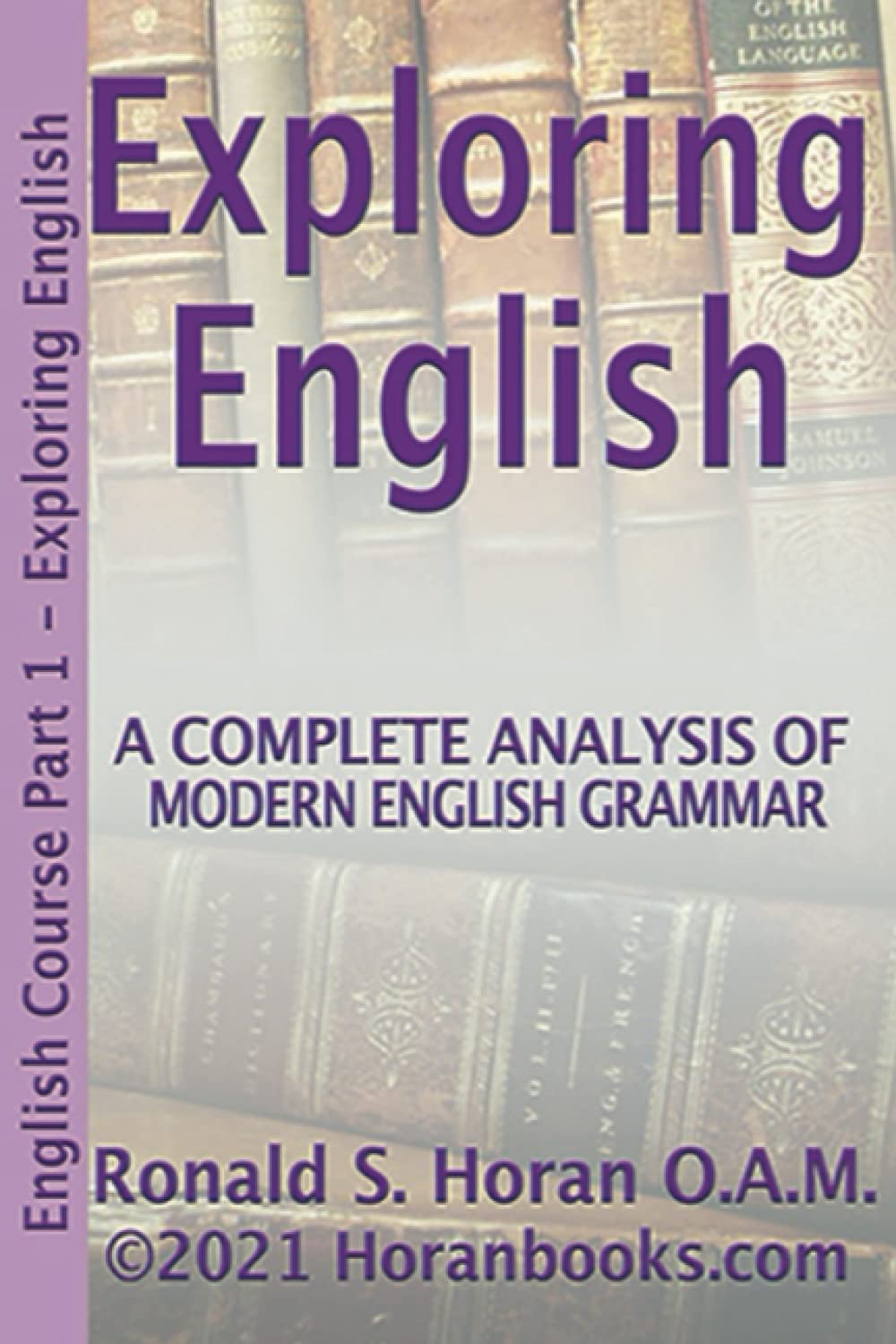
English Course Part 1 - "Exploring English": A Complete Analysis of Modern English Grammar (cn)
$35.00
by Ronald S. Horan O.A.M



There are available texts that devote themselves to the perplexing field ofEnglish spelling. There are also books that have as their subject matter thepresentation of the origins of the English vocabulary; of the different levelsof language or of questions of style. Great omnibuses take up aspects of theEnglish tongue alphabetically rather than having a comprehensive approachalong a particular line. And then there are the workbooks affording practice in acertain area after a brief coverage.There are indeed many components to the English language and manyhundreds of books have been published concerning them. Why then does thisbook make its appearance at the end of the twentieth century? The reason isthat of the hundreds, possibly thousands, no modern book has done preciselywhat Exploring English does.The book’s basic aim is to present a comprehensive analysis of the grammarof modern English in a practical manner. While the same bases are operativeas far as the eight parts of speech are concerned as in Nesfield’s day a centuryago, there have been changes in the functions of words, account of which hasnot been fully taken up in the updating of older works. Further, it was consideredthat a more simple, concise and cohesive approach was possible than thatforming the construction of the many other texts. A ponderous, convoluted styleis not a sine qua non in an exploration of English grammar. The material couldbe presented in a fluid and uncomplicated way; In being comprehensive, awork does not have to be ponderous. In such guise this grammar of the Englishlanguage is presented, treating all aspects of operative usage today.Firstly, detailed attention is paid to the eight parts of speech, the grammaticalfunction of each being described together with its syntactic relation to anotherword or other words in the sentence. Thus will it be possible to parse each wordin order to ensure that one’s sentences hold together. Special attention is givento words that afford syntactical difficulty.The three elements of a word are its spelling, its meaning and its sound. Adictionary will of course provide the meaning. However, one’s vocabulary can bestrengthened by the ability to analyse the parts of which it is composed.To this end, an investigation of the roots of words is made, together with thechanges afforded by the use of prefixes and suffixes. Careful examination ismade of the ways in which compound words are formed.A detailed study of the phonetic system of the English language is given. Tablesof the vowel sounds and the vowel combinations together with a table of theconsonants show the complex patterns of the pronunciation and spelling ofEnglish. The companion volume Spelling English presents a complete analysisand should be used in conjunction with the present work.Ideal for ESOL, TESOL, ESL.Other titles in this Series are:English Course Part 2 - Spelling English a Concise Guide to English Spelling, Punctuation and StyleEnglish Course Part 3 - Using English Workbook AE ExercisesA Practical Workbook of Current English Usage, Spelling & GrammarEnglish Course Part 4 - Using English Workbook AA ANSWERSA Practical Workbook of Current English Usage, Spelling & GrammarEnglish Course Part 5 - Using English Workbook BE ExercisesA Practical Workbook of Current English Usage, Spelling & GrammarEnglish Course Part 7 - Using English Workbook CE ExercisesA Practical Workbook of Current English Usage, Spelling & GrammarEnglish Course Part 9 - Using English Workbook DE ExercisesA Practical Workbook of Current English Usage, Spelling & Grammar