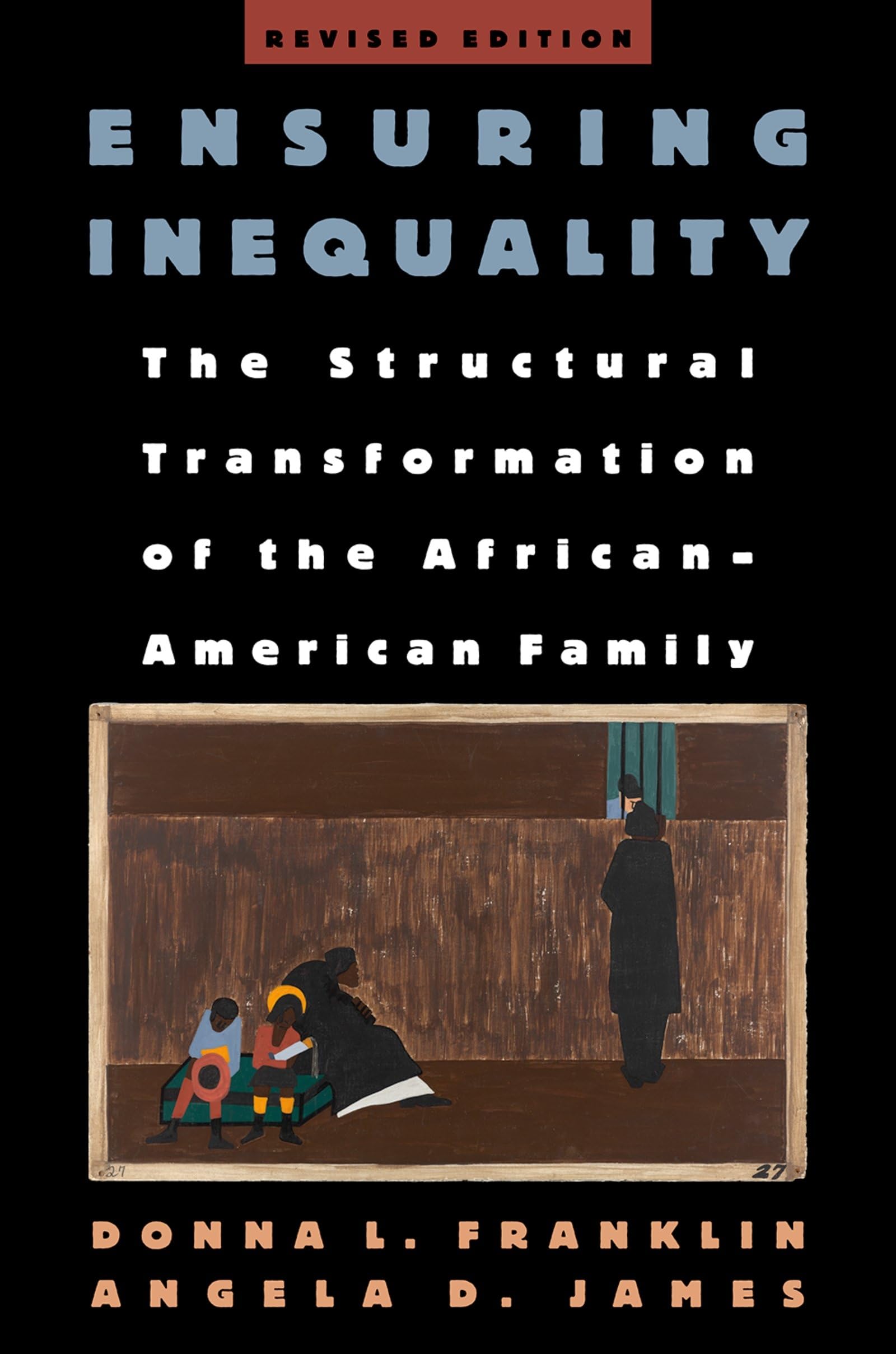
Ensuring Inequality: The Structural Transformation of the African American Family
$36.65
by Donna L. Franklin



There is a crisis today in the American family, and this crisis has been particularly severe in the African American community. Black women are more likely than ever to bear children as teenagers, to remain single, and to raise their children in poverty. As a result, a staggering number of African-American children are growing up without fathers and living in destitution. In this insightful new book, Donna L. Franklin offers an in depth account of the history and development of the African American family, revealing why the marriage and family experiences of African-Americans differs from those of white America, and highlighting the cultural and governmental forces that have combined to create this divide and to push the black family to the edge of catastrophe. In Ensuring Inequality , Franklin traces the evolution of the black family from slavery to the present, showing the cumulative effects of centuries of historical change. She begins with a richly researched account of the impact of slavery on the black family, finding that slavery not only caused extreme instability and suffering for families, but established a lasting pattern of poverty which made the economic advantages of marriage unattainable. She provides a sharp critique of the policies of the Freedmen's Bureau during Reconstruction, and demonstrates the mixed impact of the new pattern of sharecropping. On one hand, tenant farming allowed greater autonomy than the older gang labor system, and tended to consolidate two parent families; on the other hand, it reinforced male authority, and bound African Americans in debt peonage. The twentieth century brought a host of changes for black families, and Franklin incisively examines their effects. First, black women began to move to cities in search of jobs as domestic servants, while men stayed behind to work the fields, dividing the families. Then, two world wars sparked the great migration north, as African Americans pursued employment in booming factories. When the white soldiers returned home, however, many blacks found themselves out of work, shunted to the least desirable, lowest paying jobs. Roosevelt's New Deal offered limited help: in the North, it tolerated the red lining of urban neighborhoods, making it difficult for blacks to obtain home mortgages; in the South, blacks found that, as agricultural laborers, they were exempted from most labor laws, while agricultural subsidies were administered in favor of white farmers. And the distinction made between programs paid for by beneficiaries (such as social security) and those based on need (such as Aid to Families with Dependent Children) stigmatized the poor. Most blacks found themselves living an ever more tenuous, socially isolated existence. Franklin brings her comprehensive, nuanced study right up to the present, showing the impact on the urban poor of changes in the economy and society, from the dramatically shrinking pool of good jobs to the rise of the new right. "The increasing reliance on welfare by young black mothers," she writes, "corresponded to the erosion of opportunities for young black males." More important, she offers new approaches to solving the crisis. Not only does she recommend federal intervention to create new economic opportunity in urban ghettos, but she also stresses the importance of black self-help and proposes a plan of action. In addition, she outlines social interventions that can stabilize and strengthen poor, mother-only families living in ghetto neighborhoods. Exhaustively researched and insightfully written, Ensuring Inequality makes an important contribution to the central debate in American politics today. "Donna Franklin's Ensuring Inequality is distinguished by its scholarly rigor. Franklin provides an exhaustive review of the historical and social scientific literature on the impact on the black American family of slavery, sharecropping, and the various northern migrations, World War II, welfare and housing policies and unemployment...Her historical overview stands on its own as a significant contribution." -- Signs "Donna Franklin provides an outstanding analysis of the historic and contemporary social forces that have perpetuated economic hardship among a sizable minority of African-American families...Her book offers a strong historical and theoretical account of black family poverty, and it is a vital resource for policy analysts and teachers/researchers interest in the family, social work, race-ethnicity, and gender." -- Contemporary Sociology "Donna Franklin provides the reader with a very important lesson in how to understand current stresses in family life by studying the ways in which early experiences and circumstances led logically and inevitably to the present depressing, even alarming, state of family life at the end of the twentieth century. This is an important work."--John Hope Franklin, author of From Freedom to Slavery: A History of African Americans "Why are so man