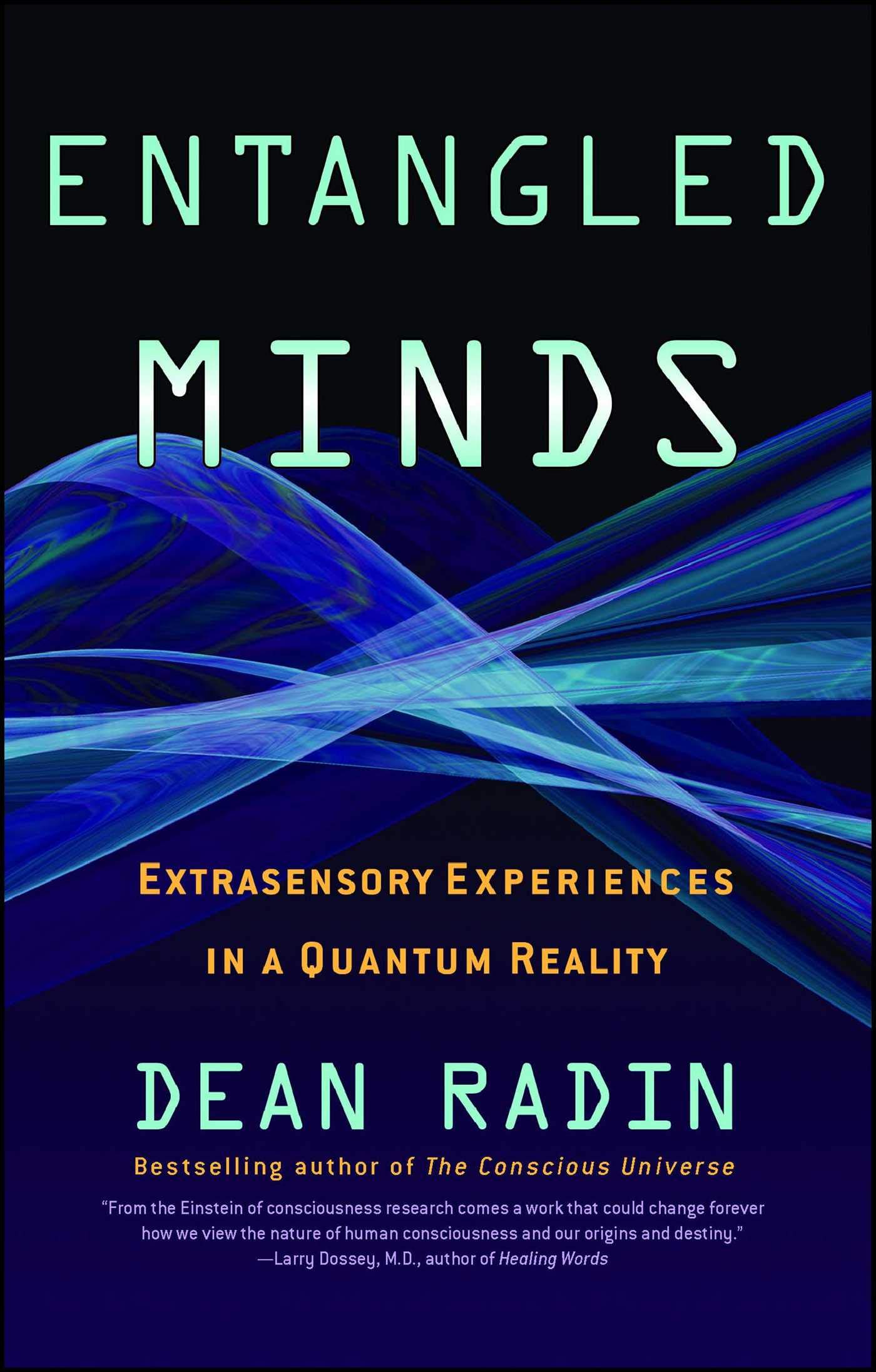
Entangled Minds: Extrasensory Experiences in a Quantum Reality (A Study on Parapsychology)
$10.99
by Dean Radin Ph.D



Is everything connected? Can we sense what's happening to loved ones thousands of miles away? Why are we sometimes certain of a caller's identity the instant the phone rings? Do intuitive hunches contain information about future events? Is it possible to perceive without the use of the ordinary senses? Many people believe that "psychic phenomena" are rare talents or divine gifts. Others don't believe they exist at all. But the latest scientific research shows that these phenomena are both real and widespread, and are an unavoidable consequence of the interconnected, entangled physical reality we live in. Albert Einstein called entanglement "spooky action at a distance"—the way two objects remain connected through time and space, without communicating in any conventional way, long after their initial interaction has taken place. Could a similar entanglement of minds explain our apparent psychic abilities? Dean Radin, senior scientist at the Institute of Noetic Sciences, believes it might. In this illuminating book, Radin shows how we know that psychic phenomena such as telepathy, clairvoyance, and psychokinesis are real, based on scientific evidence from thousands of controlled lab tests. Radin surveys the origins of this research and explores, among many topics, the collective premonitions of 9/11. He reveals the physical reality behind our uncanny telepathic experiences and intuitive hunches, and he debunks the skeptical myths surrounding them. Entangled Minds sets the stage for a rational, scientific understanding of psychic experience. "From the Einstein of consciousness research comes a work that could change forever how we view the nature of human consciousness and our origins and destiny." -- Larry Dossey, M.D., author of Healing Words "Dean Radin brings parapsychology into mainstream science. The revolution has begun." -- Deepak Chopra, author of The Book of Secrets: Unlocking the Hidden Dimensions of Your Life Dean Radin, Ph.D., is Laboratory Director at the Institute of Noetic Sciences in Petaluma, California. He worked at AT&T Bell Laboratories and GTE Laboratories on advanced telecommunications systems, and for nearly two decades he has conducted research on psychic phenomena in academia (Princeton University, University of Edinburgh, University of Nevada), and in three Silicon Valley think tanks (Interval Research Corporation, Boundary Institute, and SRI International). At SRI he served as a scientist on a highly classified program investigating psi phenomena for the U.S. government. Radin is the author of The Conscious Universe , which was a #1 parapsychology bestseller at Amazon.com. It also won the 1997 Book Award from The Scientific and Medical Network, a Best Book Award from The Anomalist, and it has been translated into eight languages. Preface If you do not get schwindlig [dizzy] sometimes when you think about these things then you have not really understood it [quantum theory]. Niels Bohr One of the most surprising discoveries of modern physics is that objects aren't as separate as they may seem. When you drill down into the core of even the most solid-looking material, separateness dissolves. All that remains, like the smile of the Cheshire Cat from Alice in Wonderland , are relationships extending curiously throughout space and time. These connections were predicted by quantum theory and were called "spooky action at a distance" by Albert Einstein. One of the founders of quantum theory, Erwin Schrödinger, dubbed this peculiarity entanglement , and said "I would not call that one but rather the characteristic trait of quantum mechanics." The deeper reality suggested by the existence of entanglement is so unlike the world of everyday experience that until recently, many physicists believed it was interesting only for abstract theoretical reasons. They accepted that the microscopic world of elementary particles could become curiously entangled, but those entangled states were assumed to be fleeting and have no practical consequences for the world as we experience it. That view is rapidly changing. Scientists are now finding that there are ways in which the effects of microscopic entanglements "scale up" into our macroscopic world. Entangled connections between carefully prepared atomic-sized objects can persist over many miles. There are theoretical descriptions showing how tasks can be accomplished by entangled groups without the members of the group communicating with each other in any conventional way. Some scientists suggest that the remarkable degree of coherence displayed in living systems might depend in some fundamental way on quantum effects like entanglement. Others suggest that conscious awareness is caused or related in some important way to entangled particles in the brain. Some even propose that the entire universe is a single, self-entangled object. If these speculations are correct, then what would human experience be like in such an intercon