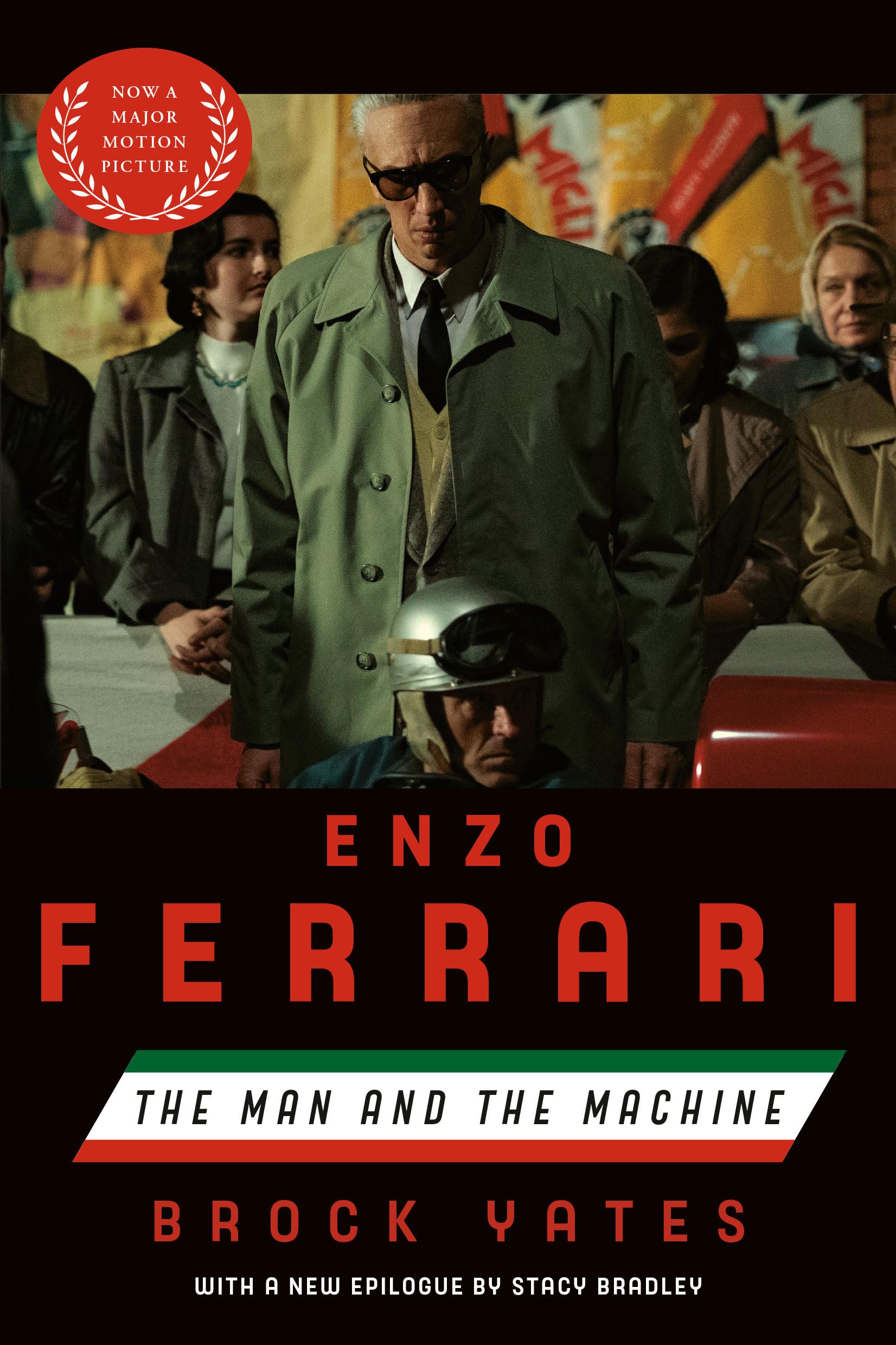



The inspiration for the major motion picture Ferrari directed by Michael Mann and starring Adam Driver, Penelope Cruz and Shailene Woodley, hailed by Variety as “ Grand Prix fused with The Godfather ” The sweeping biography of the enigmatic racer and sports car mogul who built the Ferrari brand, now featuring a new foreword, epilogue, and photo insert Genius? Tyrant? Power broker? Enzo Ferrari is the impressively researched, fully detailed biography of one of the most powerful men of the twentieth century. Brock Yates penetrated Ferrari’s inner circle and reveals everything, from his early days in the town of Modena to his bizarre relationship with his illegitimate son; from his fanatic passion for speed to his brilliant marketing of the famous Ferrari image; from his manipulative but enormously effective management tactics to his own frustrated dreams. Fast, fun, and scandalous, Enzo Ferrari more than lives up to its remarkable subject. “Captivating . . . Yates deftly records the carnage of major races, business wheeling and dealing, and the political dimensions of motor racing from the pre-WWII Rome-Berlin Axis to today’s ribbon-waving nationalism.” — Publishers Weekly Brock Yates (1933–2016) was an American television and print journalist, screenwriter, and bestselling author. He was the longtime executive editor of Car and Driver magazine. He was inducted into the Motorsports Hall of Fame in America in 2017. 1 The autoroute to Beaune lay ahead, an inkblot of asphalt. Behind him a few remaining lights of Lyon flickered in the rearview mirror as the big Renault sedan settled into a steady lope at 125 mph. He would be in Paris before dawn. He was a driver. At eighty-two years, he still handled an automobile with the same authority and resolve that had carried him to three victories at Le Mans. Twenty-four hours. Around the clock. Those races were his specialties. He had never been a sprinter, never particularly fast in the twitchy, pitiless single-seat Grand Prix machines. But give him a full-fendered Alfa Romeo or Ferrari sports car and he could run like a marathoner, hour after hour, kilometer banked on kilometer, crushing the opposition with his sheer grit and the reserves of muscle coiled in his compact bricklayer’s body. He checked his watch. The hands were slipping toward three o’clock on the morning of August 14, 1988. It was a drive he had made a hundred times: Modena to Paris, now a headlong rush along the table-smooth Italian autostradas and the French autoroutes. For forty years, the mission had been the same. The central theme had been the cars, those low-slung beasts that had caused him so much joy and grief. Up and down the autoroutes, crossing and recrossing the spine of the Alps like some crazed tourist, back and forth over the bleak expanse of the Atlantic, always with one singular purpose—the glorification and enrichment of the most supremely outrageous, overpowered and oversexed automobiles of the modern era, the crimson bolides of Modena and Maranello—the magic machines of Enzo Ferrari. Ferrari. There had been times, often lasting months, even years, when he wished he had never heard the name, but too much time had passed for that. Seventy years, he mused. He had known this incredible man since 1918, when both had been young veterans poking around the postwar automobile business in Milan and Turin. Ferrari had made Luigi Chinetti a rich man while making himself richer. Ferrari had made him important and respected, while elevating himself to world fame and becoming a demigod to the poseurs and nouveaux who seemed prepared to sell their firstborn into slavery in order to obtain one of his automobiles. It had all been an insane aerobatic display of emotion and ego warfare and now he was tired of it all. They had dueled too long and, if a winner had to be declared, it would have to be Ferrari. But did he not always win? Did he not always prevail, sometimes coming off the mat after repeated, bloody knockdowns to land a knockout punch? They had sparred many times, hugging between rounds, and he had often scored well, but now it was over, and the old warriors had fought their last fight. There would be no more confrontations, no more angry words, no more window-rattling arguments, no more lawsuits, threats, walkouts or vile insults, all generally forgiven or forgotten. Still, Ferrari towered over his life, having given it purpose and meaning, and for this he knew all the madness had been worthwhile. Yes, Ferrari had been at the center of it all. Both men were hard, unyielding, classic Italians, easily tempted to let a relationship flare into wild boasts, vicious insults and bare-faced fabrications. For all the years he had known Ferrari, business negotiations with him remained an elaborate, protracted drama of artful parlays, suspended agreements, temper tantrums, operatic claims of impending bankruptcy, social ruin, family shame, incurable disease