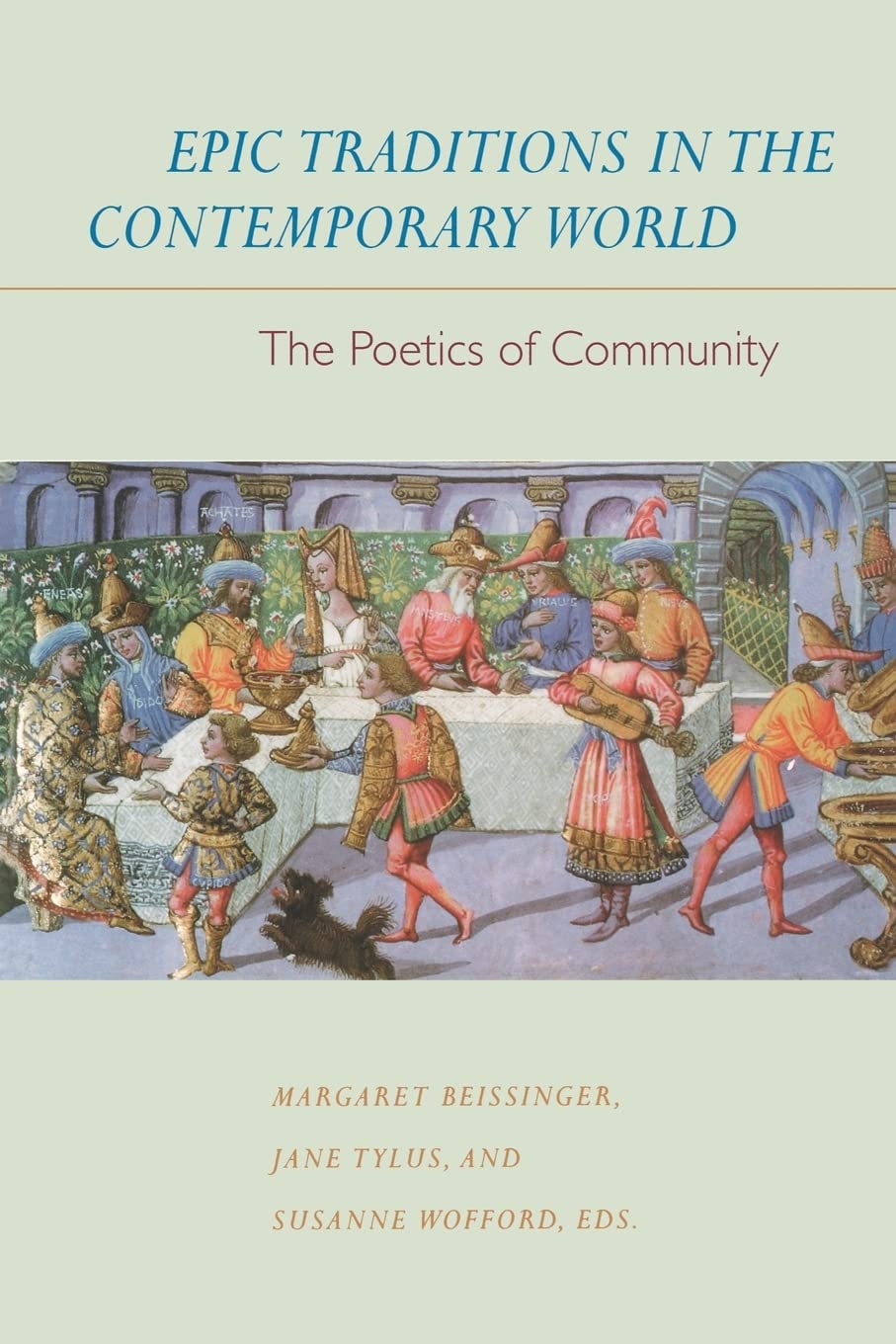
Epic Traditions in the Contemporary World: The Poetics of Community (Joan Palevsky Imprint in Classical Literature)
$31.95
by Margaret Beissinger



The epic tradition has been part of many different cultures throughout human history. This noteworthy collection of essays provides a comparative reassessment of epic and its role in the ancient, medieval, and modern worlds, as it explores the variety of contemporary approaches to the epic genre. Employing theoretical perspectives drawn from anthropology, literary studies, and gender studies, the authors examine familiar and less well known oral and literary traditions―ancient Greek and Latin, Arabic, South Slavic, Indian, Native American, Italian, English, and Caribbean―demonstrating the continuing vitality of the epic tradition. Juxtaposing work on the traditional canon of western epics with scholarship on contemporary epics from various parts of the world, these essays cross the divide between oral and literary forms that has long marked the approach to the genre. With its focus on the links among narrative, politics, and performance, the collection creates a new dialogue illustrating the sociopolitical significance of the epic tradition. Taken together, the essays raise compelling new issues for the study of epic, as they examine concerns such as national identity, gender, pedagogy, and the creation of the canon. Margaret Beissinger is Lecturer in Slavic Languages; Jane Tylus is Associate Professor of Comparative Literature; and Susanne Wofford is Associate Professor of English. All are affiliated with the University of Wisconsin, Madison. Epic Traditions in the Contemporary World Poetics Commun By Margaret H. Beissinger University of California Press Copyright © 1999 Margaret H. Beissinger All right reserved. ISBN: 9780520210387 1— Epic as Genre Gregory Nagy One of very few scholars who can speak authoritatively of both oral and written epic traditions, Gregory Nagy confronts the supposed divide between these traditions in this brief and suggestive exploration into the origins of the epic genre. In the spirit of his earlier work, such as The Best of the Achaeans, which demonstrated the impact of religious and political rituals on the Homeric poems, Nagy demonstrates that epos was even for the Greeks an elusive form whose generic expectations and demands changed considerably from archaic to classical Greece. In this rigorous philological reading of the term epos and its relationship to other terms such as muthos, Nagy cautions us to be sensitive to the varying cultural conditions that produce heroic poetry, arguing against a fixed definition of epic as such in order to encourage more flexible and inclusive models of genre. In order to speak of epic as genre, we need a set of working definitions for three not two concepts: besides genre and epic, we need to define the concept of Homer as a prototypical exponent of epic as genre. This essay develops such a set, arguing that our received idea about epic results primarily from a narrow understanding of Homer as the author of the Iliad and the Odyssey, to the exclusion of other ancient Greek traditions, such as the so-called Epic Cycle. As we will see, it is Aristotle's Poetics that ultimately made this idea prevail, just as it is Aristotle who has been most influential in shaping the concept of genre in general. In his essay "Epic and Novel," Mikhail Bakhtin goes so far as to say: "Aristotle's Poetics, although occasionally so deeply embedded as to be almost invisible, remains the stable foundation for the theory of genres."1 A problem more fundamental than the definitions of genre and epic is the definition of poetry itself in social contexts where the technology of writing is involved in neither the composition nor the performance of any given poem or song. My invocation of the two factors of composition and performance implies a derivation of ancient Greek poetry from oral poetry, as defined through the comparative fieldwork criteria developed by Milman Parry and Albert Lord.2 From Lord's empirical study of living oral traditions, especially those of South Slavic heroic song, it becomes clear that composition and performance are aspects of the same process in oral poetry. In order to achieve a more accurate taxonomy of the earliest phases of the Greek song-makingtradition culminating in "Homer" and, ultimately, in our received notions of epic as genre, the two factors of composition and performance must be kept in mind. Only then may we arrive at a basis for considering the utility of a concept such as genre—and of a related concept, occasion. In addressing these two factors of composition and performance, I propose to bring into play a crucial work that has taken them both into account, Richard P. Martin's The Language of Heroes (1989). Martin has pioneered an explicit connection between Lord's empirical observations about performance in living oral traditions and J. L. Austin's theories about the performative uses of language, as articulated in his book How to Do Things with Words (1962). As Martin demonstrates, Aus