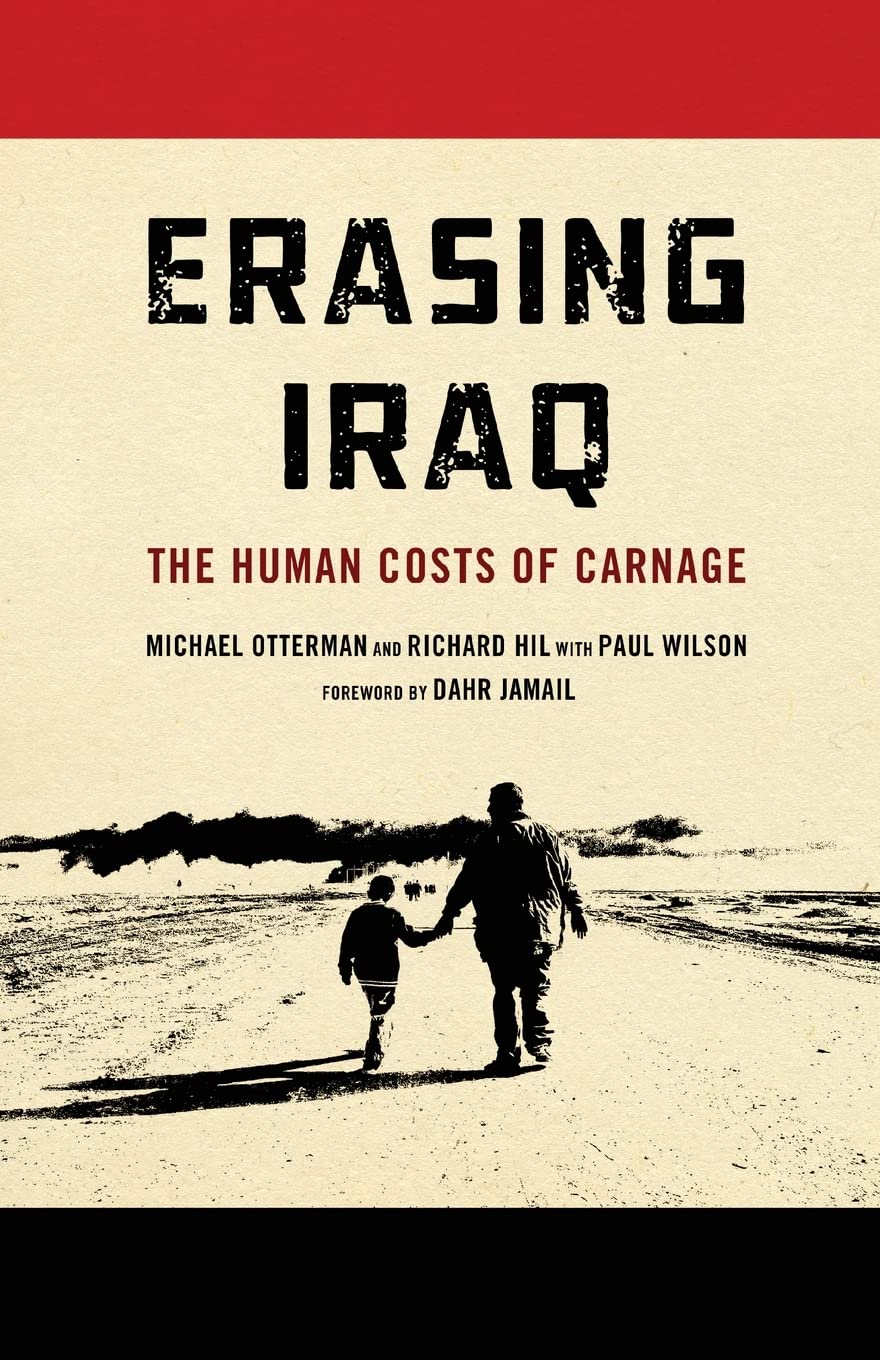
Erasing Iraq: The Human Costs of Carnage: The Human Costs of Carnage
$23.95
by Michael Otterman



For nearly two decades, the US and its allies have prosecuted war and aggression in Iraq. Erasing Iraq shows in unparalleled detail the devastating human cost. Western governments and the mainstream media continue to ignore or play down the human costs of the war on Iraqi citizens This has allowed them to present their role as the benign guardians of Iraqi interests. The authors deconstruct this narrative by presenting a portrait of the total carnage in Iraq today as told by Iraqis and other witnesses who experienced it firsthand. Featuring in-depth interviews with Iraqi refugees in Syria, Jordan and Western countries, Erasing Iraq is a comprehensive and moving account of the Iraqi people's tragedy. "If I could only recommend one book that provides a comprehensive overview of both the situation in Iraq today, and the decades of US-backed policy it took to create this nightmare scenario, Erasing Iraq is it." --Dahr Jamail, author and independent journalist Michael Otterman is an award-winning freelance journalist and human rights consultant. He was a recent visiting scholar at the Centre for Peace and Conflict Studies at the University of Sydney. He is the author of American Torture (Pluto, 2007). Richard Hil is honorary associate at the Centre for Peace and Conflict Studies, University of Sydney and was senior lecturer in the School of Arts and Social Sciences, Southern Cross University, Australia. He has co-authored and edited a number of books in the fields of criminology, youth justice, and child and family welfare. Paul Wilson , OAM, is Professor and Chair of Criminology and Forensic Psychology, Bond University, Australia. He has written or co-written over 25 books on criminal justice. Erasing Iraq The Human Costs of Carnage By Michael Otterman, Richard Hil, Paul Wilson Pluto Press Copyright © 2010 Michael Otterman and Richard Hil All rights reserved. ISBN: 978-0-7453-2897-3 Contents Foreword by Dahr Jamail, ix, Acknowledgments, xv, Introduction: Hearts of Stone, 1, 1 Iraqis Under Siege, 14, 2 Refugee Voices, 54, 3 Censoring Civilians, 88, 4 Dead Bodies Don't Count, 130, 5 Iraqi Sociocide, 162, Postscript: People of No Moment, 206, Notes, 214, Index, 238, CHAPTER 1 IRAQIS UNDER SIEGE On July 5, 2008, Karim, our host and translator in Sweden, wandered nervously over to one of the fruit and vegetable stalls in Rinkeby, a working-class Stockholm suburb known for its high concentration of Iraqi and Somali immigrants. Karim knew one of the young men who worked at the stalls — Amir, a sullen-looking 30-year-old lugging boxes from the back of a truck. The stall manager hovered ominously in the background as we approached. Amir spoke in furtive, hushed tones. Readjusting the cigarette balanced precariously on his lower lip, Amir laughed at the suggestion that this drizzly, cold July day was typical of the Swedish summer. "Yes, yes, it's very cold." As if to emphasize the point, he wore a thick, woolly hat and gloves that would befit an Olympic skier. Slowly, mediated by Karim's translations, Amir began to talk to us in Arabic about his experiences in Iraq and Sweden. Everything is Destroyed In 2005, Amir fled with his sister from Mosul to Jordan and arrived in Rinkeby the following year. Amir is among the 80,000 Iraqi refugees and asylum seekers to enter Sweden since 2003. Having left behind his parents and four sisters in extremely dangerous circumstances in Iraq, Amir shrugged when asked about his new life in Sweden. "I had no choice," he said. "It was too hard, too dangerous in Mosul." From his swollen eyes it was clear that he missed his country — his friends, his extended family, Iraqi food, and familiar places. There was little joy in his face as he talked about life in Rinkeby. In a staid tone he muttered to Karim that his job was "okay" but "hard." Once more his boss walked by and uttered a barely audible injunction into Amir's ear. Amir said he had high hopes when the American-led coalition invaded Iraq in 2003. Finally, he thought, the country would be rid of the brutal Saddam Hussein. But he remembered the fear that he and his family experienced as bombs shattered many buildings in his neighbourhood: Everybody was so scared, so frightened when the bombs began to fall. Many people were killed, many homes were destroyed ... They hit targets but many of the bombs destroyed neighbourhoods. Many, many people were killed. You could see bodies in the street. Electricity and water supplies were cut off after the bombing started, and with that the initial feelings of euphoria turned first to confusion, then disillusionment, and finally anger. Amir recalled: When the American soldiers came I thought it would be better than before. But they began to treat us badly. There was no food and no water, and we had no money ... We were all so hungry and thirsty. They kept stopping people, always asking us questions like: 'Where are you going? What are