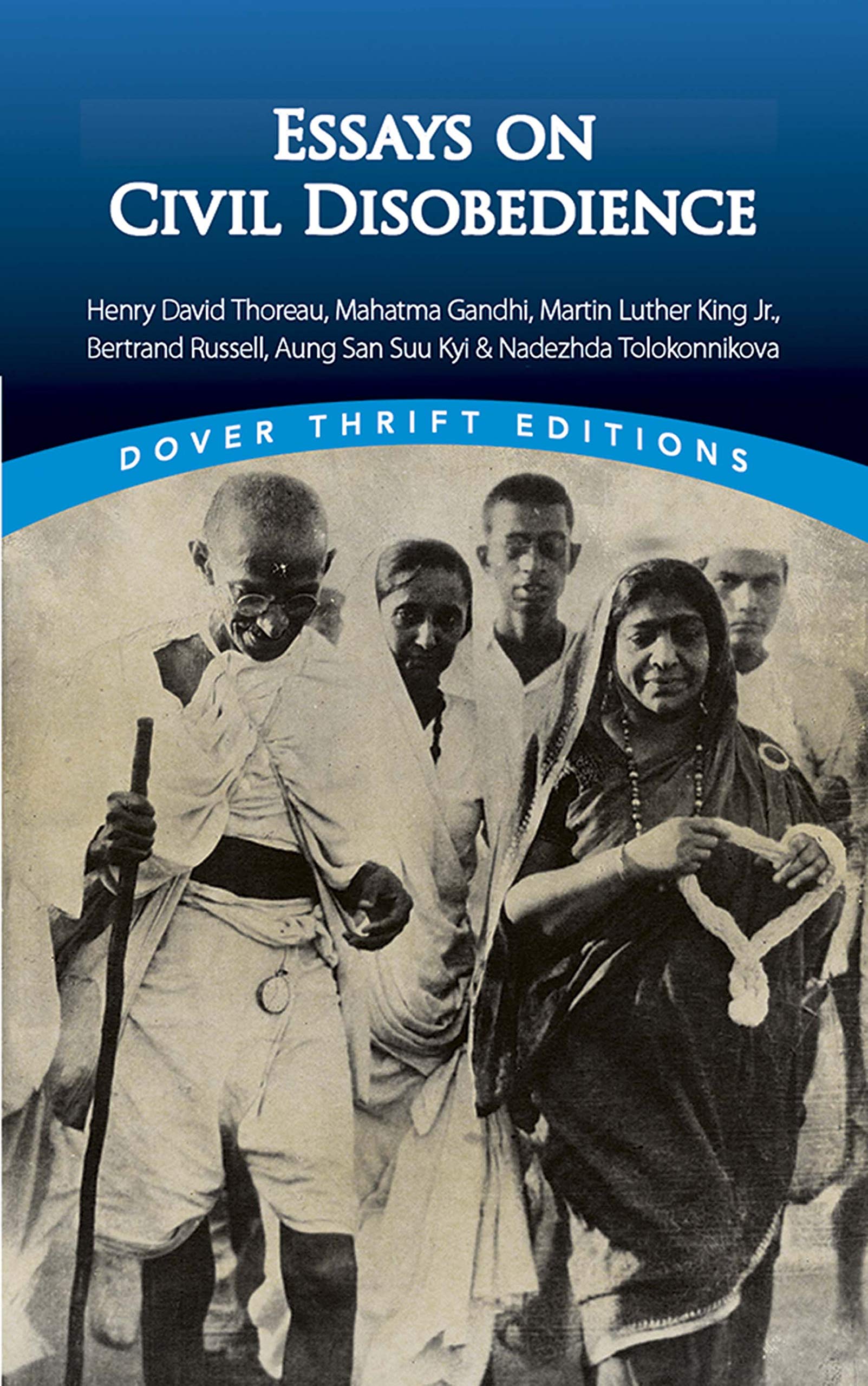
Essays on Civil Disobedience: Henry David Thoreau, Mahatma Gandhi, Martin Luther King, Jr., Bertrand Russell, Aung San Suu Kyi & Nadezhda
$8.39
by Bob Blaisdell



Inexpensive but substantial, this anthology ranges from Henry David Thoreau's great nineteenth-century polemics "Civil Disobedience" and "Slavery in Massachusetts" to more recent writings by Aung San Suu Kyi as well as Nadezhda Tolokonnikova of the subversive Russian rock group Pussy Riot. Additional selections include Leo Tolstoy's denouncement of capital punishment, "I Cannot Be Silent"; Bertrand Russell's "Civil Disobedience and the Threat of Nuclear Warfare"; and "Love, Law, and Civil Disobedience" and "Letter from Birmingham City Jail" by Martin Luther King, Jr. Other contributors include William Lloyd Garrison, Albert Einstein, and Aleksandr Solzhenitsyn. Editor Bob Blaisdell provides an informative Introduction. Bob Blaisdell is Professor of English at the City University of New York's Kingsborough Community College and the editor of more than 20 Dover literature and poetry collections. His most recent Dover books include Civil War Letters: From Home, Camp and Battlefield; Great Speeches by Mark Twain; Essays on Teaching; and Humorous American Short Stories. Essays on Civil Disobedience By Bob Blaisdell Dover Publications, Inc. Copyright © 2016 Dover Publications, Inc. All rights reserved. ISBN: 978-0-486-79381-8 Contents William Lloyd Garrison, The Declaration of Sentiments Adopted by the Peace Convention (1838), 1, Adin Ballou, Non-Resistance in Relation to Human Governments (1839), 6, Henry David Thoreau, Civil Disobedience (1849), 22, Slavery in Massachusetts (1854), 43, Leo Tolstoy, "Repent Ye, for the Kingdom of Heaven Is at Hand" (1893), 57, Two Wars (1898), 66, "Notes for Officers" (1901), 71, "I Cannot Be Silent" (1908), 78, Mahatma Gandhi, The Theory and Practice of Satyagraha (1914), 92, Ahmedabad (1919), 95, Satyagraha (Noncooperation) (1920), 99, Limitations of Satyagraha (1927), 110, On the Eve of the March (1930), 112, Message to the Nation (1930), 115, Albert Einstein, The "Two Percent" Speech (1930), 117, Martin Luther King, Jr., Love, Law, and Civil Disobedience (1961), 120, Letter from Birmingham City Jail (1963), 132, Bertrand Russell, Civil Disobedience and the Threat of Nuclear Warfare (1963), 149, Aleksandr Solzhenitsyn, Live Not By Lies (1974), 156, Aung San Suu Kyi, Freedom from Fear (1991), 162, Nadezhda Tolokonnikova (Pussy Riot), "Words Will Break Cement" (2012), 167, CHAPTER 1 WILLIAM LLOYD GARRISON The Declaration of Sentiments Adopted by the Peace Convention (1838) The Liberator, Vol. VIII. No. 39 (September 28, 1838) Best known for his brave and relentless campaign for the abolition of slavery in the United States, William Lloyd Garrison (1805–1879) also distinguished himself for his commitment to civil disobedience, or, in his terms, "nonresistance." Not only as an author but as a speaker, noted one of his contemporaries, he delivered "a rain of fire." The Peace Convention was a national political group committed to pacifism and based in Boston; "The Declaration of Sentiments Adopted by the Peace Convention" was published in Garrison's abolitionist newspaper, The Liberator, on September 28, 1838. The Russian novelist and peace activist Leo Tolstoy was inspired by Garrison's life and writings and remarked, "Garrison understood that which the most advanced among the fighters against slavery did not understand: that the only irrefutable argument against slavery is the denial of the right of any man over the liberty of another under any conditions whatsoever." Tolstoy concluded, "Therefore Garrison will forever remain one of the greatest reformers and promoters of true human progress." Assembled in convention, from various sections of the American Union, for the promotion of peace on earth and good-will among men, we, the undersigned, regard it as due to ourselves, to the cause which we love, to the country in which we live, and to the world, to publish a declaration, expressive of the principles we cherish, the purposes we aim to accomplish, and the measures we shall adopt to carry forward the work of peaceful, universal reformation. We cannot acknowledge allegiance to any human government; neither can we oppose any such government by a resort to physical force. We recognize but one King and Lawgiver , one Judge and Ruler of mankind. We are bound by the laws of a kingdom which is not of this world; the subjects of which are forbidden to fight; in which Mercy and Truth are met together, and Righteousness and Peace have kissed each other; which has no state lines, no national partitions, no geographical boundaries; in which there is no distinction of rank, or division of caste, or inequality of sex; the officers of which are Peace , its extractors Righteousness , its walls Salvation , and its gates Praise ; and which is destined to break in pieces and consume all other kingdoms. Our country is the world, our countrymen are all mankind. We love the land of our nativity only as we lov