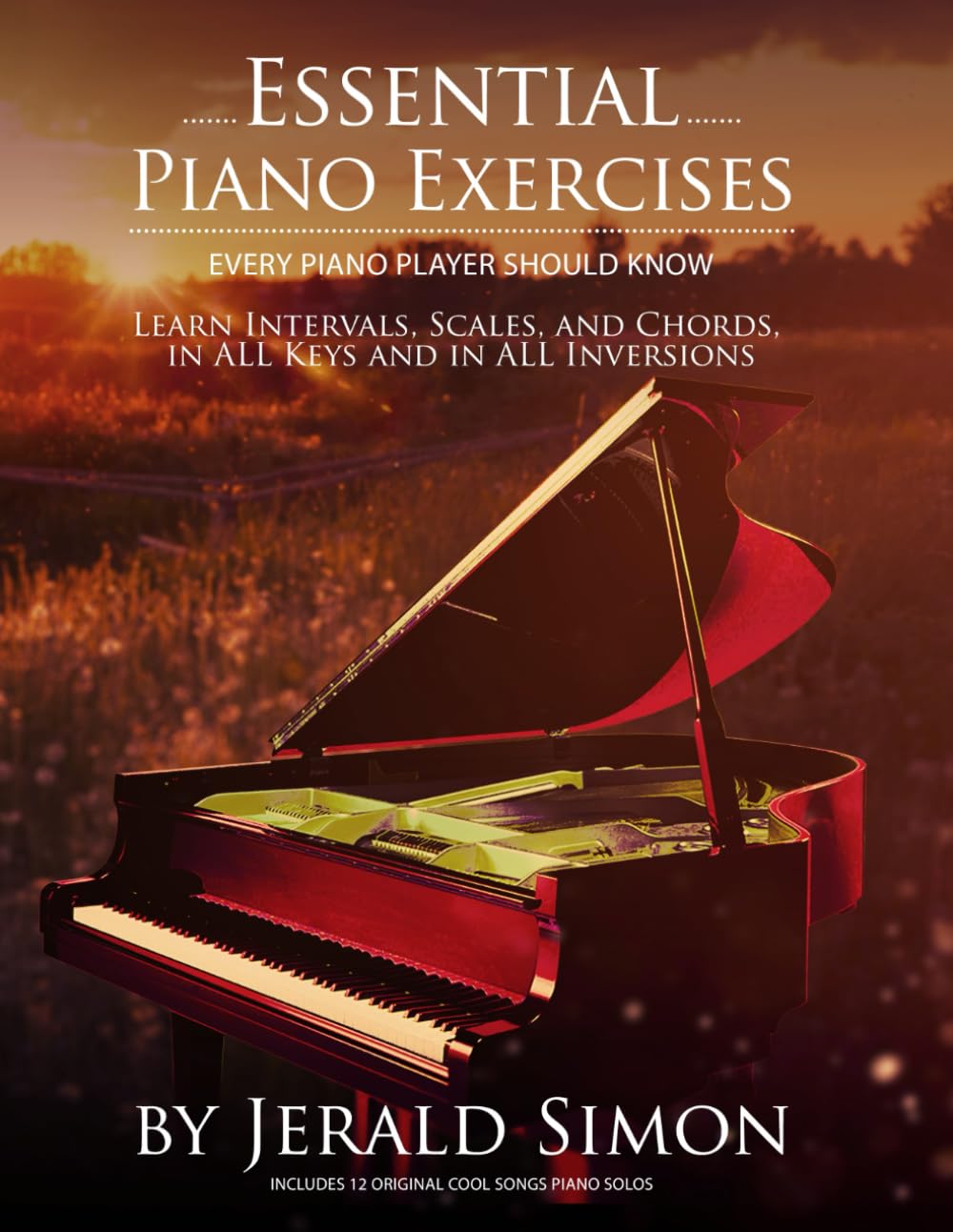
Essential Piano Exercises Every Piano Player Should Know: Learn Intervals, Pentascales, Tetrachords, Scales (major and minor), Chords (triads, sus, ..
$21.95
by Jerald Simon



What are essential piano exercises and why should we learn them? Are you a piano teacher? A piano student? A parent or guardian of a piano student? Are you the next great arranger, composer, or musical mega star? If you said yes to any of these questions, then you need to know the essential piano exercises that will take your piano playing ability to the next level. Piano students need to learn the fundamental basics of playing the piano. There are many music books out there that teach scales, modes, and chords. This book introduces piano students to intervals, pentacles, tetrachords, scales (major and minor), chords (triads, SUS chords {sus 4 and sus 2}, augmented {aug.}, diminished {dim.}, 6th, minor 6th, major 7th, minor major 7th, dominant 7th, minor 7th, minor 7th (flat 5), minor 7th (sharp 5), diminished 7th), chord progressions, and fun, cool piano exercises in all key signatures and inversions. This book follows the Music Motivation Mentorship Map created by Jerald Simon (founder of Music Motivation - musicmotivation.com, who is the creator of the COOL SONGS Club (coolsongsclub.com). The Music Motivation Mentorship Map is a guide and piano music blue print to guide piano students from beginning level - advanced levels (apprentice for 1st and 2nd year students), maestro (for 2nd - 4th year students), and virtuoso for 4th year and above students). This Music Motivation Mentorship Map lists the recommended repertoire from Jerald's COOL SONGS Series (a series of 5 books featuring FUN and Cool Sounding piano pieces from primer level to late intermediate level). The guide also lists recommended music terminology students should learn, key signatures, music notation, rhythms, intervals, scales, chords, arpeggios, inversions, technique, sight reading, ear training, music history, improvisation, and composition ideas. Essential Piano Exercises Every Piano Player Should Know presents essential piano exercises starting in pentascale position using C D E F and G and continuing on with all major pentascales, all minor pentascales, all diminished pentascales, and introduces exercises in every key signature following the circle of fifths. All of the exercises featuring the chords demonstrate the chords in every key signature - blocked and broken in root position, first inversion, second inversion, and third inversion (when playing four note chords) moving up in half steps through every key signature. After presenting the traditional and essential piano exercises, Jerald presents a section featuring FUN and COOL exercises you won't find anywhere else. Jerald also explains why it is important to learn intervals, scales, and chords and then demonstrates what you can do once you have learned the theory. Jerald refers to it as the practical application of music theory. He often calls it "Putting FUN back into Piano FUNdamentals" (emphasis on the word FUN). Take your piano playing to a whole new level with these exercises in every key signature. Piano teachers are thrilled with the amount of exercises presented in this book. Those that have experienced Jerald's work will know the thoroughness, depth, clarity and effort that goes into everything he produces. This includes his live demonstrations, his videos and his multitude of books. His latest book - "Essential Piano Exercises Every Piano Player Should Know" is, not unexpectedly, written and offered with the same vision and care. It is 290 pages filled almost completely with easy-to-comprehend theory, practical exercises and fun. Starting with a map, or journey, for the aspiring pianist, it moves on to checklists and the understanding of core concepts such as the circle of fifths, key signatures etc. From there Jerald quickly introduces us to such ideas as cool exercises, intervals, blocked intervals, three note chords, important fingering, pentascales and triads. I could go on, but would risk this review being dry and boring, which the book certainly is not. Jerald covers much more than stated here and opens up the keyboard in such depth and detail. But, nobody should be concerned or intimidated by the theory that is covered. Jerald uses theory only to build the foundation for developing a love for playing the instrument. This is evidenced by putting theory from previous exercises into fun practice by using relatively simple compositions. From there, Jerald explains how to start composing your own tunes using the skills and techniques you have learned. The journey ends with 12 "Cool Song" compositions that can further enhance the things that have been learned. "Cool Songs" have a reputation for being fun to play, easy to understand and targeted at the appropriate level whether it be beginner, intermediate or advanced. Make no mistake, this book is suitable for all levels and all ages. Beginners simply need to follow the instruction and direction Jerald supplies whereas intermediate and advanced learners will certainly gain insight and momentum from the progressive