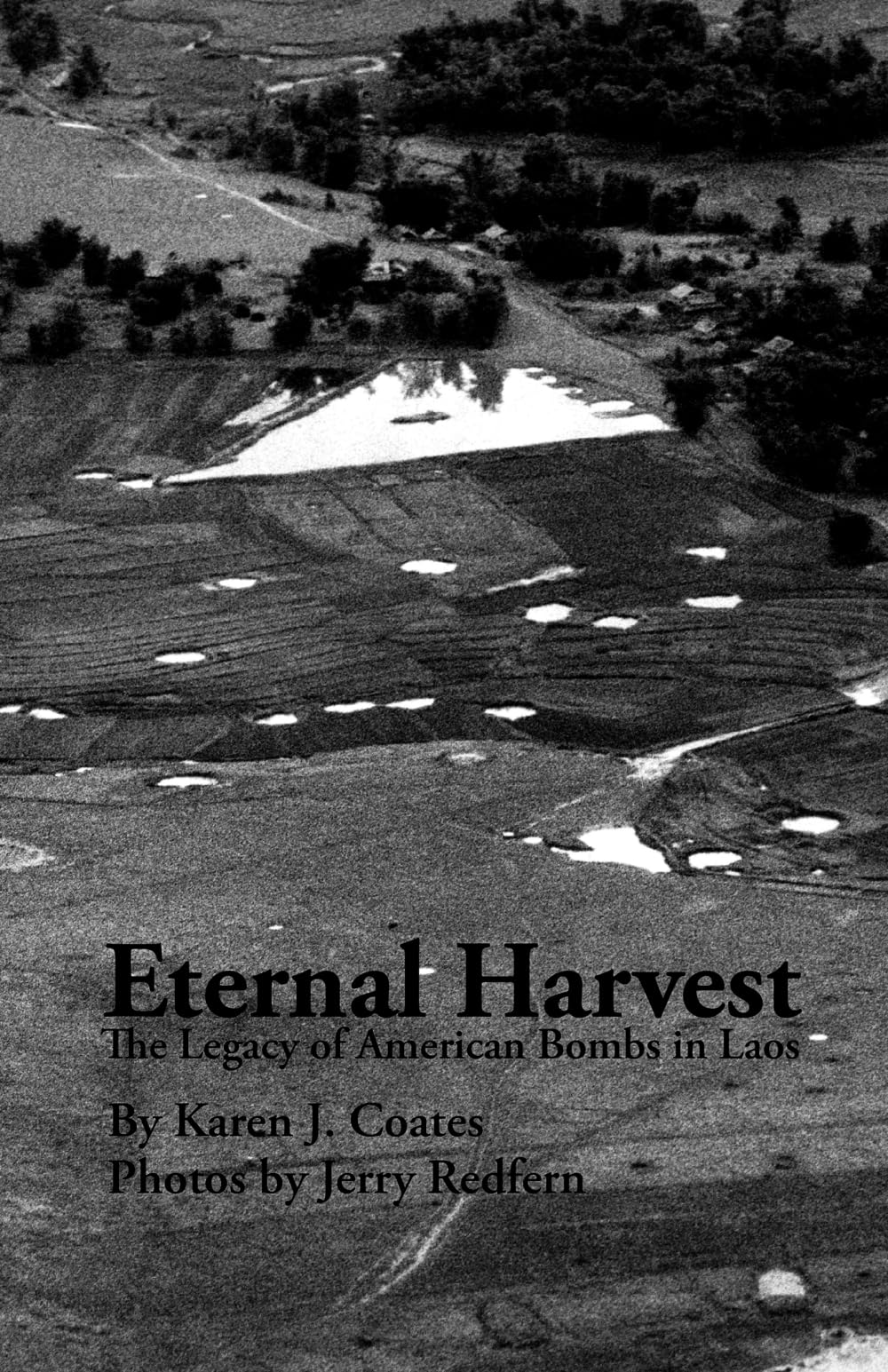



Karen Coates and Jerry Redfern spent more than seven years traveling in Laos, talking to farmers, scrap-metal hunters, people who make and use tools from UXO, people who hunt for death beneath the earth and render it harmless. With their words and photographs, they reveal the beauty of Laos, the strength of Laotians, and the commitment of bomb-disposal teams. People take precedence in this account, which is deeply personal without ever becoming a polemic. &;I&;m afraid, but I do it for the money&;&; Ruet, a scrap hunter &;I didn&;t know it was dangerous&;&; Lee Her, a wounded teenage girl and former scrap hunter &;We just keep up the good work we&;re doing, and in five thousand years&;we&;ll be finished.&; &;Jim Harris, a retired American principal and founder of We Help War Victims, who now spends his life helping to clear bombs in Laos * * * These are people who live in the midst of unexploded ordnance: Noi, who was working in the fields when a bomb went off, leaving shrapnel embedded in her face Lee Moua, a village blacksmith, who makes tools from harvested explosives Joy, a twelve-year-old boy with a metal detector who uncovers and sells scrap metal that could kill him, earning less than fifty cents a pound for his discoveries Ta, who says she lives in &;a town of UXO&; and whose son died while searching for its bounty Lue Ha, who lost his sight in an explosion and now is a blind masseur * * * These are statistics: &;To this day, Laos remains, per capita, the most heavily bombed country on earth. All told, the U.S. military and its allies dumped more than 6 billion pounds of bombs across the land&;more than one ton for every man, woman, and child in Laos at the time. American forces flew more than 580,000 bombing missions, the equivalent of one raid every eight minutes for nine years&;Among all the ordnance dropped were 270 million cluster-bomb submunitions, tiny &;bombies&; that were packed by the dozens or hundreds into canisters and casings designed to open in midair, scattering baseball-sized explosives across areas as large as a football field. Millions of submunitions fell into forests, where many lodged into treetops and scrub brush. It can take decades for something to jostle them loose. Bombies are the most common form of unexploded ordnance in Laos today.&;&; Karen Coates , who, with photographer Jerry Redfern , spent more than seven years traveling through Laos, finding the stories of people who do their best to live with death beneath the land where they farm, make their homes, and raise their children. * * * Karen Coates says &;I&;ve been hooked on Asia ever since I spent a semester of graduate school in Hanoi more than a dozen years ago. Somehow I managed to wheedle my husband, photojournalist Jerry Redfern, into a life on the move. I took a newspaper job in Phnom Penh in 1998, shortly after we married, and we&;ve been tromping through jungles and rice paddies ever since. I&;m the Southeast Asia correspondent for Archaeology and I write a Food Culture column for The Faster Times. My work appears in publications around the world such as GlobalPost, Wall Street Journal Asia, Travel + Leisure Southeast Asia, National Geographic Books, Fodor&;s Travel Guides, DAYS Japan, GEO Spain, Milwaukee Journal Sentinel and many others.&; Karen Coates and Jerry Redfern combined their talents in Cambodia Now: Life in the Wake of War (McFarland and Company 2005) and in This Way More Better; Stories and Photos from Asia&;s Back Roads (ThingsAsian Press 2013). Jerry Redfern began his career as a staff photographer at newspapers in the American West, at a time when papers still had darkrooms and photographers still processed their own film. In 1998, he and his wife, Karen Coates, moved to Cambodia where Redfern shot news, features and investigative stories for Agence France-Presse, The New York Times, The Cambodia Daily and other publications. Redfern&;s work has won awards from numerous journalism and art organizations, including the Fund for Investigative Journalism, Center &; Review Santa Fe, and the National Press Photographers Association. Redfern&;s images appear in publications around the world, includingThe New York Times, The Wall Street Journal, Forbes, Archaeology, Travel+Leisure Southeast Asia, GEO, Sierra, National Geographic Books, and many others.