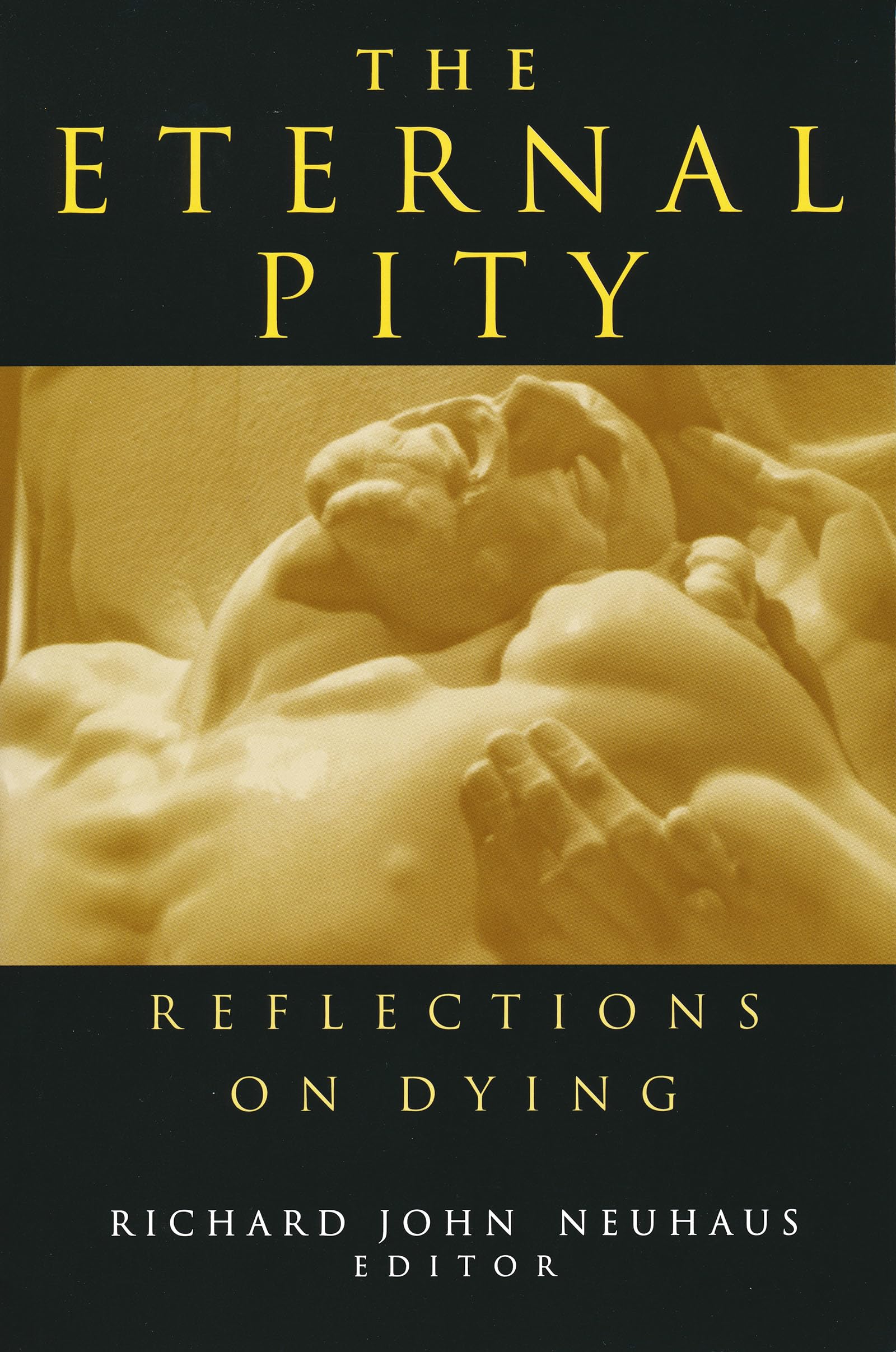
Eternal Pity: Reflections on Dying (Ethics of everyday life)
$17.99
by Richard John Neuhaus



Drawing upon a vast range of human experience and reflection, The Eternal Pity: Reflections on Dying demonstrates how people try to cope with the inevitability of death. Different cultures, informed by religious beliefs and sometimes desperate hope, teach people to respond to their own death and the deaths of others in modes as various as defiance, stoic resignation, and unbridled grief. In addition to examples from literature, poetry, and religious texts, Father Richard John Neuhaus provides an intensely personal account of his encounter with death through emergency cancer surgery and reflects on how that encounter has changed the way he lives. While many writers have deplored the “denial of death” in our culture, The Eternal Pity shows how themes of death and dying are nevertheless perennial and pervasive. Society may be viewed as a disorganized march of multitudes waving little banners of meaning before the threat of nonbeing that is death. Some selections in this book depict people utterly surprised by their mortality; others highlight how the whole of one’s life can be a preparation for what used to be called “a good death.” For some, life is a relentless effort to hold death at bay; for others, death is, although not welcomed, reflectively anticipated. Nothing so universally defines the human condition as the fact that we shall die. The Eternal Pity helps us to understand how the prospect of death compels decisions about how we might live. Convinced that "every aspect of everyday life is ethically charged" and that academic ethics are too often "remote from life as lived," several of the country's leading conservative Christian ethical scholars launched a five-volume series of books to address "The Ethics of Everyday Life." Volume two, The Eternal Pity: Reflections on Dying , is edited by Richard John Neuhaus (editor of First Things and author, most recently, of Death on a Friday Afternoon ). The book is an eclectic selection of readings regarding all manner of approaches to death and experiences of grief. It contains 26 readings from literature, poetry, and philosophy. Authors range from Montaigne to Tolstoy to Flannery O'Connor, and the book includes religious texts spanning a range marked by the Quran and the Book of Common Prayer. Neuhaus himself has provided a wide-ranging introduction to the anthology as well as a personal story about the enlivening effects of his own close brush with death. The Eternal Pity is organized in three sections, "Thinking About Dying," "When We Die," and "When Others Die," but this book should probably not be read systematically. Just mine the text for something that calls out to you--the message that grief can only be assuaged by pleasure ("The Rubaiyat of Omar Khayyam"), or a simple expression of resignation to death's arrival ("Do Not Go Gentle"). --Michael Joseph Gross Most contemporary books on ethics deal with professional ethics or particularly thorny issues. The series of which this title is a part, "The Ethics of Everyday Life," will consider life issues most people face; this volume concerns death and dying. After a fairly lengthy introduction, in which Neuhaus (Inst. on Religion and Public Life; The Naked Public Square) movingly reflects on his own bout with cancer, the book offers 27 selections from various sources, ranging in date from ancient to modern times, each with a brief introduction. Some are religious, many are not; some are autobiographical reflections, others are poetry or fiction. On the whole they are well chosen. The book does not push one viewpoint but offers these selections for consideration. The result is a handbook for the dying--that is, every one of us. Recommended for public libraries. -Augustine J. Curley, O.S.B., Newark Abbey, NJ Copyright 2000 Reed Business Information, Inc. “Those who know Richard John Neuhaus as one of America’s leading public intellectuals can now see the more essential Neuhaus in this book: the priest consecrated to the care of souls. Here Neuhaus has wisely selected from the wisdom of others on how we are to face death, and he has provided great insight from his own experience in facing death, which has made him a wiser man and a better priest.” ―Rabbi David Novak, J. Richard and Dorothy Shiff Chair of Jewish Studies, University of Toronto “This little book of thoughts on the mystery of death is a treasury of wisdom on the great perennial questions: What is the good life? How do I live it?” ―Mary Ann Glendon, Professor of Law, Harvard University “Intelligent and wise people have thought and written a great deal about death, and some of the best of what they’ve said has been collected by Father Neuhaus in this volume. The book is worth its price for the pieces by Flannery O’Connor, John Donne, and Peter De Vries alone; but there’s great wisdom, too, in Neuhaus’s own discussion of death, the kind of wisdom that comes only from a close approach to death. If you’re someone who’s preparing fo