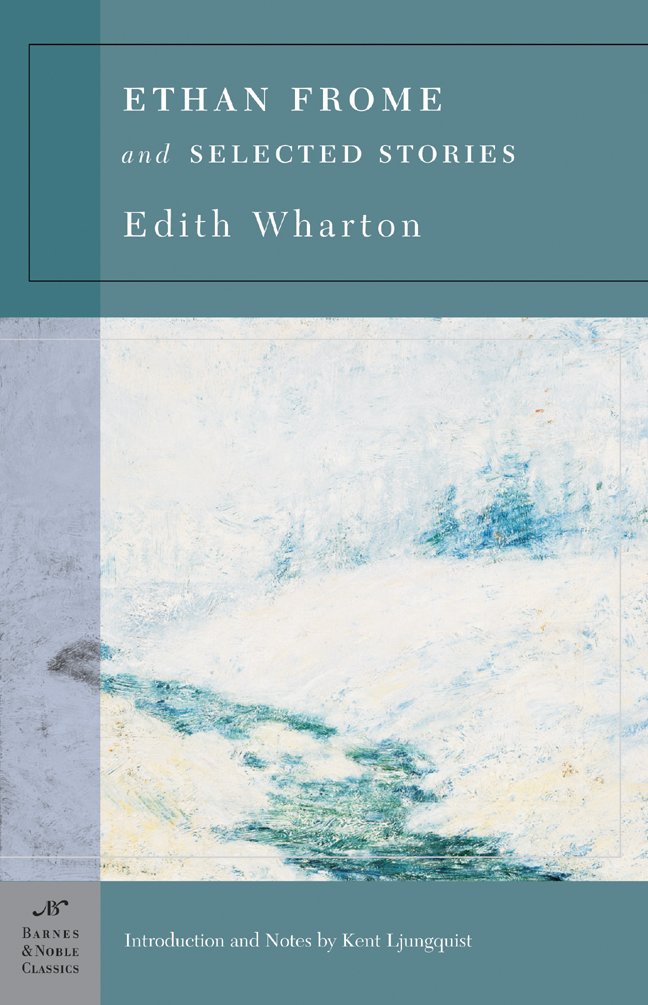



&&LDIV&&R&&LDIV&&R&&LI&&REthan Frome and Selected Stories&&L/I&&R, by &&LB&&REdith Wharton&&L/B&&R, is part of the &&LI&&RBarnes & Noble Classics&&L/I&&R &&LI&&R &&L/I&&Rseries, which offers quality editions at affordable prices to the student and the general reader, including new scholarship, thoughtful design, and pages of carefully crafted extras. Here are some of the remarkable features of &&LI&&RBarnes & Noble Classics&&L/I&&R: &&LDIV&&R New introductions commissioned from todays top writers and scholars - Biographies of the authors - Chronologies of contemporary historical, biographical, and cultural events - Footnotes and endnotes - Selective discussions of imitations, parodies, poems, books, plays, paintings, operas, statuary, and films inspired by the work - Comments by other famous authors - Study questions to challenge the readers viewpoints and expectations - Bibliographies for further reading - Indices & Glossaries, when appropriate All editions are beautifully designed and are printed to superior specifications; some include illustrations of historical interest. &&LI&&RBarnes & Noble Classics &&L/I&&Rpulls together a constellation of influences―biographical, historical, and literary―to enrich each readers understanding of these enduring works.&&L/DIV&&R&&L/DIV&&R&&LP style="MARGIN: 0in 0in 0pt"&&R &&L/P&&R&&LP style="MARGIN: 0in 0in 0pt"&&ROne of Edith Wharton’s few works of fiction that takes place outside of an urban, upper-class setting, &&LI&&REthan Frome&&L/I&&R draws upon the bleak, barren landscape of rural New England. A poor farmer, Ethan finds himself stuck in a miserable marriage to Zeenie, a sickly, tyrannical woman, until he falls in love with her visiting cousin, the vivacious Mattie Silver. As Mattie is forced to leave his household, Frome steals one last afternoon with her―one that culminates in a ruinous sled ride with unspeakably tragic results. &&L/P&&R&&LP&&RUnhappily married herself, &&LB&&REdith Wharton&&L/B&&R projected her dark views of love onto people far removed from her social class in &&LI&&REthan Frome&&L/I&&R. Her sensitivity to natural beauty and human psychology, however, make this slim novel a convincing and compelling portrait of rural life. A powerful tale of passion and loss―and the wretched consequences thereof―&&LI&&REthan Frome&&L/I&&R is one of American literatures great tragic love stories. &&LP&&RAlso included in this volume are four of Edith Wharton’s finest short stories: “The Pretext,” “Afterward,” “The Legend,” and “Xingu.”&&L/P&&R&&LP&&R&&LB&&RKent P. Ljungquist&&L/B&&R, Professor of English at Worcester Polytechnic Institute, is the author of &&LI&&RThe Grand and the Fair: Poe’s Landscape Aesthetics and Pictorial Techniques&&L/I&&R, co-editor of the SUNY Press edition of James Fenimore Coopers &&LI&&RThe Deerslayer&&L/I&&R, and editor of several reference works of American fiction.&&L/P&&R&&L/DIV&&R Kent P. Ljungquist , Professor of English at Worcester Polytechnic Institute, is the author of The Grand and the Fair: Poe’s Landscape Aesthetics and Pictorial Techniques , co-editor of the SUNY Press edition of James Fenimore Cooper's The Deerslayer , and editor of several reference works of American fiction. From Kent P. Ljungquists Introduction to Ethan Frome and Selected Stories Wharton tended to measure her literary achievements against those of male writers; in her introduction, she further distinguished her efforts from previous treatments of New England by discounting her role as a mere recorder of the more superficial or external features of her setting. She thus emphasized the steps in the construction of Ethan Frome —that is, her role as a conscious literary craftsman. She noted that her initial conception derived from an academic exercise intended to polish her proficiency in the French language. Developed in Paris in 1907, the French sketch of "Ethan Frome" contained three characters (the male was named Hart) and achieved a length that encompassed two scenes, or vignettes, that survived in the published version. The fragment contained a triangular relationship among a husband, his sick wife, and the wifes niece, to whom the "Ethan-character" is attracted; but it lacked the structure that would give focus as well as depth to the narrative. Wharton eventually hit upon the device of a storyteller, but she did not choose one steeped in the lore and history of New England. Rather than a character like the herbalist and healer Mrs. Todd in Jewetts The Country of the Pointed Firs (1896), a native authority on the regions legends and values, Wharton chose someone from outside New England to narrate the story-a looker-on, an observer. In her desire for "roundness"—Wharton seemed to resort recurrently to the terminology of the "plastic arts" or visual media—she would supplement the narrators perspective with those of her minor characters. The fresh, acute perspective derived from the narrators growing insight and awareness would