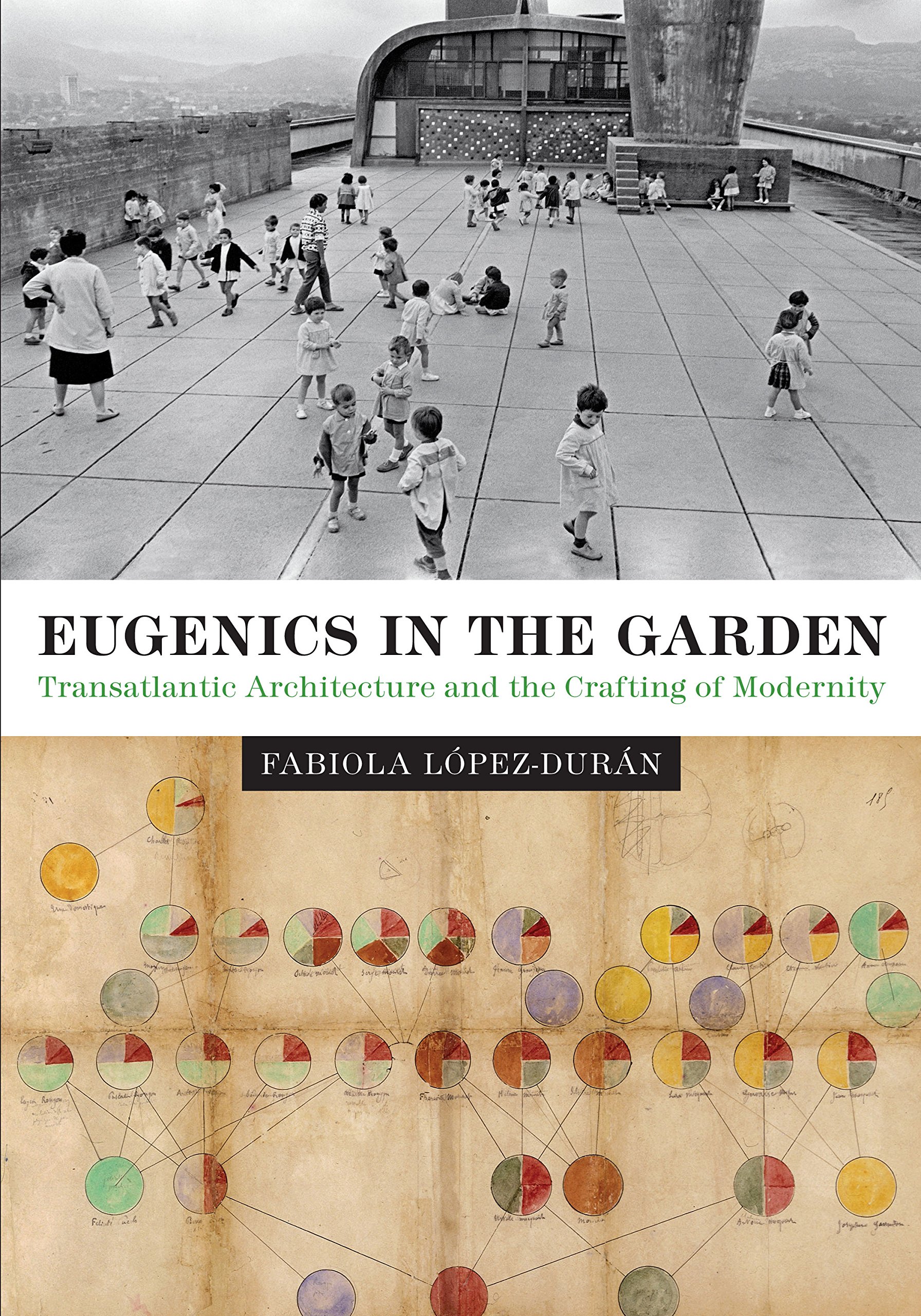
Eugenics in the Garden: Transatlantic Architecture and the Crafting of Modernity (Lateral Exchanges: Architecture, Urban Development, and
$34.95
by Fabiola López-Durán



Winner, Robert Motherwell Book Award, Outstanding Book on Modernism in the Arts, The Dedalus Foundation, 2019 As Latin American elites strove to modernize their cities at the turn of the twentieth century, they eagerly adopted the eugenic theory that improvements to the physical environment would lead to improvements in the human race. Based on Jean-Baptiste Lamarck’s theory of the “inheritance of acquired characteristics,” this strain of eugenics empowered a utopian project that made race, gender, class, and the built environment the critical instruments of modernity and progress. Through a transnational and interdisciplinary lens, Eugenics in the Garden reveals how eugenics, fueled by a fear of social degeneration in France, spread from the realms of medical science to architecture and urban planning, becoming a critical instrument in the crafting of modernity in the new Latin world. Journeying back and forth between France, Brazil, and Argentina, Fabiola López-Durán uncovers the complicity of physicians and architects on both sides of the Atlantic, who participated in a global strategy of social engineering, legitimized by the authority of science. In doing so, she reveals the ideological trajectory of one of the most celebrated architects of the twentieth century, Le Corbusier, who deployed architecture in what he saw as the perfecting and whitening of man. The first in-depth interrogation of eugenics’ influence on the construction of the modern built environment, Eugenics in the Garden convincingly demonstrates that race was the main tool in the geopolitics of space, and that racism was, and remains, an ideology of progress. [ Eugenics in the Garden ] is a timely and powerful contribution to the slow dismantling of a Eurocentric and sometimes―directly or indirectly―white supremacist history of architecture. ― Journal of the Society of Architectural Historians Published On: 2019-12-01 [ Eugenics in the Garden is] really enjoyable, extremely readable. It very deftly ties together many discursive strands and historical objects including medical and scientific treatises, popular fiction, large-scale urban demolition projects, modernist buildings, art, landscape designs, and world exhibitions. And accordingly, the book contributes to a number of disciplinary areas, including colonial medicine and, relatedly, architectures of medicine and urban hygiene; tropical architecture; and racial urban planning. I found it to be one of the most incisive interpretations of Le Corbusier I’ve read. ― Journal of Architecture Published On: 2019-06-20 An important book of innovative scholarship that breaks new ground. López-Durán’s book is timely given the current racial tensions of the United States, and will be useful to scholars of urban and architectural history, theory and criticism, public health policy, and political and economic history of Latin America; and especially to those interested in the social and cultural criticism of modernist urban design and architecture in relation to ideology, politics, and race. ― European Review of Latin American and Caribbean Studies Published On: 2020-06-22 Eugenics in the Garden is a significant contribution to recording and explaining reproachable aspects of modernist planning ideologies founded on eugenics…[López-Durán's] work is a timely reminder that social engineering, especially through planning and architecture, can all too easily become a vehicle for the application of racist ideologies; and these, regardless of the era, should be seen as unacceptable attempts to marginalize and dehumanize all those who do not fit into idealized utopian societies. For anyone interested in understanding spatial production and its implications, López-Durán’s work should form a fundamental part of their reading list. ― caa.reviews Published On: 2020-05-27 This book will open discussion of the role of eugenics in architecture/planning in France and Latin America in the first half of the twentieth century. This is a significant contribution, and it also opens the way for architectural historians to better understand how scientific theories influence architecture/design, especially neo-Lamarckian theories that allow what many view as just race-neutral ‘modernist planning’ to be seen in a new light. -- Christina Cogdell, University of California, Davis, author of Eugenic Design: Streamlining America in the 1930s [ Eugenics in the Garden ] is a timely and powerful contribution to the slow dismantling of a Eurocentric and sometimes―directly or indirectly―white supremacist history of architecture. ― Journal of the Society of Architectural Historians Published On: 2019-12-01 [ Eugenics in the Garden is] really enjoyable, extremely readable. It very deftly ties together many discursive strands and historical objects including medical and scientific treatises, popular fiction, large-scale urban demolition projects, modernist buildings, art, landscape designs, and world exhibition