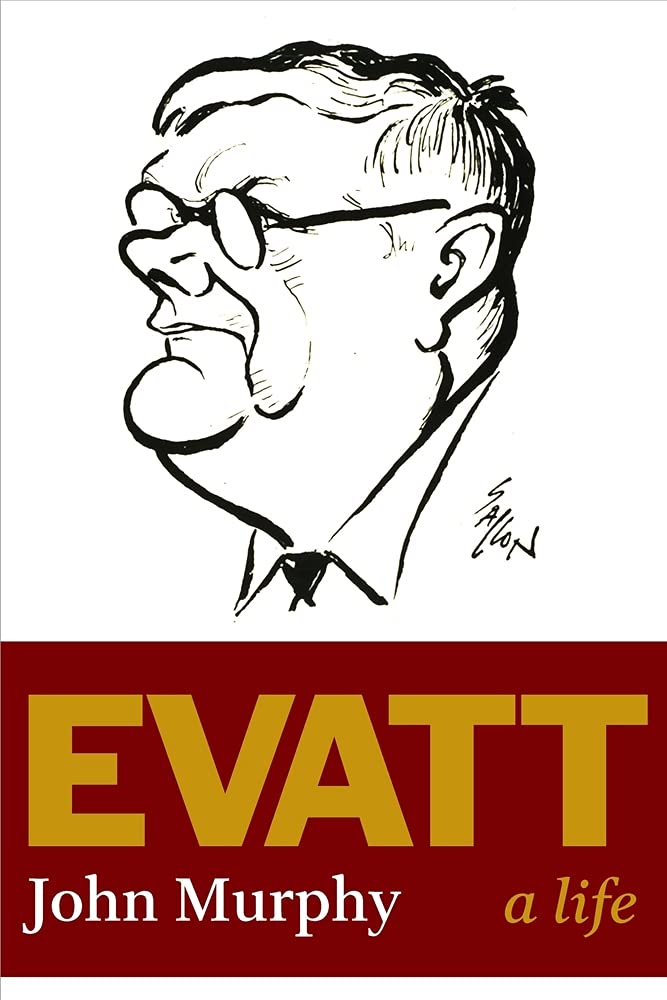



John Murphy’s Evatt: A life is a biography of Australian parliamentarian and jurist HV Evatt. Remembered as the first foreign minister to argue for an independent Australian policy in the 1940s and for his central role in the formation of the UN, Evatt went on to be the leader of the Labor party in the 1950s, the time of the split that resulted in the party being out of power for a generation. Evatt traces the course of Evatt’s life and places him in the context of a long period of conservatism in Australia. It treats Evatt’s inner, personal life as being just as important as his spectacular, controversial and eventual tragic public career. Murphy looks closely at Evatt’s previously unexamined private life and unravels some of the puzzles that have lead Evatt to be considered erratic, even mad. ‘Bert’ Evatt remains a polarising figure – still considered by many in Labor as the man who ‘split the party’ and by many conservatives as unreliable and dangerous. John Murphy is a professor of politics at the University of Melbourne. He is also Assistant Dean in the Faculty of Arts. He writes prolifically on Australian social and political history and is editor of the Australian politics and policy series in MUP’s Academic Monograph series. He is author of many books, including Harvest of Fear: A history of Australia's Vietnam War (Allen & Unwin, 1993); Imagining the fifties: Private sentiment and political culture in Menzies’ Australia (UNSW Press, 2000) and was a contributor to Half a Citizen: Life on welfare in Australia (Allen & Unwin, 2011). Evatt A Life By John Murphy University of New South Wales Press Ltd Copyright © 2016 John Murphy All rights reserved. ISBN: 978-1-74223-446-5 Contents Acknowledgements, Author's notes, Abbreviations, Introduction: The puzzle, 1 The boy, 2 The young Evatt, 3 Love and the law, 4 Politics and Jack Lang, 5 The judge, 6 The moderns, 7 The historian as judge, 8 The celebrity candidate, 9 The minister, 10 'To San Francisco, 11 'The president of the world', 12 The Labor leader, 13 The Petrov affair, 14 'The wrecker', 15 The wreckage, 16 'Dropping the pilot', Epilogue, The players, Notes, Sources, Bibliography, Index, CHAPTER 1 The boy When she was widowed in October 1901, Jeanie Evatt was aged thirty-eight and was left with six sons. Bert was the third oldest, aged seven; above him were George, the oldest at eighteen, who had already left school, and John, aged thirteen. So the gap between Bert and his next older brother was six years and it seems he was never close to them; they had moved away to work as he was growing up. Below him were Ray, aged five, Frank, aged three, and the baby, Clive, aged one. Kylie Tennant suggested he had a protective position as the oldest of these four boys, though there was also some competition between them. Maitland Evatt's father, John Ashmore Hamilton Evatt, had been born in India in 1851; his was an Anglo-Irish family with a long history of providing army officers for the empire. In the First World War, there were distant relatives active in the British military. As a boy, John Evatt had gone home from India to Ireland, and then migrated to Sydney at the age of fifteen. By the time of his marriage, he was working in Morpeth, inland and to the north of Newcastle on the Hunter River in New South Wales, as a providore, or steward, for the Hunter River Steam Navigation Company. The company worked the sea route between Sydney and Newcastle with cargo and passenger steamers, trading up the Hunter. The slow, meandering nature of the river made it navigable, though sometimes the steamers were blocked by cedar logs being floated downstream. Morpeth, along with Maitland a little further up the river, was an entrepot for the produce of the hinterland, which was then transported to Newcastle and down the coast to Sydney. Bullock teams brought in wool and timber, and warehouses lined the riverbanks at Morpeth and West Maitland; coal was mined in fields to the south, and vineyards had been planted by early white settlers in the 1820s. For a time in the mid-nineteenth century, the two Maitlands – East and West, separated by a floodplain – constituted the second town of New South Wales and the hub of the northern districts of the colony. Alan Wood, a local historian, painted it as a relatively wild town in the early colonial period, with raids by local bushrangers, some of them ex-convicts who had gone bush. But by 1900, the town had 'mellowed to a quiet and poor respectability'. Evatt's mother, Jane Sophia Gray – known as Jeanie – was born in Sydney in 1863, into an Irish Catholic family, but her mother changed to the Anglican faith after a dispute with a priest over Jeanie's baptism. When her family moved from Sydney to Morpeth, her father, John Thomas Gray, worked as a marine engineer for the steamship company, in effect as a mechanic maintaining the steam engines. For a time before her marriage, i