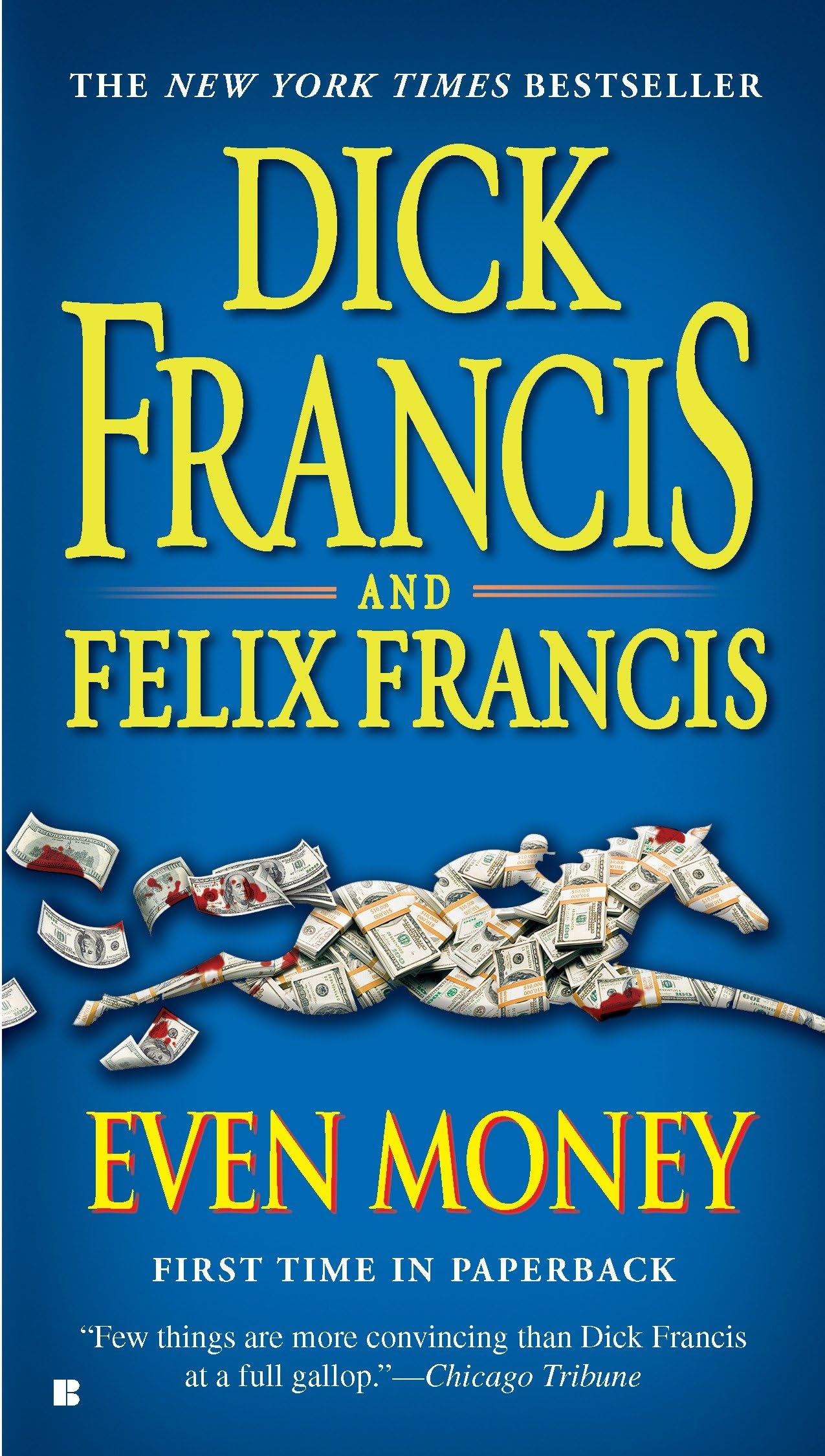



Ned Talbot is a small-time bookmaker on the edge of giving it all up when his world is turned upside down by a man who claims to be his father, long thought dead. And when the mysterious stranger is murdered, Ned feels compelled to find out exactly what is going on. But the more he discovers, the longer the odds become for his survival. Dick Francis (pictured with his son Felix Francis) was born in South Wales in 1920. He was a young rider of distinction winning awards and trophies at horse shows throughout the United Kingdom. At the outbreak of World War II he joined the Royal Air Force as a pilot, flying fighter and bomber aircraft including the Spitfire and Lancaster. He became one of the most successful postwar steeplechase jockeys, winning more than 350 races and riding for Her Majesty Queen Elizabeth, the Queen Mother. After his retirement from the saddle in 1957, he published an autobiography, The Sport of Queens , before going on to write more than forty acclaimed books, including the New York Times bestsellers Even Money and Silks . A three-time Edgar Award winner, he also received the prestigious Crime Writers’ Association’s Cartier Diamond Dagger, was named Grand Master by the Mystery Writers of America, and was awarded a CBE in the Queen’s Birthday Honours List in 2000. He died in February 2010, at age eighty-nine, and remains among the greatest thriller writers of all time. Felix Francis (pictured with his father, Dick Francis), a graduate of London University, spent seventeen years teaching A-level physics before taking on an active role in his father’s career. He has assisted with the research of many of the Dick Francis novels, including Shattered, Under Orders , and Twice Shy , which drew on Felix’s experiences as a physics teacher and as an international marksman. He is coauthor with his father of the New York Times bestsellers Dead Heat, Silks , and Even Money . He lives in England. Victoria, Australia BOOKMAKERS’S ODDS AS USED ON BRITISH RACETRACKS 1 I sank deeper into depression as the Royal Ascot crowd I enthusiastically cheered home another short-priced winning favorite. To be fair, it wasn’t clinical depression—I knew all about that—but it was pretty demoralizing, just the same. I asked myself yet again what I was doing here. I had never really enjoyed coming to Ascot, especially for these five days in June. It was usually much too hot to be wearing morning dress, or else it rained, and I would get soaked. I preferred the informality of my usual haunts, the smaller steeplechase tracks of the Midlands. But my grandfather, who had started the family business, had always used the fact that we stood at the Royal Meeting as one of our major marketing tools. He claimed that it gave us some form of respectability, something he had always craved. We were bookmakers. Pariahs of the racing world. Disliked by all, and positively hated by many, including large numbers of those whose very livelihoods depended on gambling. I had discovered over the years that my clients were never my friends. Whereas City investors might develop a close relationship with their stockbrokers, punters never wanted to be seen socializing with their bookies. Most of my regulars didn’t even know my name, nor did they want to. I suppose that was fair. I didn’t know most of their names either. We were simply participants in transactions where each of us was trying to bankrupt the other. I suppose it was a situation not really likely to engender mutual respect. “Score on seven,” said a tall, top-hatted young man thrusting a banknote towards me. I glanced up at our board to check the odds we were offering on horse number seven. “Twenty pounds on number seven at eleven-to-two,” I said, taking his note and adding it to the wad of others in my left hand. A small printer in front of me whirred and disgorged a ticket that I handed to the man. He snatched it from me and moved quickly away into the throng as if he didn’t want to be seen fraternizing with the enemy. His place in front of me was taken by a short, portly gentleman whose multicolored vest was fighting a losing battle against his expansive stomach. He was one of my regular Royal Ascot customers. I knew him only as A.J., but I had no idea what the A.J. stood for. “Hundred on Silverstone to win,” he wheezed at me, holding out some folded twenty-pound notes in his chubby fingers. “Hundred on two at even money,” I said, taking his cash and checking the amount. Another betting slip appeared out of the small printer as if by magic, and I passed it over. “Good luck, A.J.,” I said to him, not really meaning it. “Huh?” he said, somewhat surprised by my comment. “Good luck,” I repeated. “Thanks,” he wheezed, and departed. In the good old days, when bookmaking was an art rather than a science, every transaction was written down in “the book” by an assistant. Nowadays, as in most things, it was on a computer that everything was recorded. The same computer that pri