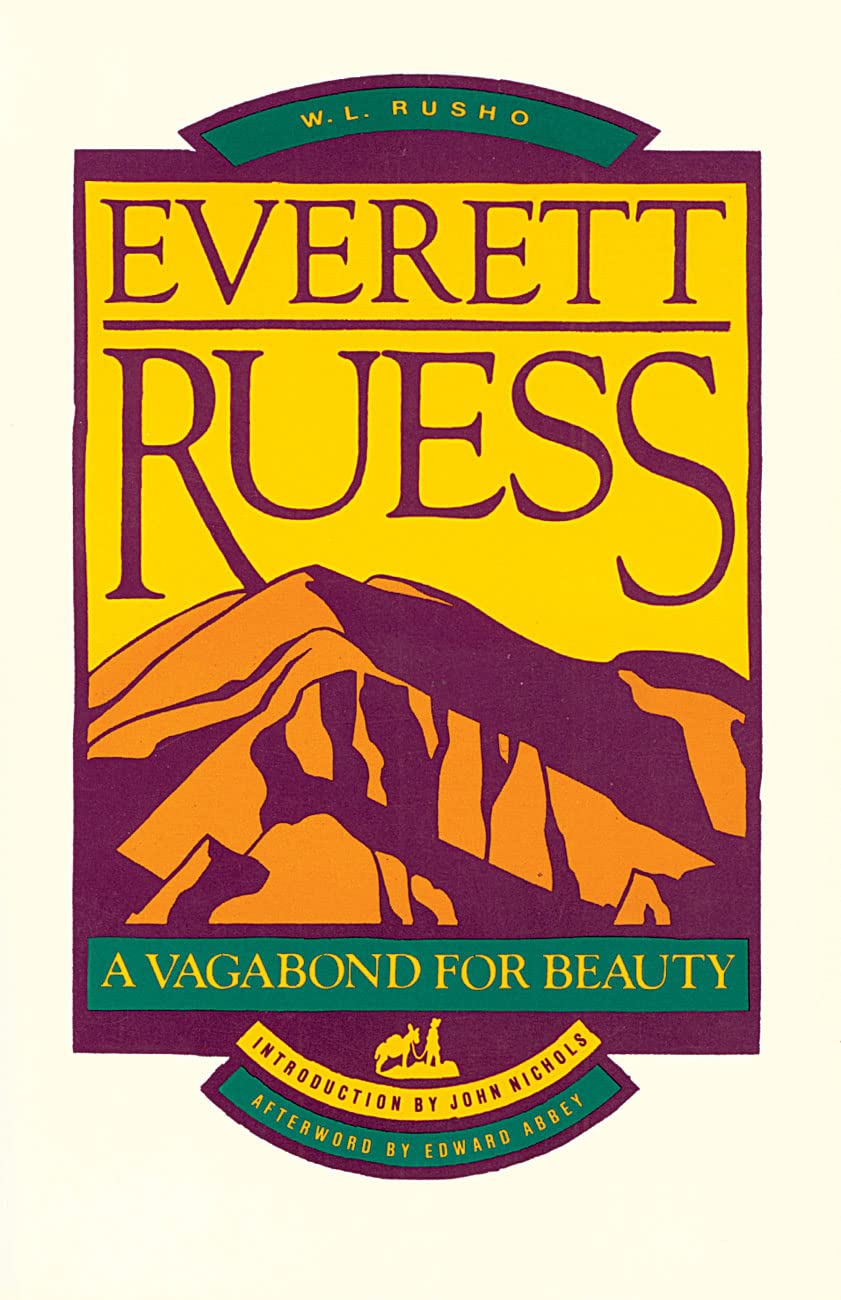



Everett Ruess, the young poet and artist who disappeared into the desert canyonlands of Utah in 1934, has become widely known posthumously as the spokesman for the spirit of the high desert. Many have been inspired by his intense search for adventure, leaving behind the amenities of a comfortable life. His search for ultimate beauty and oneness with nature is chronicled in this remarkable collection of letters to family and friends. Everett Ruess, bold adventurer, artist, writer. He traded prints with Ansel Adams. He studied and lived with Edward Weston, Maynard Dixon, and Dorothea Lange. He tramped around the Sierra Nevada, the California coast, and the desert wilderness of the Southwest, pursuing his dream of ultimate beauty and oneness with nature. Then, in November of 1934, at the age of 20, he mysteriously vanished into the barren Utah desert. This search for ultimate beauty and adventure is chronicled in this remarkable collection of letter to friends and family. The collections covers the period from 1930 until he vanished without a trace in 1934. "This message every poet and vagabond seeker like Ruess leaves behind is simple: Life on this earth is very precious and very beautiful. We must learn to heed the pure and delicate voices of those who cherish it." John Nichols, author of the Magic Journey, The Sterile Cuckoo, and The Milagro Beanfield War from his Introduction. "He was one of the earth's oddlings--one of the wandering few who deny restraint and scorn inhibition. His life was a quest for the new and the fresh. Beauty was a dream. He pursued his dream into desert solitudes--there with the singing wind to chant his final song." Hugh Lacy in On Desert Trails. W. L. Rusho's is a historian and expert on the life of Everett Ruess. His first book on Ruess was published in 1985, and he authored two (four, six, eight?) more books on the subject. Lifetime sales of Everett Ruess: A Vagabond for Beauty, have been 20,000 plus. Introduction--by John Nichols By the time Everett Ruess disappeared, he had fashioned a magnificent obsession that probably killed him. His determination to plod alone through the southwestern wilderness was so fierce and arrogant that at time he seemed to be utterly consumed. Eventually, it is probable he lost all understanding of natural scale or human endurance. And along the way that ordinary awareness of danger we human beings carry must also have dissolved from his consciousness.