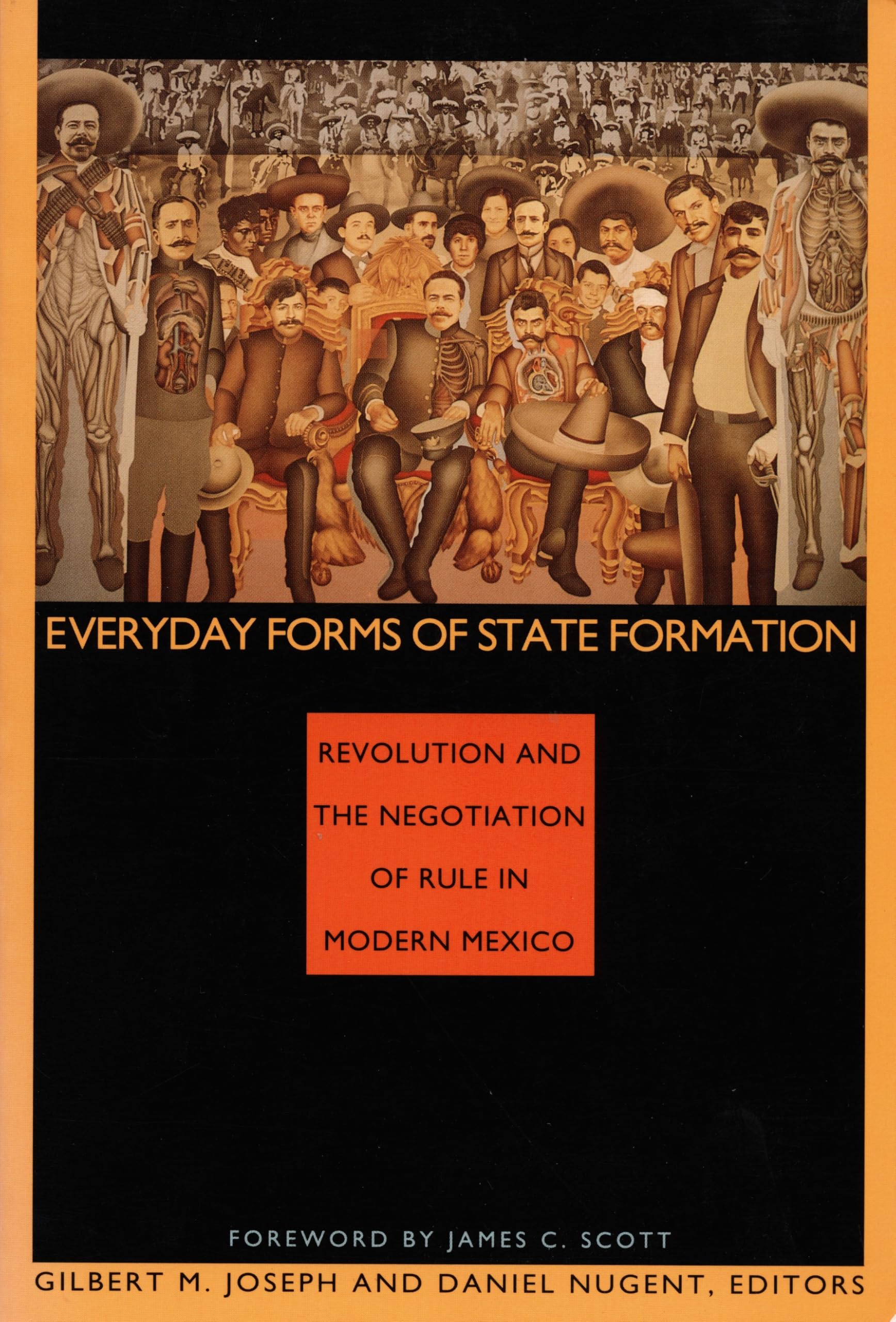
Everyday Forms of State Formation: Revolution and the Negotiation of Rule in Modern Mexico
$37.35
by Gilbert M. Joseph



Everyday Forms of State Formation is the first book to systematically examine the relationship between popular cultures and state formation in revolutionary and post-revolutionary Mexico. While most accounts have emphasized either the role of peasants and peasant rebellions or that of state formation in Mexico’s past, these original essays reveal the state’s day-to-day engagement with grassroots society by examining popular cultures and forms of the state simultaneously and in relation to one another. Structured in the form of a dialogue between a distinguished array of Mexicanists and comparative social theorists, this volume boldly reassesses past analyses of the Mexican revolution and suggests new directions for future study. Showcasing a wealth of original archival and ethnographic research, this collection provides a new and deeper understanding of Mexico’s revolutionary experience. It also speaks more broadly to a problem of extraordinary contemporary relevance: the manner in which local societies and self-proclaimed "revolutionary" states are articulated historically. The result is a unique collection bridging social history, anthropology, historical sociology, and cultural studies in its formulation of new approaches for rethinking the multifaceted relationship between power, culture, and resistance. Contributors . Ana María Alonso, Armando Bartra, Marjorie Becker, Barry Carr, Philip Corrigan, Romana Falcón, Gilbert M. Joseph, Alan Knight, Florencia E. Mallon, Daniel Nugent, Elsie Rockwell, William Roseberry, Jan Rus, Derek Sayer, James C. Scott "The essays in Everyday Forms of State Formation brilliantly shift the understanding of the Mexican Revolution to a new analytical framework that highlights the mediations between power and everyday forms of resistance and organization. Drawing on new theoretical approaches to the processes of hegemony, the authors go beyond analyses that posit either a reified oppressive state or a homogenized, often romanticized notion of ‘the people’ as heroic subjects of revolutionary change."—George Yúdice, Hunter College "This book represents something eminently new and original. I believe it will have a great impact and draw Mexico and its evolution into the general discussion of state formation, popular culture and revolution from which it has been significantly absent for a long time."—Friedrich Katz, University of Chicago "This book represents something eminently new and original. I believe it will have a great impact and draw Mexico and its evolution into the general discussion of state formation, popular culture and revolution from which it has been significantly absent for a long time."--Friedrich Katz, University of Chicago Gilbert M. Joseph is Professor of History and Chair of the Council of Latin American Studies at Yale University. He is the author of Revolution From Without: Yucatán, Mexico, and the United States , also published by Duke University Press. Daniel Nugent teaches anthropology and Latin American studies at the University of Arizona and is a managing editor of the Journal of Historical Sociology . Everyday Forms of State Formation Revolution and the Negotiation of Rule in Modern Mexico By Gilbert M. Joseph, Daniel Nugent Duke University Press Copyright © 1994 Duke University Press All rights reserved. ISBN: 978-0-8223-1467-7 Contents Foreword, Preface, State Formation, I Theoretical Prolegomena, Popular Culture and State Formation in Revolutionary Mexico, Weapons and Arches in the Mexican Revolutionary Landscape, II Empirical Studies, Reflections on the Ruins: Everyday Forms of State Formation in Nineteenth-Century Mexico, Force and the Search for Consent: The Role of the Jefaturas Políticas of Coahuila in National State Formation, Rethinking Mexican Revolutionary Mobilization: Yucatán's Seasons of Upheaval, 1909-1915, Schools of the Revolution: Enacting and Contesting State Forms in Tlaxcala, 1910-1930, Multiple Selective Traditions in Agrarian Reform and Agrarian Struggle: Popular Culture and State Formation in the Ejido of Namiquipa, Chihuahua, The Mexican Revolution, Agrarian Activism, and Agrarian Reform, Torching La Purísima, Dancing at the Altar: The Construction of Revolutionary Hegemony in Michoacán, 1934-1940, The "Comunidad Revolucionaria Institucional": The Subversion of Native Government in Highland Chiapas, 1936-1968, The Seduction of the Innocents: The First Tumultuous Moments of Mass Literacy in Postrevolutionary Mexico, The Fate of the Vanguard under a Revolutionary State: Marxism's Contribution to the Construction of the Great Arch, III A Theortical Reprise, Hegemony and the Language of Contention, Everyday Forms of State Formation: Some Dissident Remarks on "Hegemony", Bibliography, Archives, Newspapers, Books and Articles, Index, Contributors, CHAPTER 1 GILBERT M. JOSEPH AND DANIEL NUGENT Popular Culture and State Formation in Revolutionary Mexico * * * A cent