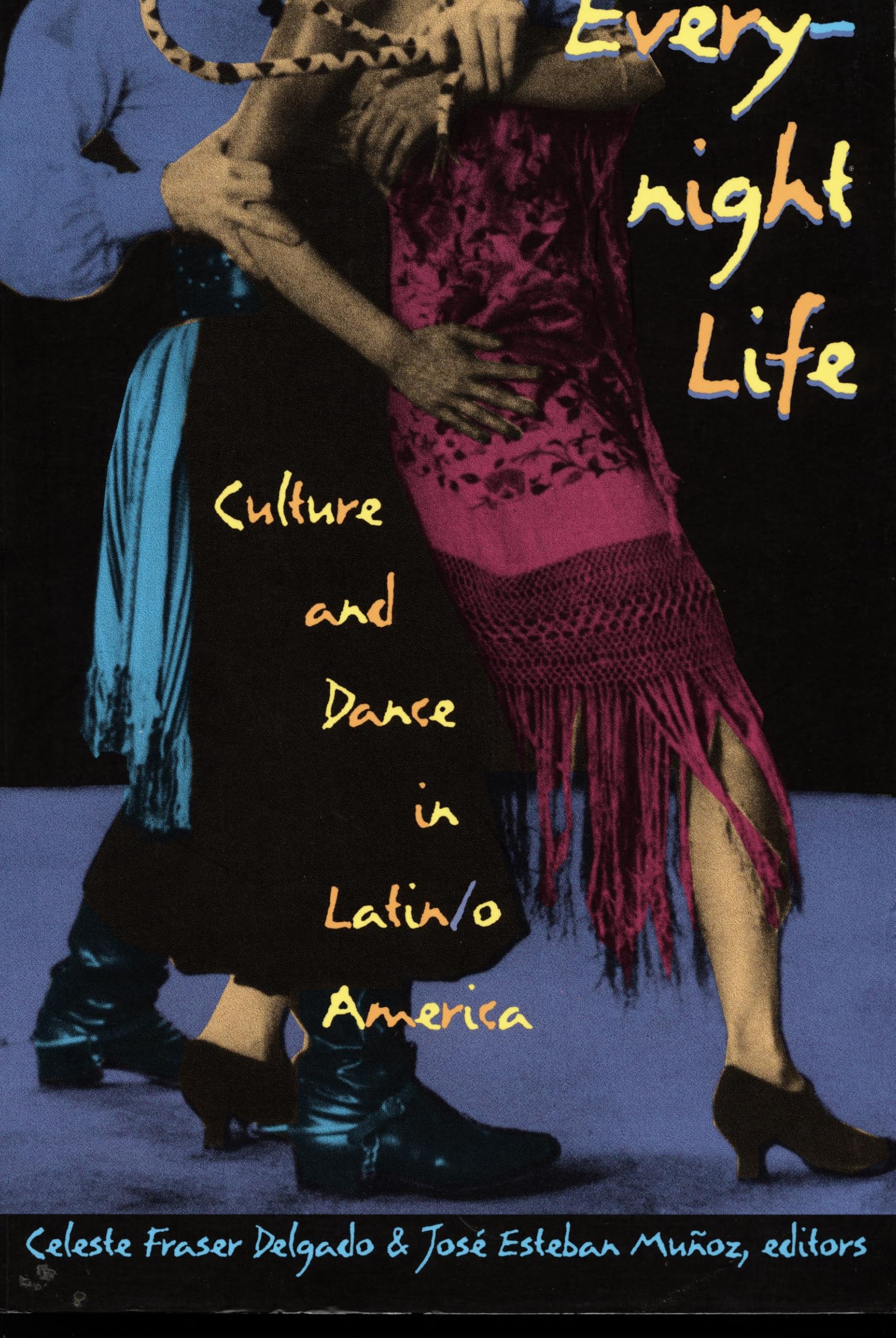
Everynight Life: Culture and Dance in Latin/o America (Latin America Otherwise)
$39.95
by Celeste Fraser Delgado



The function of dance in Latin/o American culture is the focus of the essays collected in Everynight Life . The contributors interpret how Latin/o culture expresses itself through dance, approaching the material from the varying perspectives of literary, cultural, dance, performance, queer, and feminist studies. Viewing dance as privileged sites of identity formation and cultural resistance in Latin/o America, Everynight Life translates the motion of bodies into speech, and the gestures of dance into a provocative socio-political grammar. This anthology looks at many modes of dance—including salsa, merengue, cumbia, rumba, mambo, tango, samba, and norteño—as models for the interplay of cultural memory and regional conflict. Barbara Browning’s essay on capoeira, for instance, demonstrates how dance has been used as a literal form of resistance, while José Piedra explores the meanings conveyed by women of color dancing the rumba. Pieces such as Gustavo Perez Fírmat’s "I Came, I Saw, I Conga’d" and Jorge Salessi’s "Medics, Crooks, and Tango Queens" illustrate the lively scope of this volume’s subject matter. Contributors . Barbara Browning, Celeste Fraser Delgado, Jane C. Desmond, Mayra Santos Febres, Juan Carlos Quintero Herencia, Josh Kun, Ana M. López, José Esteban Muñoz, José Piedra, Gustavo Perez Fírmat, Augusto C. Puleo, David Román, Jorge Salessi, Alberto Sandoval “ Everynight Life is a major contribution to the ongoing investigation of specific cultural practices heretofore ignored by traditional academic investigation. It will be of specific value to scholars and critics studying issues of performance and performativity as they inform practices of subject-formation in its political, cultural, and sexual dimensions.”—Ricardo Ortiz, Dartmouth College “This is an exciting and an important book, just the kind of contribution that many of us have been eager to find. It weaves politics with popular culture, national borders with rhythm. In short it’s up-to-date in terms of intellectual issues, and sensitively down-to-earth in ways that make practical sense.”—Doris Sommer, Harvard University ""Everynight Life" is a major contribution to the ongoing investigation of specific cultural practices heretofore ignored by traditional academic investigation. It will be of specific value to scholars and critics studying issues of performance and performativity as they inform practices of subject-formation in its political, cultural, and sexual dimensions."--Ricardo Ortiz, Dartmouth College Celeste Fraser Delgado is Music Editor at the weekly New Times in Miami. José Esteban Muñoz is Associate Professor of Performance Studies at Tisch School of the Arts, New York University. Everynight Life Culture and Dance in Latin/o America By Celeste Fraser Delgado, José Esteban Muñoz Duke University Press Copyright © 1997 Duke University Press All rights reserved. ISBN: 978-0-8223-1919-1 Contents About the Series, Preface: Politics in Motion, Rebellions of Everynight Life, Embodying Difference: Issues in Dance and Cultural Studies, Headspin: Capoeira's Ironic Inversions, Hip Poetics, Medics, Crooks, and Tango Queens: The National Appropriation of a Gay Tango, Salsa as Translocation, Notes Toward a Reading of Salsa, Una Verdadera Crónica del Norte: Una Noche con la India, I Came, I Saw, I Conga'd: Contexts for a Cuban-American Culture, Caught in the Web: Latinidad, AIDS, and Allegory in Kiss of the Spider Woman, the Musical, Against Easy Listening: Audiotopic Readings and Transnational Soundings, Of Rhythms and Borders, Bibliography, Index, Contributors, CHAPTER 1 Rebellions of Everynight Life Celeste Fraser Delgado and José Esteban Muñoz Tonight, at the Palace of Happiness, Federico presents the Big Dance with Two Orchestras: Noro Morales, the famous Puerto Rican pianist, and Ricardo Rico with his Authentic Dominicans, each playing Merengues, Mambos, Boleros, and Cha cha cha. Leaning out of the window of el Palacio de la Alegría (the Palace of Happiness) in Brooklyn, Federico Pagani—the famous promoter who created the legendary dance hall, the Palladium—exchanges a conspiratorial glance with a tuxedoed man in the street. Looking past tonight's menu of merengue, mambo, bolero, and cha cha cha, Pagani might be inviting his companion to join in the dance. Alternatively, Pagani might be calling his comrade to a meeting of the Puerto Rican Voter's Association, whose members gathered in the dance hall when the orchestras were silent. On the back of this photograph someone has written: "this is the place where the Hérnandez brothers held their dances and their political meetings." Associated with the Merchant Marines and the National Maritime Union, the Hérnandez brothers were active in the political struggles of the growing Puerto Rican community in New York in the 1940s and 1950s. The periodic transformation of the Palace of Happiness into a Puerto Rican voters' forum suggests