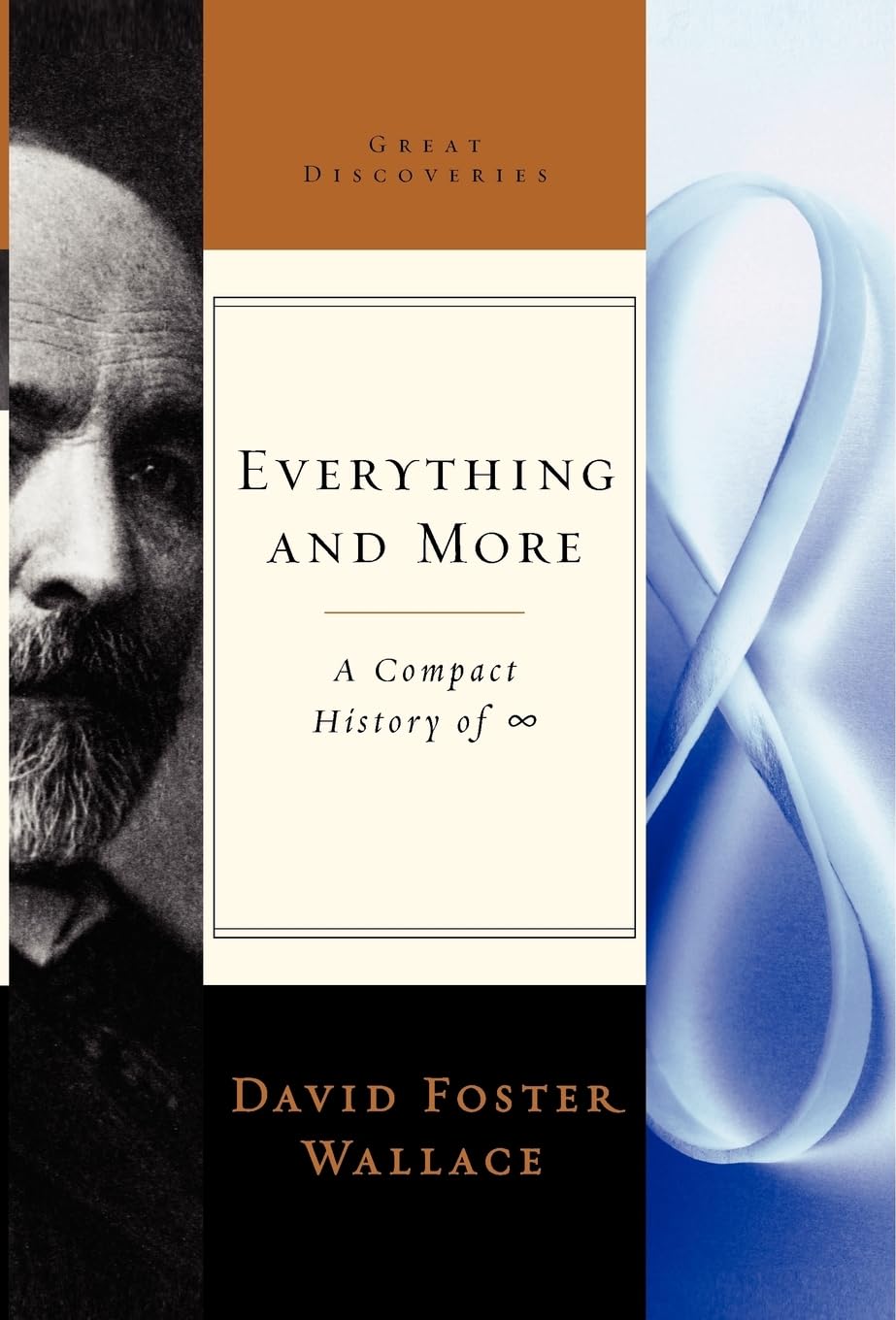
Everything and More: A Compact History of Infinity (Great Discoveries (Hardcover))
$17.00
by David Foster Wallace



The best-selling author of Infinite Jest on the two-thousand-year-old quest to understand infinity. One of the outstanding voices of his generation, David Foster Wallace has won a large and devoted following for the intellectual ambition and bravura style of his fiction and essays. Now he brings his considerable talents to the history of one of math's most enduring puzzles: the seemingly paradoxical nature of infinity. Is infinity a valid mathematical property or a meaningless abstraction? The nineteenth-century mathematical genius Georg Cantor's answer to this question not only surprised him but also shook the very foundations upon which math had been built. Cantor's counterintuitive discovery of a progression of larger and larger infinities created controversy in his time and may have hastened his mental breakdown, but it also helped lead to the development of set theory, analytic philosophy, and even computer technology. Smart, challenging, and thoroughly rewarding, Wallace's tour de force brings immediate and high-profile recognition to the bizarre and fascinating world of higher mathematics. Before discussing the merits of David Foster Wallace's Everything and More: A Compact History of Infinity , it is essential to define what the book is not . This volume in the "Great Discoveries" series is not a history of the personalities and social conditions that led to the "discovery" of infinity. Nor is it a narrative fixated on the cultish fear of--and obsession with--the infinite that has seemingly driven mathematicians insane over the centuries. Rather, Everything and More is a surprisingly rigorous march through the 2000 plus years of mathematical research that began with Aristotle; continued through Galileo, Isaac Newton, G.W. Leibniz, Karl Weierstrass, and J.W.R. Dedekind; and culminated in Georg Cantor and his Set Theory. The task Wallace (author of the bestseller Infinite Jest and other fiction) has set himself is enormously challenging: without radically compromising the complexity of the philosophy, metaphysics, or mathematics that underlies the evolving concept of infinity, present the material to a lay audience in a manner that is entertaining. To propel his narrative, Wallace even develops a style that mirrors the mathematical language he probes. One difficulty in his focus on concepts and not a strict human chronology, though, is that his structure is dependent on frequent digressions (especially early on). Patience is required. Wallace demands that his reader walk through the equations, study the graphs and charts, and relearn college-level concepts to follow along on the exploration. Indeed, after one wrenching dip into Zenos paradoxes, Wallace spouts at his imagined complaining audience: "Deal." But the book should be deemed a success. If one grants him the attention he requires, Wallace has made the trip richly rewarding. --Patrick OKelley *Starred Review* In his previous books-- Infinite Jest (1996), A Supposedly Fun Thing I'll Never Do Again (1997)--Wallace has displayed dazzling intellect, keen wit, and a fondness for footnotes. But not even his biggest fans could have suspected that Wallace could write a clever, extensively footnoted, and shockingly readable introduction to the philosophical, historical, and mathematical significance of the concept of infinity. He begins with ancient understandings of infinity, paying special attention to Xeno and Aristotle, the latter of whom he describes as being "sort of grandly and breathtakingly wrong, always and everywhere, when it comes to infinity." As the story culminates in Georg Cantor's worldview-shattering breakthroughs, the math becomes devilishly abstract, but Wallace's colloquial style makes it a relatively easy transition from the simple abstraction of numbers (i.e., that five represents something more than five apples or five oranges) into the mind-bending abstractions of transfinite numbers. Though readers with some college math will certainly find this less intimidating, the prose is so engaging, and the underlying metaphysical arguments so fascinating, that even this reviewer (who gave up on math entirely after a C-minus in pre-calc) got lost only a few times. A brilliant antidote both to boring math textbooks and to pop-culture math books that emphasize the discoverer over the discovery. John Green Copyright © American Library Association. All rights reserved "A gripping guide to the modern taming of the infinite." ― New York Times Book Review "[Wallace] brings to his task a refreshingly conversational style as well as a surprisingly authoritative command of mathematics....A success." ― John Allen Paulos, The American Scholar "Shockingly readable....A brilliant antidote both to boring math textbooks and to pop-culture math books that emphasize the discoverer over the discovery." ― Booklist David Foster Wallace (1962―2008) is the author of Infinite Jest , Girl with Curious Hair , Everything and Mo