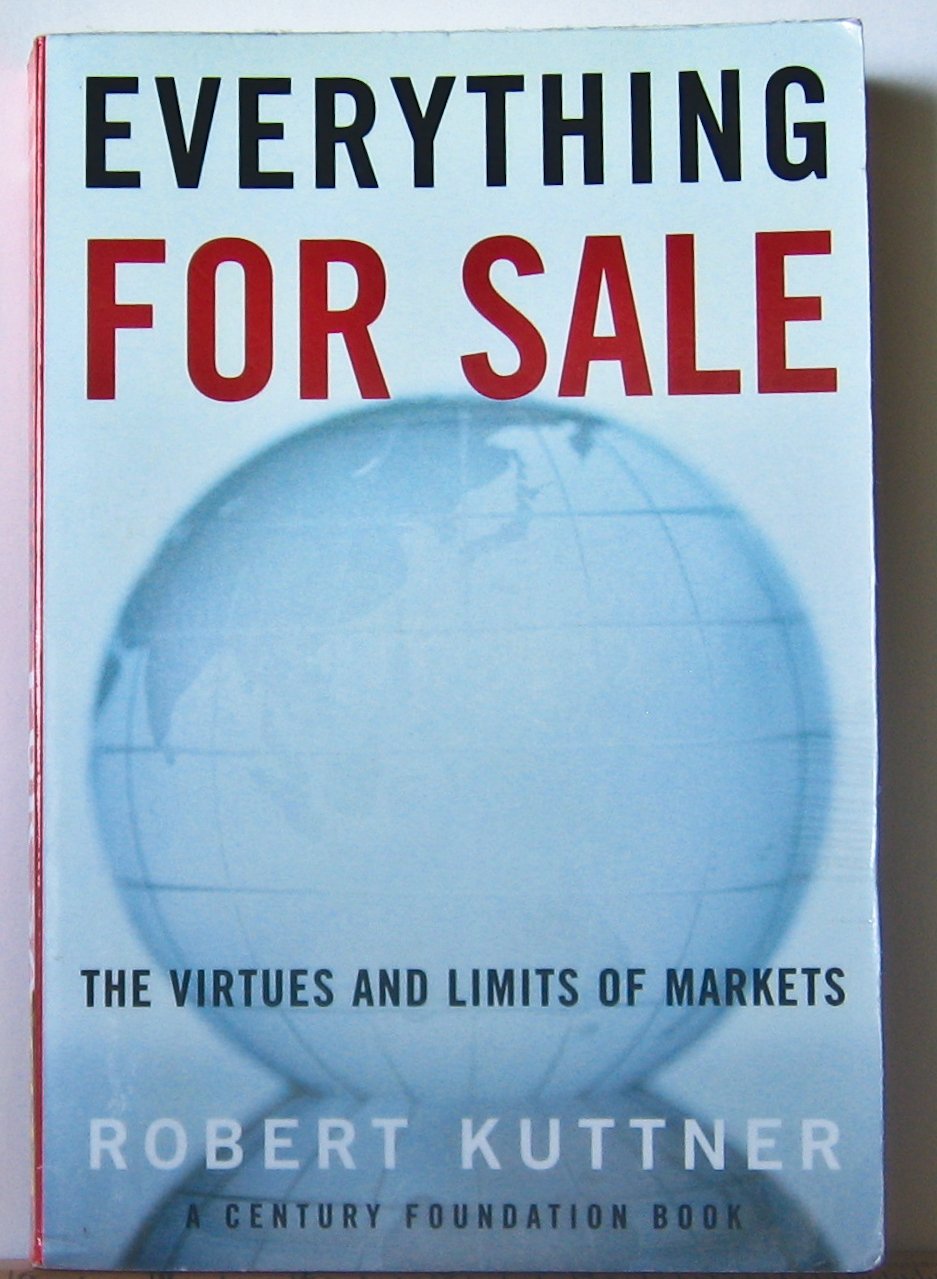



Zeroing in on such realms as health care and the workplace, the commercialization of sports and the arts, the chaotic deregulation of airlines, S&Ls, and telecommunications, and the buying and selling of public offices, Kuttner shows how markets can fail precisely those whom they are supposed to serve. Asking the crucial question, "What should not be for sale?", Kuttner shows why a society conceived as a grand auction block would not be a democracy worth having. 416 pp. Author tour. 25,000 print. Everything For Sale is an erudite reprieve from the deluge of books written in praise of free markets. Robert Kuttner fires back with a book that documents relevant, real-world examples of market failure and makes the case for intelligent intervention to attain more desirable outcomes. His exhaustive litany of successful (some, even cherished) government interventions in the market--from National Public Radio to the Internet--creates a persuasive case for a mixed program of political and market-based approaches in the shaping of public policy. When Kuttner pushes his argument for a culture with less commercial emphasis, his preferences exhibit an anti-market bias. But overall, his argument is clear and compelling, exposing blind adherence to market outcomes as largely arbitrary, ideological, and often, an affront to democracy. Academic economists who ignore the political desires of the people in order to protect the purity of their mathematical models draw Kuttner's fire in particular. He writes about ideas and economic details with great verve and ability. Kuttner's book is certain to be a touchstone of debate, if not reform, among public policy makers. In this thorough, scholarly approach to current economics relative to the political scene, journalist Kuttner (End of Laissez-Faire, LJ 2/15/91), who writes columns for BusinessWeek and the Washington Post, examines in great detail the free-market economy. The free market he intends is that envisioned by libertarian thought, with less government intervention and deregulation. Kuttner offers comparisons with the mixed economy of previous decades back to the Roosevelt era. He demonstrates how government regulation, intervention, and other actions have affected the economy in the past and how they still do. The serious student of economic history and policy will glean from his work many thought-provoking and controversial ideas that reveal how the free market has changed in the areas of labor, healthcare, sports, and business practices, to name a few. Kuttner's research has produced a well-written tome that certainly has a place on the shelves of academic and large public libraries.?Steven J. Mayover, Free Lib. of Philadelphia Copyright 1997 Reed Business Information, Inc. An exhaustive but tendentious critique of market economics from the liberal commentator who first addressed this issue in The End of Laissez-Faire (1991). In his three-part audit, Business Week columnist Kuttner first provides an overview that effectively damns markets with faint praise. For instance, while commending their role in facilitating commerce, setting prices for goods and services, and allocating resources, he cites a lengthy list of instances in which markets fail to measure up. By way of example, the author notes that there is no good market reason for free public libraries, which most polities rightly value. Sniping away at utopian ideologues who view the market as a panacea for whatever ails society, Kuttner reviews the putative shortcomings of labor, health-care, and capital markets, arguing that intervention is required to avert the sometimes calamitous or undesirable results of overly free enterprise. He does not face up to such unpleasant matters as the fact that the burden of government-mandated benefits has stalled job growth in the European Union, whose mixed economy he much admires. In like vein, the author offers kind words for Japan's bureaucratically guided approach to capitalism without dwelling on that nation's consumers, who are obliged to pay artificially high prices at retail as a result of the system. By contrast, Kuttner includes a wealth of scenarios spelling out ways in which prosperity might be advanced by riding closer herd on competition in any number of private-sector industries (airlines, electric utilities, telecommunications, et al.), giving federal regulatory agencies appreciably greater powers, and implementing economic/trade policies that could enhance the common weal. A ``yes . . . but'' analysis that accentuates the negative aspects of laissez-faire and promotes a decidedly progressive political/socioeconomic agenda. The text has a notably belligerent foreword by Richard C . Leone, president of the Twentieth Century Fund (which sponsored Kuttner's book). (Author tour) -- Copyright ©1996, Kirkus Associates, LP. All rights reserved. If you're ever challenged to name "just one thing" the United States Government has ever done right, you'll be fully prepa