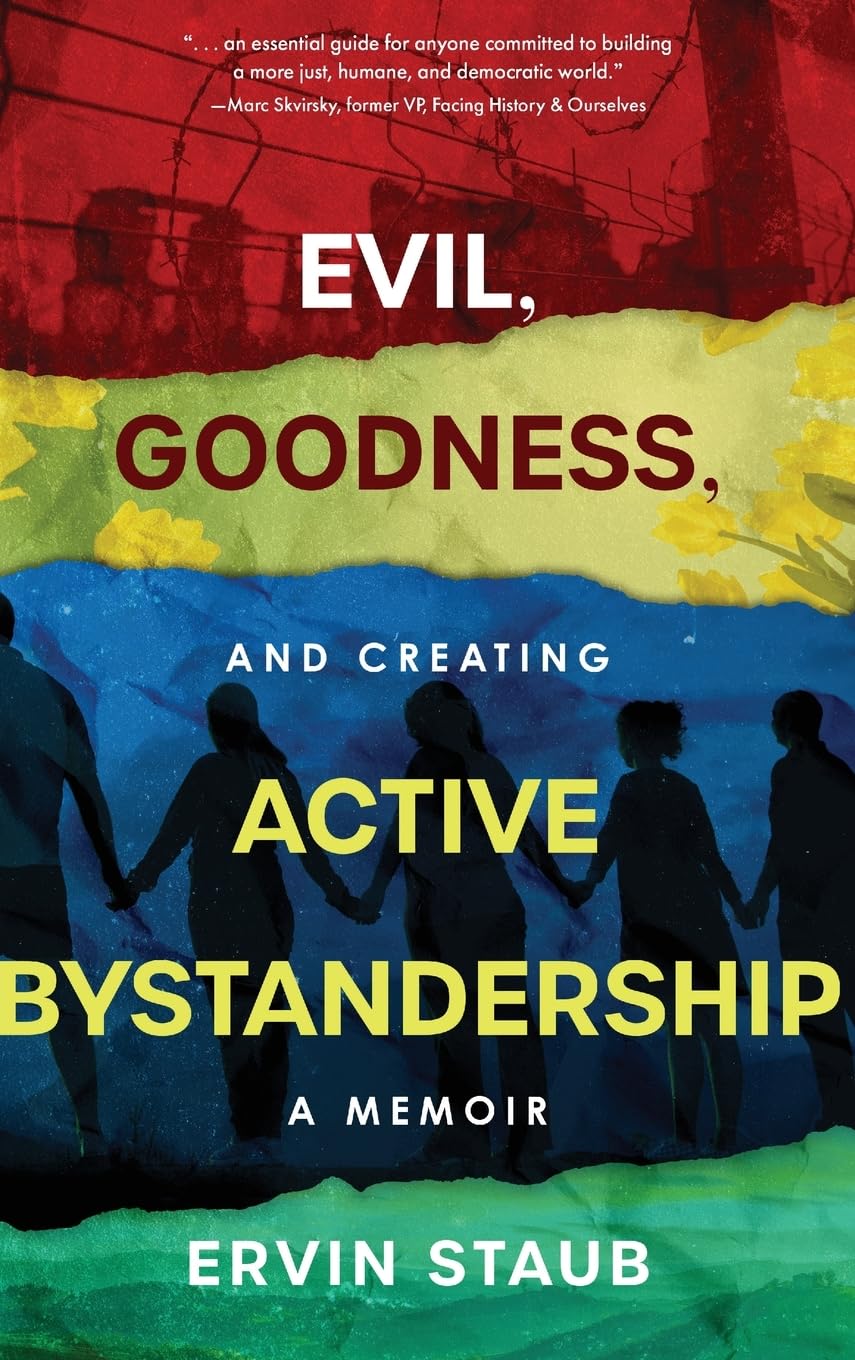



"Staub's message is both powerful and timely." - Publishers Weekly “A measured blend of memoir and scholarship with urgent contemporary relevance.” — Kirkus Reviews Evil, Goodness, and Creating Active Bystandership shares the remarkable journey of Ervin Staub, a scholar and actor in the world whose early life was shaped by surviving the Holocaust in Hungary and growing up under communism. After escaping Hungary and immigrating to the US, he received a PhD from Stanford, going on to teach at Harvard, Stanford, and the University of Massachusetts. Pursuing a lifelong commitment to prevent evil and promote goodness, Staub studied the roots of caring, helping, and mass violence and worked to move children and adults to care for others and be "active bystanders" who respond to the need for help. He has promoted reconciliation in Rwanda after a genocide; peace between ethnic and Muslim Dutch in Amsterdam; police officers training to prevent unnecessary violence by fellow officers; and more. Through concrete stories and real-life experiences, Evil, Goodness, and Creating Active Bystandership offers practical ways to create a more peaceful, harmonious, and connected world, even in our turbulent times. "Staub's message is both powerful and timely, and he sagely observes that the focus on 'human rights and individual rights and work toward equality' is waning in contemporary America. His answer starts with turning inward to analyze our values, before reaching out to 'people on the other side' for conversation, connection, and to 'discuss roots of division and hostility.' Only then, he urges, can change truly occur." -Publishers Weekly "A measured blend of memoir and scholarship with urgent contemporary relevance." -Kirkus Reviews "...thoughtful, deeply human work that feels both timely and timeless, Staub reminds us that the choice to act - especially when it's difficult - may be the most powerful force we have to shape a more humane world." -BookTrib "Ervin Staub's memoir is a rare and invaluable contribution-a seamless integration of personal history, rigorous scholarship, and deeply impactful fieldwork. Evil, Goodness, and Creating Active Bystandership illuminates the development of his influential ideas about empathy, moral agency, and the prevention of violence, and shows how those ideas have been put into practice in classrooms, NGOs, police departments, and divided societies around the world. It is an essential guide for anyone committed to building a more just, humane, and democratic world." -Marc Skvirsky, vice president and chief program officer emeritus at Facing History and Ourselves; faculty member, Institute for Nonprofit Practice "Ervin Staub's life is a testament to the power of moral courage. In this memoir, he shows how a child who survived genocide grew into a scholar and humanitarian who taught thousands of us-officers, teachers, lawyers, and community members alike-what it means to step in, speak up, and protect one another. Ervin doesn't just study active bystandership; he lives it. This book is a gift to anyone who believes that policing, and society itself, can be better when good people choose to act." -Michael S. Harrison, superintendent, New Orleans Police Department (ret.); commissioner, Baltimore Police Department (ret.) "Ervin stands in the lineage of Elie Wiesel, a survivor who turned memory into moral responsibility. In a world where indifference and hate are again on the rise, we need his lessons now more than ever. This book is a playbook for courage, showing how ordinary people can become brave leaders who step in, speak out, and push back against hate." -Mitch Tuchman, managing director and chief investment officer, Rebalance Wealth Management and advisory board member, Borns Jewish Studies, Indiana University Ervin Staub, PhD, survived the Holocaust as a young child and at eighteen escaped from communist Hungary, then received a PhD at Stanford and taught at Harvard, the University of Massachusetts, and Stanford. He has published six books, including The Roots of Evil: The Origins of Genocide and Other Group Violence and The Roots of Goodness and Resistance to Evil, and edited/coedited four more. He has also published many articles and book chapters and written blogs for Huffington Post, Psychology Today, and Oxford, appeared on TV and radio, and his work has been widely reviewed in the media.