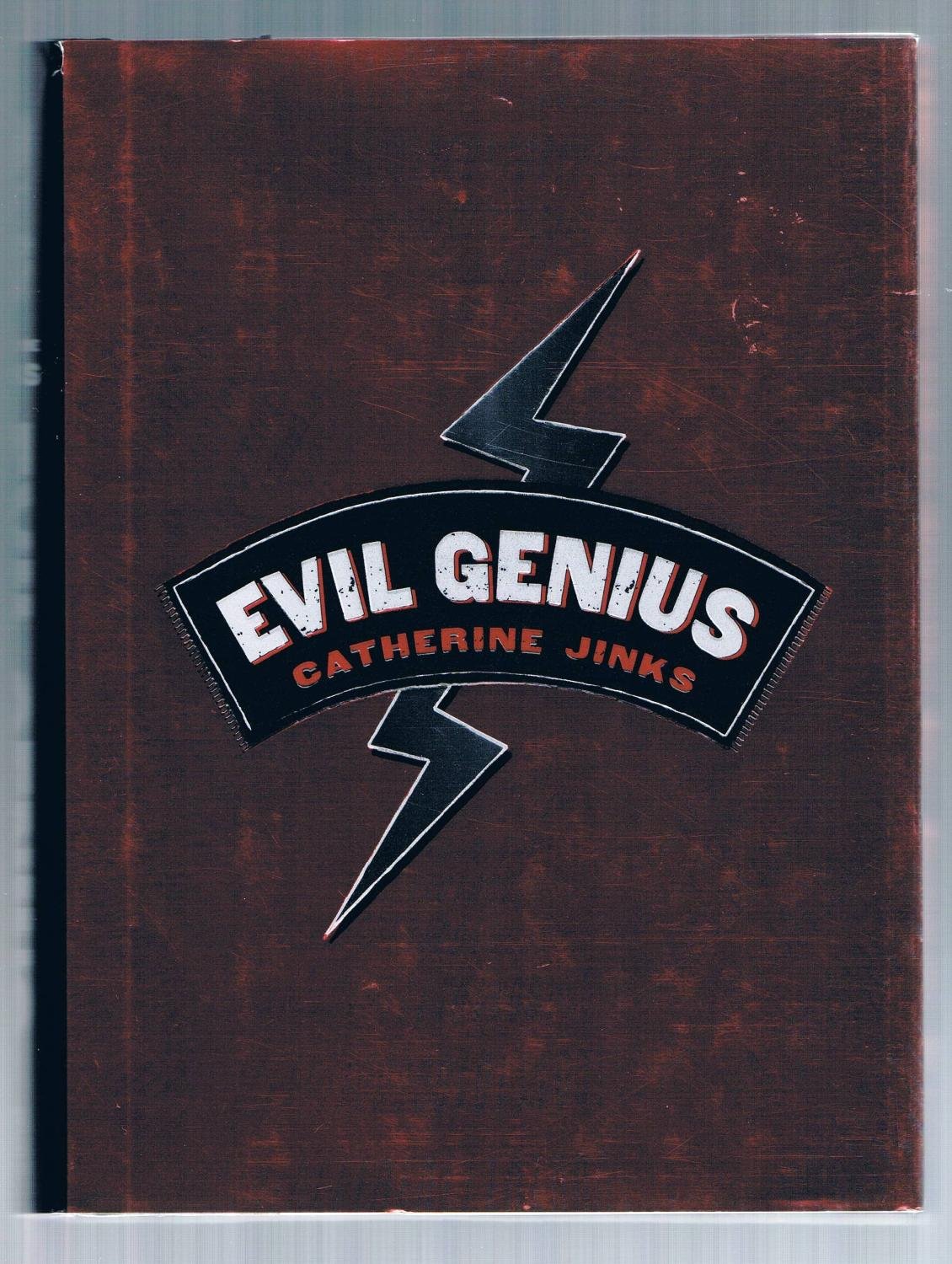



Cadel Piggott has a genius IQ and a fascination with systems of all kinds. At seven, he was illegally hacking into computers. Now he’s fourteen and studying for his World Domination degree, taking classes like embezzlement, forgery, and infiltration at the institute founded by criminal mastermind Dr. Phineas Darkkon. Although Cadel may be advanced beyond his years, at heart he’s a lonely kid. When he falls for the mysterious and brilliant Kay-Lee, he begins to question the moral implications of his studies. But is it too late to stop Dr. Darkkon from carrying out his evil plot? An engrossing thriller with darkness and humor, freaks and geeks, Evil Genius explores the fine line between good and evil in a strange world of manipulations and subterfuge where nothing is as it seems. *Starred Review* Is it possible to cultivate readers' affection for a character who has been trained from his tenderest years to dismiss evil as a "loaded word"? Australian writer Jinks, author of the Crusades-era Pagan series, successfully meets the challenge in this very different novel. She devises gradations of wrongdoing so steep that her antihero's adversaries leave him (almost) smelling like a rose. At age seven, child prodigy Cadel Piggott lands in a shrink's office for illegal computer hacking, where psychologist Thaddeus Roth delivers startling counsel: "Next time, don't get caught." Thaddeus is an agent of Cadel's real father, a brilliant crook who, from behind bars, manages to place Cadel at the secretive Axis Institute for World Domination. By 13, Cadel is earnestly studying "Infiltration, Misinformation, and Embezzlement," but as he increasingly relies on an outside friendship, he privately plots to extricate himself from the paterfamilias.Comic-book fans will enjoy the school's aspiring villains (including one who floors foes with deadly B.O.), but this is more than a campy set-piece. Cadel's turnabout is convincingly hampered by his difficulty recognizing appropriate outlets for rage, and Jinks' whiplash-inducing suspense writing will gratify fans of Anthony Horowitz's high-tech spy scenarios. Although some of the technical concerns of evil geniuses (firewalls, tax shelters, nanotechnology) may stymie less-patient readers, most will press on, riveted by the chilling aspects of a child trapped in adult agendas that, iceberglike, hide beneath the surface. Mattson, Jennifer Copyright © American Library Association. All rights reserved CATHERINE JINKS is a three-time winner of the Children's Book Council of Australia Book of the Year award and was honored with a Centenary Medal for her contribution to Australian children's literature. She lives in Leura, Australia. One Cadel Piggott was just seven years old when he first met Thaddeus Roth. Dr. Roth worked in a row house near Sydney Harbor. The house was three stories high, its garden shrouded by a great many damp, dark trees. There was moss growing on its sandstone window ledges. Curtains drawn across all its windows gave it a secretive air. Its front fence was made of iron, with a spike on top of each post; beside the creaking gate was a brass sign bearing Dr. Roth’s name and qualifications. “That’s it,” said Mrs. Piggott. “Number twenty-nine.” “Well, we can’t stop here,” her husband replied. “No parking.” “I told you to park back there.” “It doesn’t matter. We’ll try down this street.” “Stuart, that’s a one-way street.” “Dammit!” “I knew we’d never find a space. Not around this area.” “Just shut up for a minute, will you?” Mr. and Mrs. Piggott were not Cadel’s real parents. They had adopted him when he was not quite two years old. Mrs. Piggott was thin and blond, Mr. Piggott fat and gray. They almost never agreed about anything, but that didn’t matter because they almost never met. Their busy schedules kept them away from home, and one another, a good deal of the time. At the suggestion of the police, however, they had both agreed to attend this interview. “We’re going to be late,” Mrs. Piggott warned her husband after they had circled the block four times in Mr. Piggott’s big, gleaming Mercedes Benz. “Just let us out, for god’s sake.” “I’ll park here.” “Stuart, you’ll never fit in there!” “Watch me.” Cadel said nothing. He sat on the backseat, dressed in his good brown cords and a lamb’s-wool sweater, staring out the window at Dr. Roth’s house. He didn’t like the look of it. He thought it had a murky, ominous appearance. “I don’t want to go,” he said flatly when Mrs. Piggott got out and opened the door beside him. “I know, honey, but we have to.” “No we don’t,” Cadel retorted. “Yes we do.” “There were no formal charges,” Cadel pointed out, in his high, clear voice. “It was just a suggestion.” “That’s right,” said Mr. Piggott, yanking Cadel out of the back of the car. “And when the police make a suggestion, you always follow it. Rule number one.” “Be careful, Stuart, you’ll wreck his clothes.” Cadel was so small—even for a seven-year-old—that he didn’t stand a