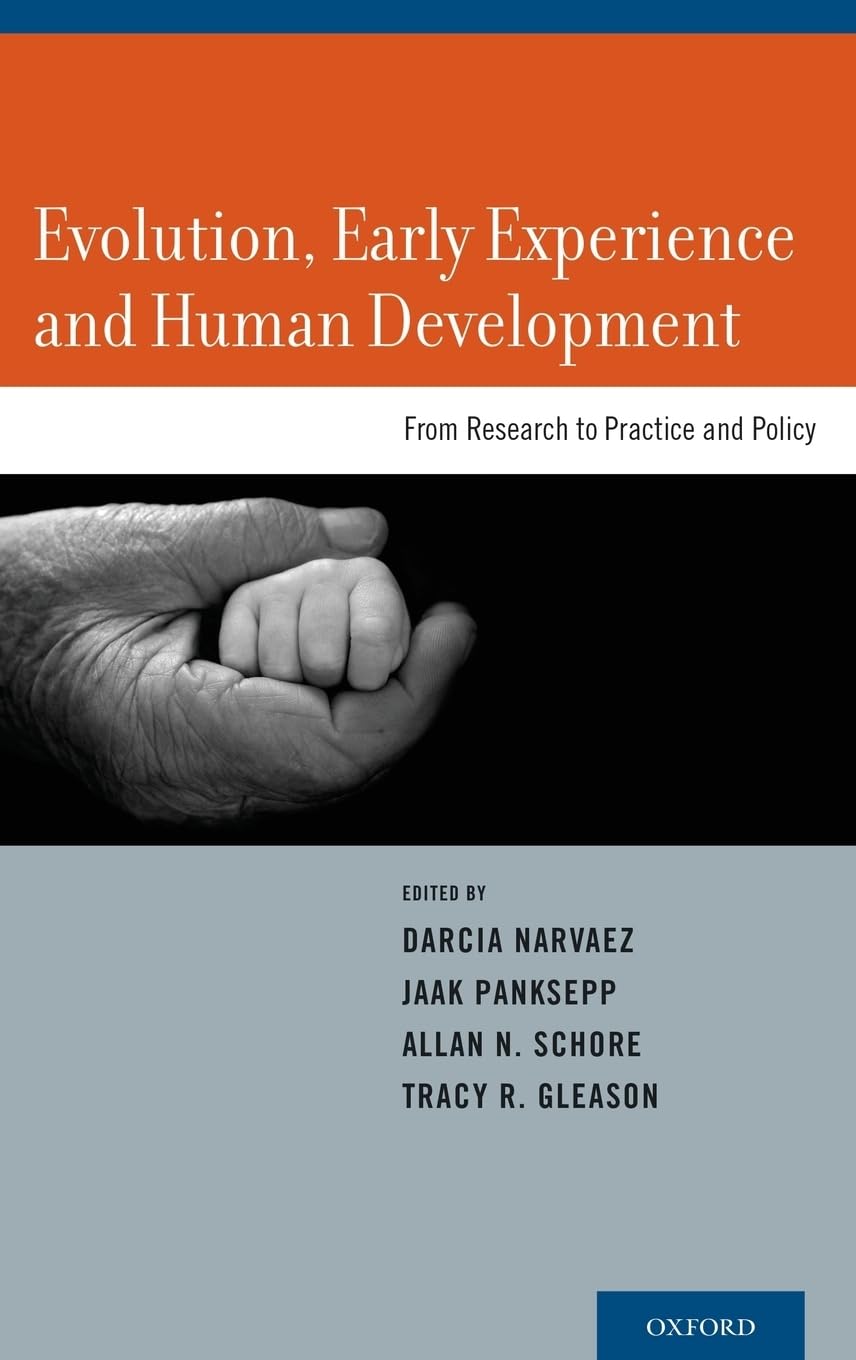
Evolution, Early Experience and Human Development: From Research to Practice and Policy
$77.34
by Darcia Narvaez Ph.D



The field of cognitive psychology has expanded rapidly in recent years, with experts in affective and cognitive neuroscience revealing more about mammalian brain function than ever before. In contrast, psychological problems such as ADHD, autism, anxiety, and depression are on the rise, as are medical conditions such as diabetes, obesity, and autoimmune disorders. Why, in this era of unprecedented scientific self-knowledge, does there seem to be so much uncertainty about what human beings need for optimal development? Evolution, Early Experience and Human Development asserts that human development is being misshaped by government policies, social practices, and public beliefs that fail to consider basic human needs. In this pioneering volume, scientists from a range of disciplines theorize that the increase in conditions such as depression and obesity can be partially attributed to a disparity between the environments and conditions under which our mammalian brains currently develop and our evolutionary heritage. For example, healthy brain and emotional development depends to a significant extent upon caregiver availability and quality of care. These include practices such as breastfeeding, co-sleeping, and parental social support, which have waned in modern society, but nevertheless may be integral to healthy development. As the authors argue, without a more informed appreciation of the ideal conditions under which human brains/minds develop and function, human beings will continue to struggle with suboptimal mental and physical health, and as problems emerge psychological treatments alone will not be effective. The best approach is to recognize these needs at the outset so as to optimize child development. Evolution, Early Experience and Human Development puts forth a logical, empirically based argument regarding human mammalian needs for optimal development, based on research from anthropology, neurobiology, animal science, and human development. The result is a unique exploration of evolutionary approaches to human behavior that will support the advancement of new policies, new attitudes towards health, and alterations in childcare practices that will better promote healthy human development. "This is a must-read for any neuroscientist, psychoanalyst, social science researcher, mental health practitioner, and educator. Ongoing dialogue through commentary and intense debate organize this volume with contributions from internationally known experts. We must integrate these findings as we struggle for answers regarding human dysfunction through psychological symptoms, violence in our communities, and the cyclical nature of human destructiveness. Many answers with clear direction toward realistic solutions are found in this long-overdue and compelling book." -- Mark D. Smaller, Ph.D., President-elect, American Psychoanalytic Association and Executive Director (emeritus), The Neuropsychoanalysis Foundation "Bringing together a diverse collection of some of the greatest experts on early development and social behavior, this carefully edited volume presents an exciting new paradigm. The interplay between nature and nurture, our evolved attachment system, and affective neuroscience are brought together to erect a framework that does justice to the caring side of our species." -- Frans de Waal, Ph.D., C.H. Chandler Professor and Director of the Living Links Center at the Yerkes Primate Center, Emory University, and author of The Age of Empathy "This is an exciting, thought-provoking, and intellectually stimulating collection of chapters by an interdisciplinary group of outstanding scholars. They tackle fundamental issues in human nature, such as the role of early experience and early parent-child bonds, the interweaving of biology, relationship, and culture, and evolutionary influences on adaptive and maladaptive development." -- Grazyna Kochanska, Dewey B. and Velma P. Stuit Professor of Developmental Psychology, University of Iowa "This volume offers a useful counterpoint to the fields' current enthusiasm for research and theory focused on resilience and the idea that all common patterns of behavior must be adaptive. The editors present the case for early adversity as the impetus for maladaptation, current child care arrangements as placing children at risk because they deviate markedly from our environment of evolutionary adaptedness, and the implications of this argument for child policies and practices. This volume is likely to spur debate." -- Megan R. Gunnar, Regents Professor, Director, Institute of Child Development, University of Minnesota "In spite of increasing evidence that our children are in peril, U.S. social and educational policies do not reflect core findings from decades of research on how to build healthy children. As the data mounts on the rates of school failure, developmental challenges, drug abuse, domestic violence, and incarceration, ignoring this information is akin