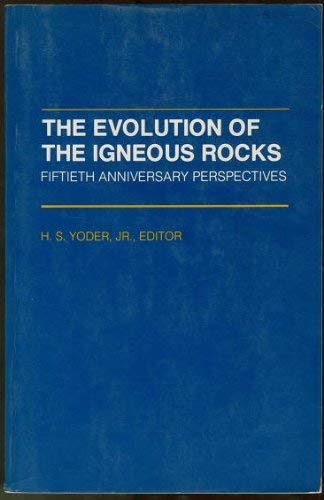
Evolution of the Igneous Rocks: Fiftieth Anniversary Perspectives (Princeton Legacy Library)
$24.50
by H. S. Yoder Jr



The Evolution of the Igneous Rocks , by N. L. Bowen, appeared in 1928 and had a profound influence on later generations of petrologists. Drawing on his series of lectures at Princeton University in the spring of 1927, Dr. Bowen identified, outlined, and applied the principles of physical chemistry relevant to petrological processes. Whereas the major petrochemical questions he discussed are still relevant today, the answers appear to change with time. The purpose of the present volume is to provide an updated view of those questions, in the light of almost fifty years of accumulated observations, using the principles Bowen set forth. Originally published in 1979. The Princeton Legacy Library uses the latest print-on-demand technology to again make available previously out-of-print books from the distinguished backlist of Princeton University Press. These editions preserve the original texts of these important books while presenting them in durable paperback and hardcover editions. The goal of the Princeton Legacy Library is to vastly increase access to the rich scholarly heritage found in the thousands of books published by Princeton University Press since its founding in 1905. The Evolution of the Igneous Rocks Fiftieth Anniversary Perspectives By Hatten Schuyler Yoder Jr. PRINCETON UNIVERSITY PRESS Copyright © 1979 Princeton University Press All rights reserved. ISBN: 978-0-691-08224-0 Contents Preface, Chapter 1 THE PROBLEM OF THE DIVERSITY OF IGNEOUS ROCKS by G. Malcolm Brown, 3, Chapter 2 SILICATE LIQUID IMMISCIBILITY IN MAGMAS by Edwin Roedder, 15, Chapter 3 FRACTIONAL CRYSTALLIZATION AND PARTIAL FUSION by D. C. Presnall, 59, Chapter 4 CRYSTALLIZATION IN SILICATE SYSTEMS by Arnulf Muan, 77, Chapter 5 THE REACTION PRINCIPLE by E. F. Osborn, 133, Chapter 6 FRACTIONAL CRYSTALLIZATION OF BASALTIC MAGMA by Ikuo Kushiro, 171, Chapter 7 THE LIQUID LINE OF DESCENT AND VARIATION DIAGRAMS by Ray E. Wilcox, 205, Chapter 8 GLASS AND THE GLASSY ROCKS by I. S. E. Carmichael, 233, Chapter 9 ROCKS WHOSE COMPOSITION IS DETERMINED BY CRYSTAL ACCUMULATION AND SORTING by T. N. Irvine, 245, Chapter 10 EFFECTS OF ASSIMILATION by A. R. McBirney, 307, Chapter 11 THE FORMATION OF SILICEOUS POTASSIC GLASSY ROCKS by David B. Stewart, 339, Chapter 12 THE FELDSPATHOIDAL ALKALINE ROCKS by J. Gittins, 351, Chapter 13 MELILITE-BEARING ROCKS AND RELATED LAMPROPHYRES by H. S. Yoder, Jr., 391, Chapter 14 THE FRACTIONAL RESORPTION OF COMPLEX MINERALS AND THE FORMATION OF STRONGLY FEMIC ALKALINE ROCKS by David R. Wones, 413, Chapter 15 FURTHER EFFECTS OF FRACTIONAL RESORPTION by E. D. Jackson, 423, Chapter 16 THE IMPORTANCE OF VOLATILE CONSTITUENTS by C. Wayne Burnham, 439, Chapter 17 PETROGENESIS AND THE PHYSICS OF THE EARTH by P. J. Wyllie, 483, Chapter 18 PARTITIONING BY DISCRIMINANT ANALYSIS: A MEASURE OF CONSISTENCY IN THE NOMENCLATURE AND CLASSIFICATION OF VOLCANIC ROCKS by F. Chayes, 521, Author Index, 533, Subject Index, 544, Systems Index, 586, CHAPTER 1 THE PROBLEM OF THE DIVERSITY OF IGNEOUS ROCKS G. MALCOLM BROWN Department of Geological Sciences, University of Durham, Durham, England The science of igneous petrogenesis is a study of the origin and evolution of rocks that have formed through the generation of magmas by melting processes, and the cooling of those magmas from a liquid, or liquid and crystalline state, into a glassy to crystalline state. Field and textural observations do not constitute sufficient evidence for defining a rock as igneous in origin (Barth, 1962, p. 51) but when allied with experimental studies on silicate melts similar in composition to the rock in question, the origin of the rock can be verified. Experimental studies, primarily by N. L. Bowen, formed the only firm basis from which the science of igneous petrogenesis could develop. If there were no diversity of igneous rocks, there would be no science of igneous petrogenesis. Large-volume flows of apparently homogeneous basalt are problematical, but only when viewed in relation to the more common type of diverse flow. The "problem" of the diversity of igneous rocks is more a matter of "problems" that will not be solved until all the complex processes of igneous petrogenesis have been understood. Bowen was as aware of that, in 1928, as one is now, and selected the topic of diversity for the opening chapter of his book. He stressed the importance of igneous rock associations and the need to explain differences in mineral assemblages and rock compositions, both between and within those associations, according to definite physicochemical processes. One should first consider, briefly, what type of diversity led Bowen to make the investigations that were described in the rest of his book, and then view the subject in the light of contemporary knowledge. Bowen endorsed the concept of "petrographic provinces" (Judd, 1886), but pointed to the importance of time as well as place in such groupings a