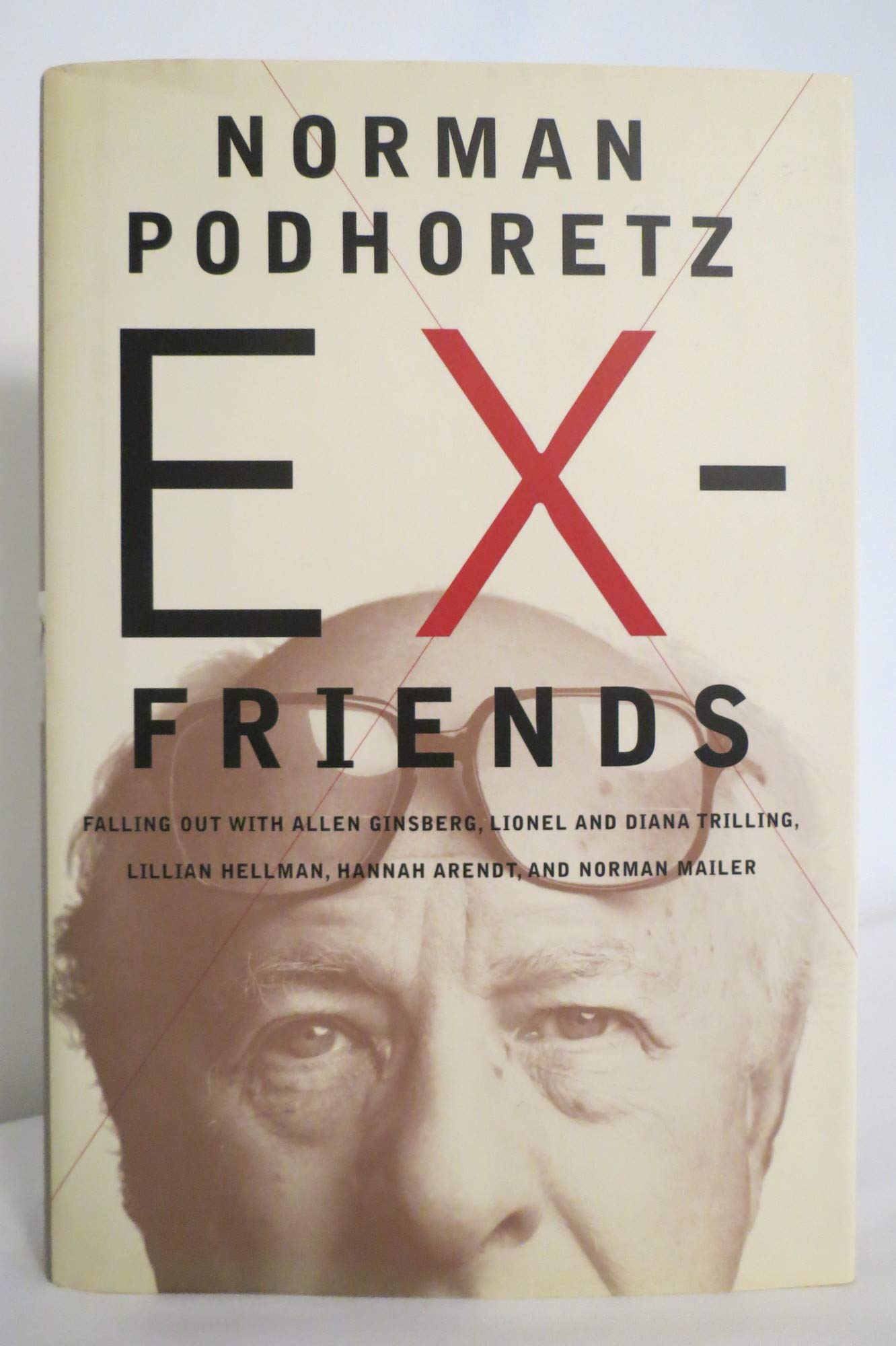
Ex-Friends: Falling Out with Allen Ginsberg, Lionel and Diana Trilling, Lillian Hellman, Hannah Arendt and Norman Mailer
$18.93
by Norman Podhoretz



Allen Ginsberg, Lionel and Diana Trilling, Lillian Hellman, Hannah Arendt, and Norman Mailer -- all are ex-friends of Norman Podhoretz, the renowned editor and critic and leading member of the group of New York intellectuals who came to be known as "the Family." As only a family member could, Podhoretz tells the story of these friendships, once central to his life, and shows how the political and cultural struggles of the past fifty years made them impossible to sustain. With wit, piercing insight, and startling honesty, we are introduced as never before to a type of person for whom ideas were often matters of life and death, and whose passing from the scene has left so large a gap in American culture. Podhoretz was the trailblazer of the now-famous journey of a number of his fellow intellectuals from radicalism to conservatism -- a journey through which they came to exercise both cultural and political influence far beyond their number. With this fascinating account of his once happy and finally troubled relations with these cultural icons, Podhoretz helps us understand why that journey was undertaken and just how consequential it became. In the process we get a brilliantly illuminating picture of the writers and intellectuals who have done so much to shape our world. Combining a personal memoir with literary, social, and political history, this unique gallery of stern and affectionate portraits is as entertaining as a novel and at the same time more instructive about postwar American culture than a formal scholarly study. Interwoven with these tales of some of the most quixotic and scintillating of contemporary American thinkers are themes that are introduced, developed, and redeveloped in a variety of contexts, with each appearance enriching the others, like a fugue in music. It is all here: the perversity of brilliance; the misuse of the mind; the benightedness of people usually considered especially enlightened; their human foibles and olympian detachment; the rigors to be endured and the prizes to be won and the prices to be paid for the reflective life. Most people live their lives in a very different way, and at one point, in a defiantly provocative defense of the indifference shown to the things by which intellectuals are obsessed, Norman Podhoretz says that Socrates' assertion that the unexamined life was not worth living was one of the biggest lies ever propagated by a philosopher. And yet, one comes away from Ex-Friends feeling wistful for a day when ideas really mattered and when there were people around who cared more deeply about them than about anything else. Reading of a time when the finest minds of a generation regularly gathered in New York living rooms to debate one another with an articulateness, a passion, and a level of erudition almost extinct, we come to realize how enviable it can be to live a life as poignantly and purposefully examined as Norman Podhoretz's is in Ex-Friends. "If you like gossip, you'll adore Ex-Friends ," columnist Liz Smith has said. And, boy, does archconservative Norman Podhoretz's account of his bitter splits with important American intellectuals rollick. See Norman Mailer, whom critic Podhoretz gave a crucial early boost, get naked and attempt a three-way with his girlfriend and Podhoretz! (Podhoretz tried orgies, pot, and speed, but hated them as much as Kerouac's and Bellow's novels). Hear Mailer's tale after he stabbed his wife almost to death and ran straight to Podhoretz's place! Thrill as critic Allen Tate challenges editor William Barrett to a death-duel over Ezra Pound's Bollingen Award! As Woody Allen said of the literati Podhoretz calls "the Family," "They only kill their own." Ex-Friends is a nifty if one-sided sketch of the intellectual gang wars, and it captures people more two-faced than does a Cubist painting. After ideas, writes Podhoretz, the Family's second passion was "gossiping with the wittiest possible malice about anyone who had the misfortune not to be present." Podhoretz only discovered Hannah Arendt's faked friendship by reading the published letters of Arendt and Mary McCarthy, and he nails her for her German chauvinism and impenetrable arrogance. He trashes Allen Ginsberg, who published Podhoretz's first poem, for Ginsberg's outrageous grandstanding, and because homosexuality outrages him. He liked Lillian Hellman partly because she gave glamorous parties, and stomps her for loyalty to Stalin's party and her prose ("an imitation of Hammett's imitation of Hemingway"). He skewers many besides the celebs in his subtitle, including Joseph Heller, whose Catch-22 he helped make a hit. He won Jackie Onassis's affection by returning her put-down with a quick "F--- you," like the Brooklyn street tough he was and remains. Mailer betrayed him for not getting him invited to Jackie's party. The Family had big ideas--and, as Podhoretz proves, egos as big as thin-skinned dodo eggs. --Tim Appelo In this memoir, Podhoretz, who edited Com