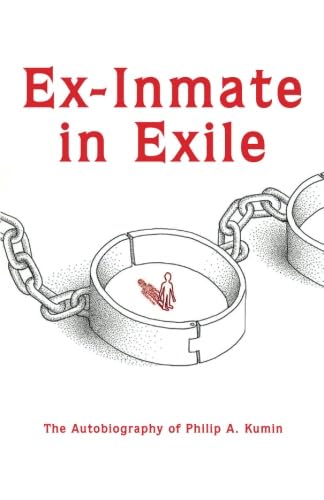



There are some mental patients who refer to themselves as "former psychiatric inmates". Hence the title of Philip A. Kumin's autobiographical account of his journey through the mental health system, EX-INMATE IN EXILE. Mr. Kumin is a talented new writer, whose book resembles a work of fiction rather than the true story it is. Peppered with moments of humor, it is rife with revelations critically needing exposure. This necessary book is deserving of a dedicated readership. Sample Chapter Chapter One My mother once told me that I was born around 3:00 p.m., on the date of my birth, February 25, 1953. I recall that she said I was born at the "old" Sinai Hospital, then located in East Baltimore. My father, Howard J. Kumin, was then a labor statistician for the United Nations, assigned to assess and implement labor programs throughout Latin America. I was the youngest of three, my brother, Gerson, having been born in 1941, and my sister, Susie, in 1945. My earliest recollections are of a house that we lived in, and a car that we owned, in Bogota, Colombia. I was perhaps two years old when we arrived in Colombia for a 14-month stay, on one of my father's regional assignments. I have memories of touring the salt mines of Cali, and of the open-air meat market at a place called "Chia." I have memories of traveling through the lush mountains by train. I remember bending over to look at the red-hot boiler underneath the steam engine, at one point at which we had stopped. I remember being frightened by the hissing of steam. Perhaps one of my most vivid memories from that time, was of the rural Latin American airport from which we departed, the day of our return to the United States. Immediately beyond a small wooden building which served as a terminal, lay the airport's lone dirt runway. However, off to the right of this same building, an open storage area was located, where several rows of Lockheed Constellations were tethered to the ground. Most of these belonged to the Colombian airline, Avianca. We had time to kill before the departure of our flight, and so Susie walked me around this deserted, quiet, gravel apron. It was there, that day, that I learned the meanings of the words "fuselage" and "aileron," and there that I began a long love affair with airplanes. We returned, in the late 1950s, to the same northwestern part of Baltimore City where my mother, father, and sister had been living when I was born. At that point, this neighborhood was still predominantly white and Jewish, though already in the beginning stages of transition from white to black. Susie and I were both born in Baltimore at Sinai Hospital. However, at the time that Gerson was born, my parents were living in the Washington metropolitan area, and thus he was born in a Washington, DC, hospital. Gerson was also the only one of the three of us who was delivered by natural childbirth. Unfortunately, the attending obstetrician used a pair of forceps on my brother's head in an effort to pry him loose from my mother's birth canal, causing him lasting brain damage. To this day, Gerson suffers from a seizure disorder. Partially because of his misunderstood seizure disorder, and partially because of ill effects that my father had had on my brother's psychological development, it was recommended that Gerson be sent to an experimental extension of the University of Chicago, known as the Orthogenic School, run by the late psychiatrist Dr. Bruno Bettelheim. It was here that he resided at the time of my birth, although he returned shortly thereafter to accompany us to Bogota. When we returned to Baltimore after that, my mother enrolled me in a nearby nursery school, Susie entered the sixth grade, and Gerson began public high school. My father continued to work and travel overseas. Though my maternal grandfather (whom I never knew, but have always wished I had) was a native Baltimorean, my mother's mother was born and raised in London, England. It was here as well that my mother, Hazel Edna Goldman, the first of four girls, was born, though my grandparents returned to Baltimore soon thereafter. Mother was born in 1913, and it wasn't long before the rest of the Lyon family, including my great Aunt Miriam, followed my grandmother, Lillian, to America. My paternal grandparents, Sadie and Max Kumin, were born and raised in the Baltic country of Latvia, later annexed by the Soviet Union. My father, the first of three boys, was born in Brockton, Massachusetts, in 1907, after my grandparents had emigrated to the U.S. Though Susie, Gerson, and I were always raised much more closely to our mother's side of the family than our father's, we nonetheless visited our aunts, uncles, and cousins in New England. My recollection of my father's father is that he was the complete personal opposite of his wife. Though extremely hard of hearing, whenever one was able to communicate with him, one discovered what a very warm, jovial, affable person he was. By contrast, my vag