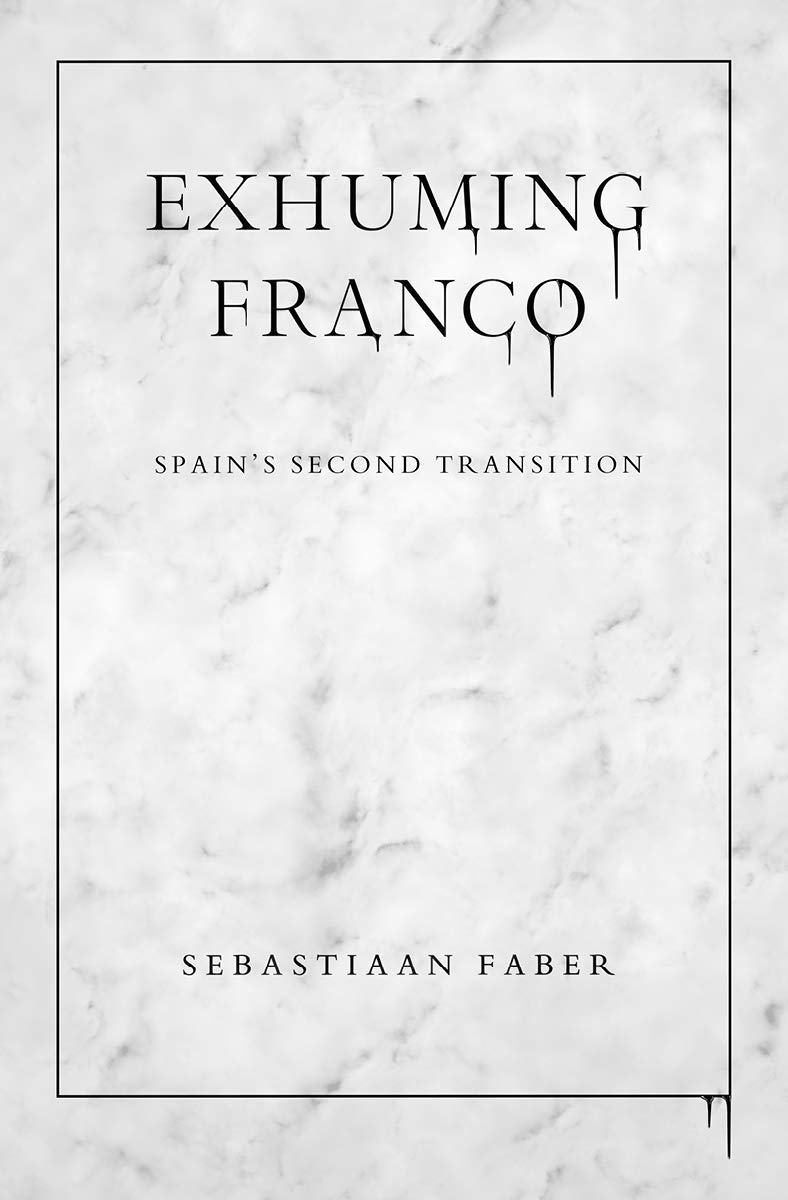



What is left of Francisco Franco's legacy in Spain today? Franco ruled Spain as a military dictator from 1939 until his death in 1975. In October 2019, his remains were removed from the massive national monument in which they had been buried for forty-four years. For some, the exhumation confirmed that Spain has long been a modern, consolidated democracy. The reality is more complicated. In fact, the country is still deeply affected—and divided—by the dictatorial legacies of Francoism. In one short volume, Exhuming Franco covers all major facets of the Francoist legacy today, combining research and analysis with reportage and interviews. This book is critical of Spanish democracy; yet, as the final chapter makes clear, Spain is one of many countries facing difficult questions about a conflictive past. To make things worse, the rise of a new, right-wing nationalist revisionism across the West threatens to undo much of the progress made in the past couple of decades when it comes to issues of historical justice. "Fascinating. . . . Faber's research makes clear that even now, forty-five years after his death, Spain has still not overcome aspects of Franco's legacy." — Jon Lee Anderson , staff writer, The New Yorker , and author of Che Guevara: A Revolutionary Life "A fascinating read by a very seasoned observer of Spanish political life." — Omar Guillermo Encarnación , author of Democracy Without Justice in Spain: The Politics of Forgetting Sebastiaan Faber , professor of Hispanic studies at Oberlin College, is the author of several books, including Memory Battles of the Spanish Civil War and Exile and Cultural Hegemony: Spanish Intellectuals in Mexico, 1939–1975 (both published by Vanderbilt University Press). Chapter 1 Securely Tied Down If it hadn’t been for a couple of straps and last-minute screws, the embalmed corpse of Francisco Franco may well have slipped from its coffin and crashed onto the esplanade. The scene—macabre and surrealist, with the entire world looking on—would have been worthy of Luis Buñuel. Fortunately for Franco, things happened otherwise. A bit before one o’clock in the afternoon on October 24, 2019, eight pall bearers carefully carried the former dictator’s remains out of the basilica at the Valley of the Fallen, toward the hearse that had pulled up a short distance further. Peeking out from under a brown cloth covering the coffin were two bright orange straps that kept the entire thing together. Just moments earlier, when Franco’s tombstone was lifted, it had become clear that 44 years under ground had not passed in vain: the coffin had suffered serious water damage. Since the wood had decayed in several places, the funeral experts who were supervising the operation recommended transferring the dictator’s remains to a new container. Yet the family members present, who had been opposed to the exhumation until the very end, rejected that idea out of hand. (“Here we are, grandpa,” Franco’s granddaughter had groused a moment before. “Here we are, with these defilers of your grave!”) (Escolar & Ejerique 2019). The experts refused to give any guarantees. Still, just in case, they put in a couple of screws to strengthen the rickety coffin’s rotten corners and strapped it on to a large wooden plank that they happened to have on hand. The emergency measures worked: the coffin made it to the hearse without incident, and from there into a helicopter. Moments later, Franco’s remains—straps and all—had arrived at the family plot, a short 20-mile flight from the Valley. There, the brown cloth covering the coffin was replaced with a Francoist flag while a priest—who, as it happened, was the son of the officer who in 1981 had led a failed military coup—issued a homily in which he praised the dictator as a great leader and champion of Catholicism. Finally, the Generalissimo was reinterred next to his wife. *** Franco, who ruled Spain from his 1939 victory in the Spanish Civil War until his death in 1975, wasn’t known for his sense of humor. Still, he might have appreciated the symbolism of those unsightly orange straps. “Todo ha quedado atado, bien atado,” he famously said in his 1969 Christmas address to the nation: “Everything is tied down, securely tied down.” The phrase described his intended legacy. That same summer, Juan Carlos de Borbón, the grandson of Spain’s last king, had sworn loyalty to the principles of Francoism, after which the parliament had appointed him as Franco’s successor. The continuation of the regime was secure, the then-77-year-old dictator assured his listeners—even after his eventual death. Has Franco been able to keep his posthumous promise? Does he continue to exert power from beyond the grave? How many of the Spain’s challenges today can be ascribed to Franco’s legacies? These are questions that continue to divide Spaniards five decades on. Around the time of the exhumation, which coincided with the conflict over Catalonia’s bid for indepe