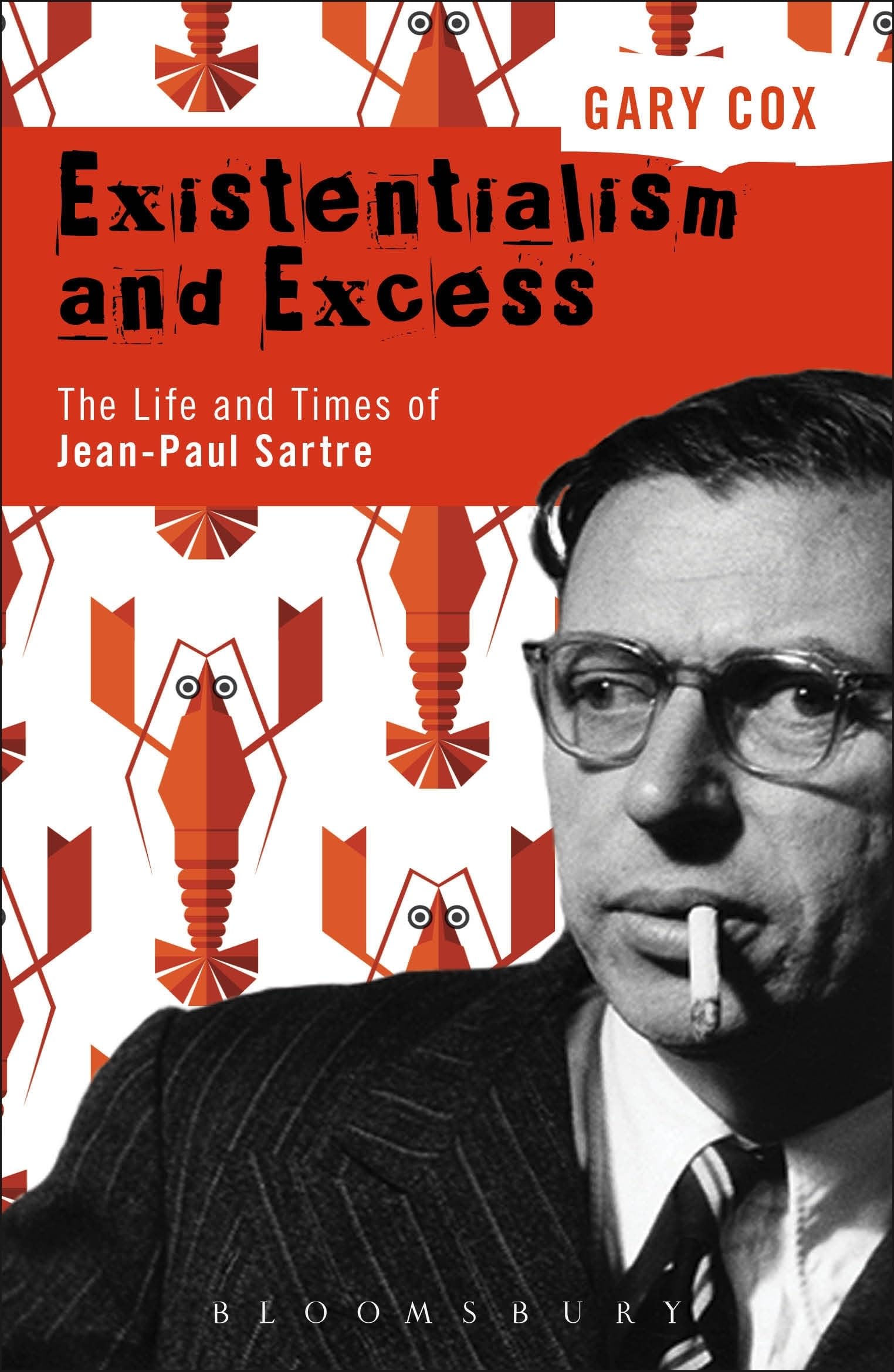



Jean-Paul Sartre is an undisputed giant of twentieth-century philosophy. His intellectual writings popularizing existentialism combined with his creative and artistic flair have made him a legend of French thought. His tumultuous personal life - so inextricably bound up with his philosophical thinking - is a fascinating tale of love and lust, drug abuse, high profile fallings-out and political and cultural rebellion. This substantial and meticulously researched biography is accessible, fast-paced, often amusing and at times deeply moving. Existentialism and Excess covers all the main events of Sartre's remarkable seventy-five-year life from his early years as a precocious brat devouring his grandfather's library, through his time as a brilliant student in Paris, his wilderness years as a provincial teacher-writer experimenting with mescaline, his World War II adventures as a POW and member of the resistance, his post-war politicization, his immense amphetamine fueled feats of writing productivity, his harem of women, his many travels and his final decline into blindness and old age. Along the way there are countless intriguing anecdotes, some amusing, some tragic, some controversial: his loathing of crustaceans and his belief that he was being pursued by a giant lobster, his escape from a POW camp, the bombing of his apartment, his influence on the May 1968 uprising and his many love affairs. Cox deftly moves from these episodes to discussing his intellectual development, his famous feuds with Aron, Camus, and Merleau-Ponty, his encounters with other giant figures of his day: Roosevelt, Hemingway, Heidegger, John Huston, Mao, Castro, Che Guevara, Khrushchev and Tito, and, above all, his long, complex and creative relationship with Simone de Beauvoir. Existentialism and Excess also gives serious consideration to Sartre's ideas and many philosophical works, novels, stories, plays and biographies, revealing their intimate connection with his personal life. Cox has written an entertaining, thought-provoking and compulsive book, much like the man himself. 'When he finally stopped writing he was so severely over-stimulated he was unable to keep his body still. His arms flailed about and he paced so much on de Beauvoir's carpet that he wore a hole in it. He was a speed freak. Speed renders the tongue hyperactive, even when one is not talking, and at one point he wore all the skin off the tip of his. A nightly,near overdose of sleeping tablets was the only possible way for him to comedown from all the uppers and grab a few hours of rest. What a marvellous, fascinatingly hideous spectacle he must have made. A small, ugly bundle of intellectual and physical energy, likely to self-destruct at any moment, maniacally pushing himself beyond all reasonable limits of mental and bodily endurance in order to feel ever more intensely what he called 'the speed of my soul' ( Words , p. 154). He was a hungry ghost striving to fill the void within himself by internalizing the entire world. For him this meant trying to capture and explain the entire world, the entire human condition, in an all-embracing script.' ( Existentialism and Excess , p. 201) Yes, that was Jean-Paul Sartre as vividly described in Gary Cox's new biography of the great and legendary philosopher, author and formidable lover, accurately titled Existentialism and Excess . Although neither Sartre nor Simone de Beauvoir, his life and intellectual partner for fifty years, much liked the label Existentialist when it was first attached to him, as it became popular he learned to live with it. And as to excess, well I dare say that Sartre made the old cliché of 'packing three lives into one' come true. Sartre's life is the mirror opposite of Gertrude Stein's famous putdown of Oakland, in that there is almost too much there, there. In Cox's bibliography, the list of Sartre's published books goes on for two full pages; and in a small font old man, in a small font and single-spaced too. Included there are deep and serious works on philosophy, as well as novels, polemics, short stories, an autobiography, a four volume (four!)of Flaubert, and plays. The other third of the art is the tone of the writing. I suggest and I hope that the quotations I have drawn from Existentialism and Excess lead you to conclude that Gary Cox is delightfully literate,almost conversational in how he reveals the life of Jean-Paul Sartre. Cox amuses, informs and draws on his skills as a tenured Professor of Philosophy to make Existentialism and Phenomenology understandable for any reasonably bright reader. God bless him for that and I wish to hell I'd been in his class when I was trying to wrap my lumpy melon-head around Kant and Hegel all those years ago. Hubert O'Hearn, By The Book Reviews. The average reader will read Existentialism and Excess with relative ease. Its clear, declarative sentences and short yet detailed paragraphs make for a breezy introduction to Sartre's