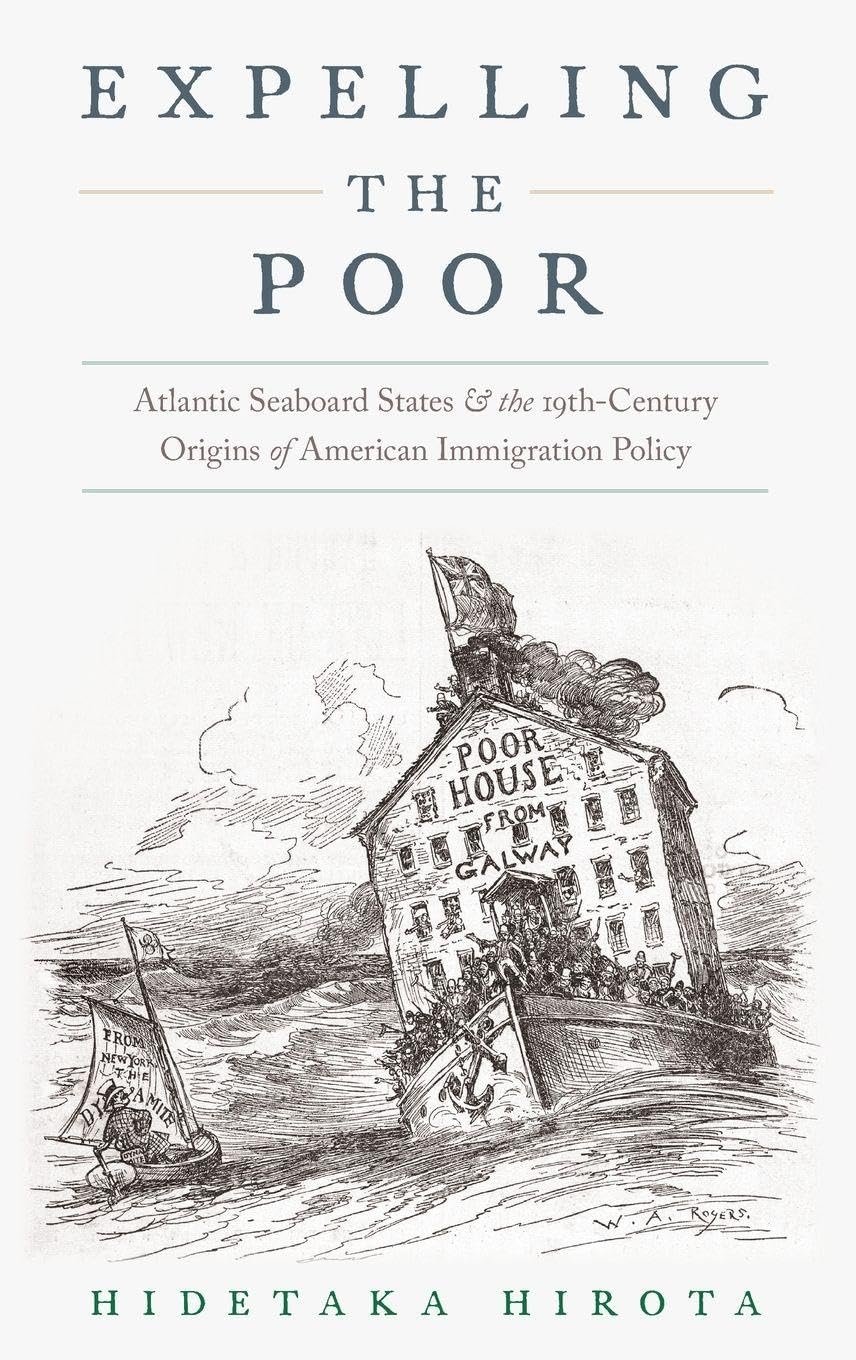
Expelling the Poor: Atlantic Seaboard States and the Nineteenth-Century Origins of American Immigration Policy
$66.75
by Hidetaka Hirota



Historians have long assumed that immigration to the United States was free from regulation until anti-Asian racism on the West Coast triggered the introduction of federal laws to restrict Chinese immigration in the 1880s. Studies of European immigration and government control on the East Coast have, meanwhile, focused on Ellis Island, which opened in 1892. In this groundbreaking work, Hidetaka Hirota reinterprets the origins of immigration restriction in the United States, especially deportation policy, offering the first sustained study of immigration control conducted by states prior to the introduction of federal immigration law. Faced with the influx of impoverished Irish immigrants over the first half of the nineteenth century, nativists in New York and Massachusetts built upon colonial poor laws to develop policies for prohibiting the landing of destitute foreigners and deporting those already resident to Europe, Canada, or other American states. These policies laid the foundations for federal immigration law. By investigating state officials' practices of illegal removal, including the overseas deportation of citizens, this book reveals how the state-level treatment of destitute immigrants set precedents for the use of unrestricted power against undesirable aliens. It also traces the transnational lives of the migrants from their initial departure from Ireland and passage to North America through their expulsion from the United States and postdeportation lives in Europe, showing how American deportation policy operated as part of the broader exclusion of nonproducing members from societies in the Atlantic world. By locating the roots of American immigration control in cultural prejudice against the Irish and, more essentially, economic concerns about their poverty in nineteenth-century New York and Massachusetts, Expelling the Poor fundamentally revises the history of American immigration policy. "A superbly disruptive new book ... Expelling the Poor helps explain the powerful federal system of subsequent centuries, but as a history of the nineteenth century, it illustrates localism and inconsistency." -- Alison Clark Efford, Journal of the Civil War Era "Hidetaka Hirota has written one of the most important recent books on the history of immigration to the United States. He breaks important new ground with his study but has also produced a work that, though focused on the nineteenth century, still speaks to current debates on immigration. He highlights more continuity in the story of immigration regulation than has been traditionally recognized." -- David T. Gleeson, Journal of American History " Expelling the Poor combines analysis of law-making with heart-wrenching social history of Irish deportee experiences. Through his careful attention to the lives of these unwanted outcasts, Hirota goes some way to restoring the dignity stripped from them in the course of multiple forced Atlantic crossings." -- Anne Rees, Australasian Journal of American History "[S]eminal....[P]resents a virtual treasure trove of research and analytical insights that will set the pace for ensuing scholarship on U.S. immigration."--Luke Ritter, Journal of American Ethnic History "In this important and very timely book, historian Hirota goes back to the beginnings of the debate over immigration to the US to look at the origin of formal immigration policy. He focuses on the many thousands of Irish, most desperately poor, who began arriving in ever-increasing numbers in the early 19th century....By including the story of those who were not allowed entry and deported, the author makes an important contribution to the study of Irish immigration. The book's great strength is as a pioneering study of immigration policy. It is very readable and will be accessible to anyone interested in the development of immigration policy, as well those primarily concerned with current policy."-- CHOICE "Significant and innovative....A major book in the study of U.S. state immigration policy, the best in the field to date.... Expelling the Poor raises timely questions about the ways immigration laws and their enforcement, in the nexus of ignorance and nativism, create and exacerbate poverty."--Torrie Hester, American Nineteenth Century History "Hirota has written a stunning and major book....His work [is] an impressive and path breaking study....Hirota's revelations carry forward to the present....In the last four years a record number of bills dealing with immigration have been introduced into state legislatures. Today's struggles are no longer about Irish paupers but the conflict over immigration, whether at the state or federal levels seems to have no end."--David Reimers, New York Irish History " Expelling the Poor shows how state authorities on the East Coast fashioned the first regulations designed either to prevent the landing of undesirable immigrants or to ensure their expulsion to 'whence they came.' Moreover, Hiro