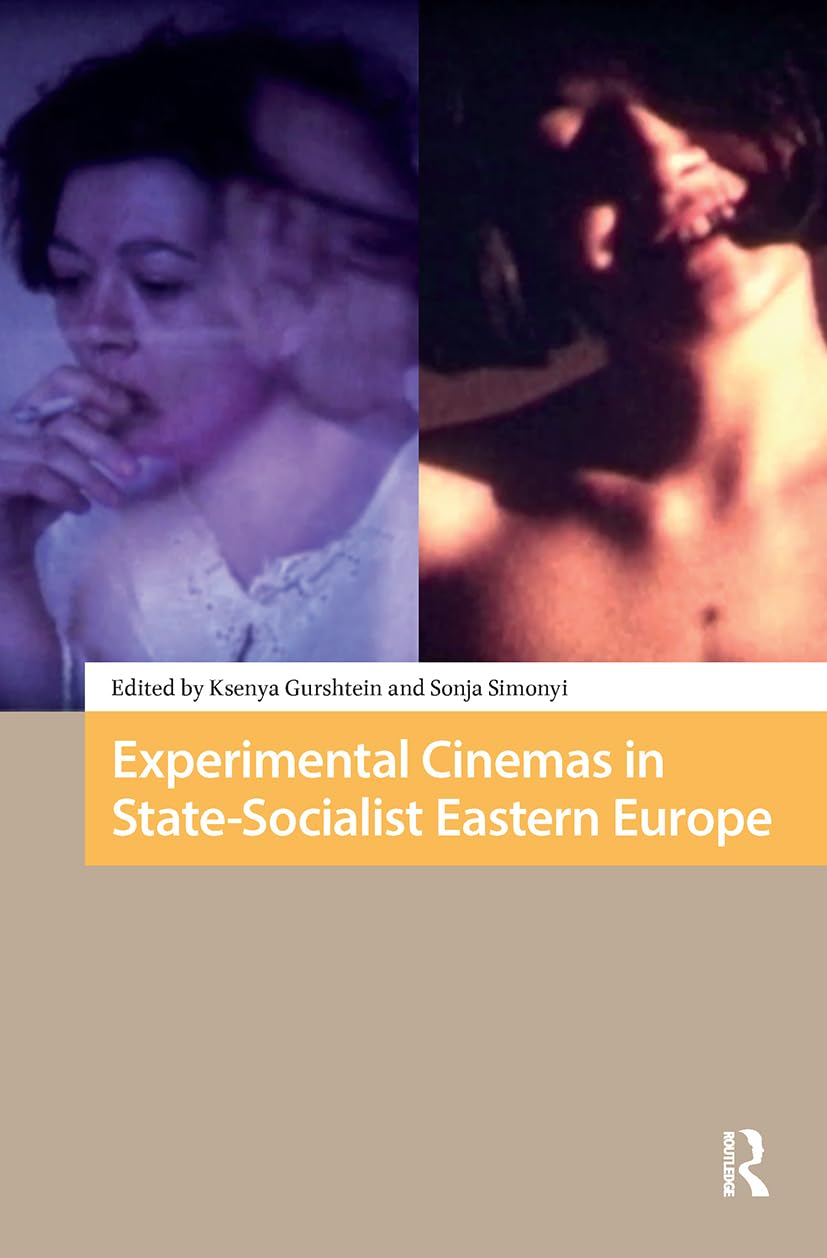
Experimental Cinemas in State-Socialist Eastern Europe (Eastern European Screen Cultures)
$42.74
by Ksenya Gurshtein



Was there experimental cinema behind the Iron Curtain? What forms did experiments with film take in state-socialist Eastern Europe? Who conducted them, where, how, and why? These are the questions answered in this volume, the first of its kind in any language. Bringing together scholars from different disciplines, the book offers case studies from Bulgaria, the Czech Republic, former East Germany, Hungary, Poland, Romania, and former Yugoslavia. Together, these contributions demonstrate the variety of makers, production contexts, and aesthetic approaches that shaped a surprisingly robust and diverse experimental film output in the region. The book maps out the terrain of our present-day knowledge of cinematic experimentalism in Eastern Europe, suggests directions for further research, and will be of interest to scholars of film and media, art historians, cultural historians of Eastern Europe, and anyone concerned with questions of how alternative cultures emerge and function under repressive political conditions. Ksenya Gurshtein is the Curator of Modern and Contemporary Art at the Ulrich Museum of Art, Wichita State University in Wichita, Kansas. She holds a Ph.D. in the History of Art, and her academic research has focused on post-war conceptual, experimental, and neo-avant-garde art in Eastern Europe. Her scholarship and criticism have appeared in scholarly journals, popular magazines, exhibition catalogs, and online. Sonja Simonyi is an independent scholar working on the audiovisual cultures of socialist Eastern Europe. She completed her dissertation at New York University’s Department of Cinema Studies and her writings on both popular and experimental film have appeared in a number of art magazines, edited volumes, as well as academic journals. Dr. Gábor Gelencsér is a professor of film studies at the ELTE University in Budapest. He has published on various aspects of Hungarian film culture in magazines, journals, and edited volumes and has written six monographs (in Hungarian), including books on the aesthetics of Hungarian cinema in the 1960s and 1970s (2002) and a study of the relationship between cinema and literature in postwar Hungarian film (2015). He also coedited the exhibition catalog on the history of the Hungarian Balázs Béla Studio (2009). Dr. Greg de Cuir Jr. is an independent curator, writer, and translator who lives and works in Belgrade, Serbia. He is cofounder and managing editor of the journal NECSUS, as well as editor of the book series Eastern European Screen Cultures, both published by Amsterdam University Press. De Cuir Jr. received his DPhil from the Faculty of Dramatic Arts at University of Arts Belgrade. ?ukasz Mojsak is an independent curator of art and film as well as a writer and translator. He holds an MA in Contemporary Art Theory from Goldsmiths, University of London. Between 2011 and 2016, he worked at the Museum of Modern Art in Warsaw. He currently collaborates with the Arton Foundation in Warsaw and was the cocurator of the Polish Pavilion at the 2019 Venice Biennale. Katerina Lambrinova is a film expert for Bulgarian National Television, where she advises on film projects from the scriptwriting stage and through_x0002_out the production process. She is also a film critic, art journalist, film programmer, and editor in chief at FemGems in the Arts (https://medium.com/femgems). She is a PhD candidate at the Institute of Art Studies of the Bulgarian Academy of Sciences. Dr. Masha Shpolberg is an assistant professor of film studies at the University of North Carolina Wilmington, where she teaches courses on Russian and Eastern European cinema, as well as global documentary. Her first book project focuses on the aesthetics of labor in Polish cinema of the late socialist period. She is also the coeditor of Cinema and the Environment in Eastern Europe (forthcoming). Dr. Petra Belc holds a PhD in Film Studies from the University of Zagreb; her dissertation explored ”The Poetics of Yugoslav Experimental Cinema from the 1960s and 1970s.” She also holds degrees in women’s studies, philosophy, and comparative religion. As an independent researcher, she explores the fields of feminisms and philosophy of image/making; she is interested in the archiving and preservation of small-gauge films. Dr. Aleksandar Boškovi? is a lecturer in Bosnian, Croatian, and Serbian in the Department of Slavic Languages at Columbia University in New York. He is the author of The Poetic Humor in Vasko Popa’s Oeuvre (in Serbian, 2008). His articles have appeared in scholarly journals in the United States and Europe (Apparatus, Cultural Critique, Digital Icons, Književna istorija, Slavic Review) as well as in various edited collections Dr. Ileana L. Selejan is a research fellow with the Decolonising Arts Institute and an associate lecturer at the University of the Arts London. As honorary research fellow in the Department of Anthropology at University College London, she participates in the European Rese