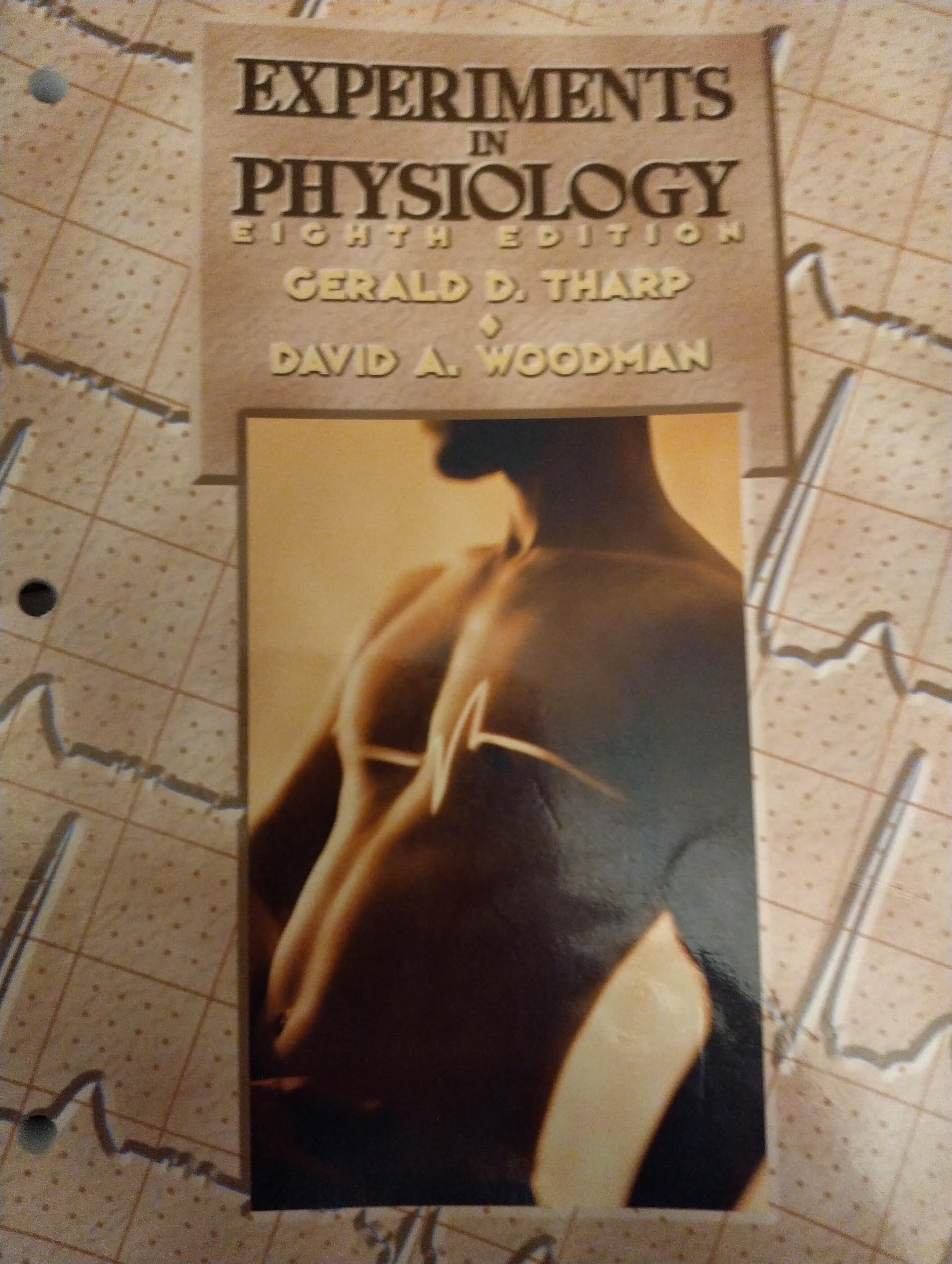



Laboratory manual is written in a workbook format to be easily used with any physiology text. Experiments are grouped in 23 teaching units including: lab reports, sample data, graphs, and enough experiments to be used in a semester-long course. Previous edition: c1997. Softcover, with three-hole punched perforated pages. FEATURES New! Companion Website enhances understanding of the physiological principles behind the experiments. Includes links to web-based tutorials and animations. www.prenhall.com/tharpwoodman Flexible organization permits use with any physiology textbook. Fully illustrated with detailed figures of laboratory specimens and equipment. TO THE INSTRUCTOR A laboratory manual is never the work of one author alone; it represents a blend of ideas from other lab manuals, other teachers, and personal experience in the laboratory. We have selected the experiments in this manual because they fulfill two key criteria: They produce consistently successful resultsstudents need not be trained scientists to get meaningful data. - They teach significant physiological concepts. The manual is written in a "generic" format so that it can be used with any text and with a variety of laboratory equipment. Detailed directions for operating specialized equipment are not included, so the manual is more versatile and less cluttered with excessive directions that are seldom read by students. The major change in the 8th Edition is the addition of a companion website with links to pages that will enhance a student's ability to understand the physiological principles behind the experiments. An ever increasing number of excellent web-based tutorials and animations are now available, each designed to illustrate a particular physiological process. We have attempted to collect the best of these and link them to the companion website. Our goal is to update the website on a regular basis to remove dead links, and to add new links. The companion website is at www.prenhall.com/tharpwoodman . The following features of the manual have made it an effective tool for student learning and efficient teaching by instructors. Experiments are grouped into 23 "teaching units". Each teaching unit consists of a group of related experiments suitable for a 3-hour laboratory period. By eliminating some of these experiments, an instructor can also provide an effective 2-hour lab. The teaching units presented are those that we have found can be successfully performed and discussed by students during a typical 3-hour lab. This grouping of experiments was initiated in the fourth edition and has been well received by instructors and students because it helps them better organize the learning that takes place each week. It also helps students focus on related concepts in physiology, thus maximizing their learning. A lab report for each teaching unit is provided after each exercise. Lab reports consist of data tables, graphs, and questions designed to stimulate students' thinking on what they have seen and done in lab. These reports can be removed from the manual and turned in for grading. The questions posed are not meant to be comprehensive but are to accent the major concepts explored experimentally in each unit. Most of the questions can be answered by short statements that can be easily graded by the lab instructor. Comments by instructors indicate that these lab reports are a major feature of the manual. Students have commented that the reports help them understand what they are doing in lab and make it easier to relate their findings to the theoretical concepts studied in lecture. Some questions are more complex than others; they require an application of knowledge of new situations. In the elementary physiology course, the Laboratory Report questions are used as a basis for discussion at the end of the lab period, and the answers to complex questions are provided after discussion. In upper-level courses, students are expected to think through these questions on their own. The Instructor's Guide provides sample data, graphs, and answers to questions in the lab reports. These experimental results represent average values obtained in our teaching labs; they provide guidelines the instructor may use to compare with his or her own results. Instructors are encouraged to devise additional questions for lab quizzes that probe students' knowledge of other facets of the lab experience. The Instructor's Guide also provides lists of materials and equipment needed for each teaching unit and the quantities needed for a lab of 20 to 24 students. This simplifies the ordering of supplies and preparation of solutions. An adequate number of experiments is included so that the manual can be used for one-semester introductory courses in physiology or for upper-level courses one or two semesters in length. Instructors teaching upper-level courses may wish to use this manual for the foundation core of experiments and to add a few ex