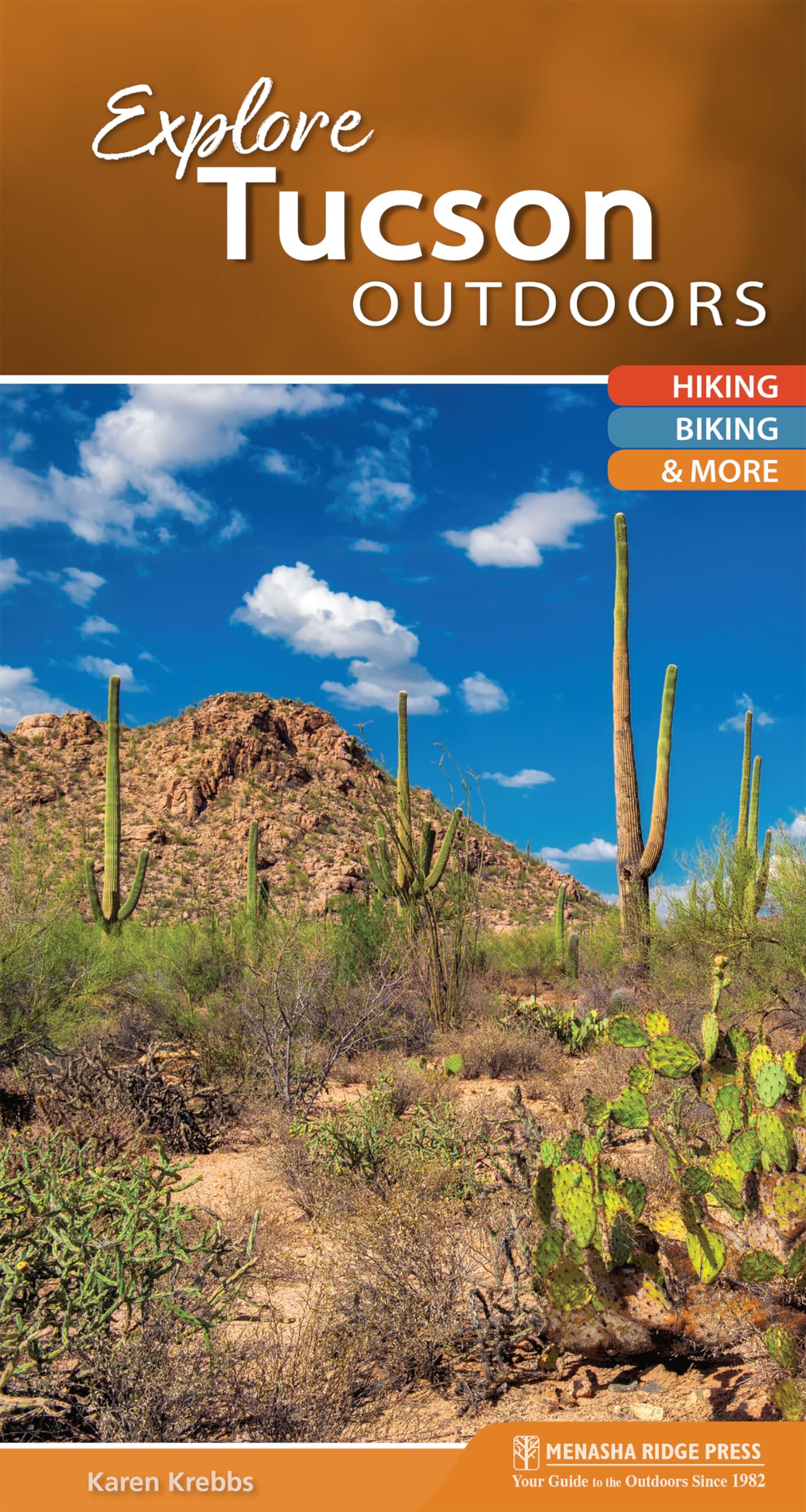



The Best of Tucson Whether you’re a resident or are visiting from out of town, to fully experience everything Tucson has to offer, you need to get outside. Explore Tucson Outdoors offers the details you need to easily find 20 of the Arizona city’s top outdoor locations and a wide variety of activities, including trails in botanical gardens, wetlands, canyons, and forests. The trails are split between walks in the city and hikes in Tucson’s wild backyard, so you can enjoy outings in places like nearby Saguaro National Park, the Santa Catalina Mountains, and Tucson Mountain Park. The full color guide’s pocket-sized format is great for a backpack or back pocket, and every site description includes maps, color photos, and directions. Written by local author and naturalist Karen Krebbs, this is your guide to enjoying Tucson in the best possible way: outdoors! Karen Krebbs worked at the Arizona-Sonora Desert Museum for more than 26 years and has extensive knowledge of birds, mammals, plants, reptiles, insects, deserts, and animal adaptations and behavior. Her passion for hummingbirds has resulted in a book, book chapters, scientific papers, and also a husbandry manual for captive hummingbirds for the Association of Zoos and Aquariums. Her research on hummingbirds includes migration, nesting biology, behavior, song development, and longevity. Karen regularly advises zoological institutions and aviaries on the proper care and husbandry of captive hummingbirds. She has conducted educational workshops and seminars on Sonoran Desert animals and plants for various organizations, schools, yearly wildlife festivals, and local conservation groups. Karen has also studied bats for more than 30 years; she presents lectures, leads workshops, and trains government employees on the proper handling and protocol for studying bats. She has led and co-led natural history trips in Arizona, New Mexico, Texas, Mexico, Baja, Costa Rica, Ecuador, Galapagos, and Africa. Karen, an avid hiker, camper, photographer, and natural history traveler, has a B.Sc. degree in Wildlife & Fisheries Science from the University of Arizona. She has lived in Tucson, Arizona, for more than 50 years. Catalina State Park Birding and Nature Trails These two trails are available at Catalina State Park for birding and nature enthusiasts. Both trails make a loop and return to the parking lot. Scenic views of the Catalina Mountains and the Sonoran Desert are possible. Difficulty: Easy (There’s a brief upward climb at the beginning of the Nature Trail.) Length/Time: Each trail is a 1-mile loop; 1-2 hours, depending on the pace and number of stops Hours/Fees: 5 a.m.-10 p.m. daily; Fees: Vehicle pass (with 1-4 Adults), $7; Individual/Bicyclist, $3 Getting There: 11570 N. Oracle Rd. (Catalina State Park Visitor Center) GPS: N32° 25.7825', W110° 56.0334' Contact: 520-586-2283; azstateparks.com/catalina/ Additional Information: Both hikes are pleasant and not strenuous. Interpretive signs line both trails, and the views of the Catalina Mountains are spectacular. The trails are appropriate for families and children. The Nature Trail sign is located north of the parking lot. Interpretive signs line the trail, as well as concrete animal footprints of common desert animals. The views include Romero Canyon and the Catalina Mountains to the east, Pusch Ridge and Sutherland Wash to the south. Benches are also available along the trail. At the end of the trail, turn east (left) to cross the Sutherland Wash to the Birding Trail. Here, you can spot everything from Arizona’s famous Greater Roadrunners to buntings, grosbeaks, and more. The Birding Trail passes through a mesquite bosque habitat and gradually climbs up railroad ties. Benches and interpretive signs also line this trail, and there are views of Pusch Ridge.