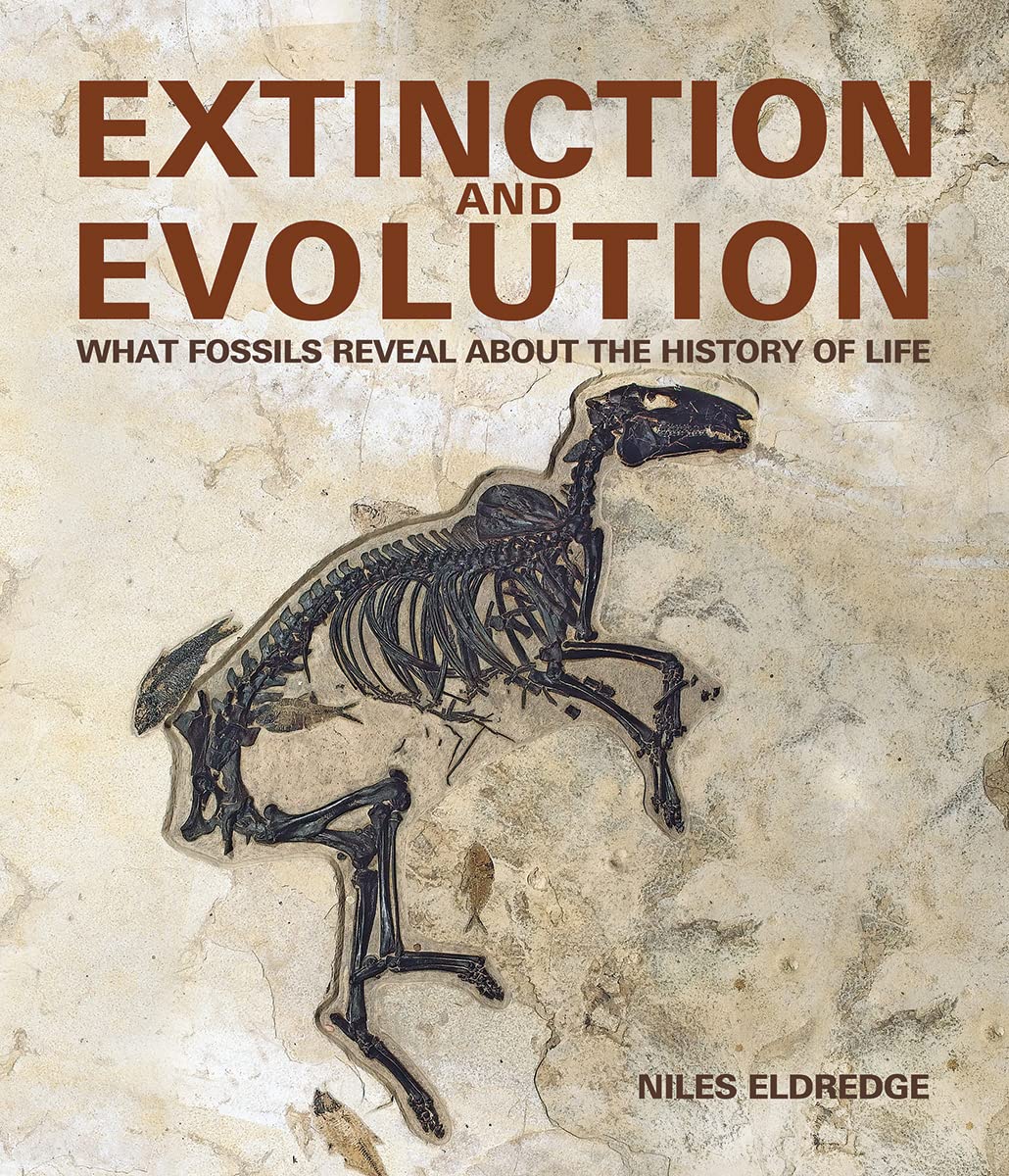
Extinction and Evolution: What Fossils Reveal About the History of Life
$15.86
by Niles Eldredge



"A splendidly illustrated and thoughtfully constructed account of one of the greatest ideas ever conceived by the human mind -- evolution." -- Donald C. Johanson, Founder of the Institute of Human Origins, and author of From Lucy to Language "Splendid photographs, vivid language and concise text: a great read." --Nature "The amount of evolutionary ground covered in the relatively short text, and the clarity with which it's laid out for the benefit of the reader, are exemplary." --Reports of the National Center for Science Education Extinction and Evolution recounts the research of paleontologist Niles Eldredge, whose discoveries overturned Charles Darwin's theory of evolution as a slow and inevitable process. In his 1859 treatise On the Origin of Species , Darwin posited that evolutionary changes happen very slowly over millions of years. Eldredge's work, however, disproved the accepted Darwinian view, proving instead that significant changes occurred after a mass extinction event. Eldredge's groundbreaking work is now accepted as the definitive statement of how life evolved on Earth. This book chronicles how Eldredge made his discoveries and traces the history of life through the lenses of paleontology, geology, ecology, anthropology, biology, genetics, zoology, mammalogy, herpetology, entomology and botany. Remaining rigorously accurate, the text is accessible, engaging and free of jargon. Extinction and Evolution features 160 beautiful color plates (14 of which are new to this edition) that bridge the gap between science and art, and show more than 200 different fossil specimens, including photographs of some of the most significant fossil discoveries of recent years. Utilizing beautiful photos from the fossil record, Extinction and Evolution: What Fossils Tell Us About the History of Life takes us on a journey of how life has both changed and stabilized throughout time. A wide range of adults and older children would enjoy this book as it looks at extinction and evolution through various lenses: paleontology, biology, anthropology, genetics, and many more disciplines. Author Niles Eldredge has managed to take a complex topic and make it both interesting and easily digestible. -- Julie Travaglini ― Green Teacher Magazine Published On: 2021-01-01 [Review of hardcover edition:] In a world where science is under assault from many angles, this wonderfully illustrated account of how evolution "joins nature in all its disparity into a single flow" is both timely and authoritative. Author Eldredge, a renowned paleontologist, explains in accessible prose how fossils reveal the hidden history of life in the earth's ancient past... Eldredge details how paleontology and genetics work together to reveal how the same evolutionary processes that drove the development of life over time continue to create the diversity of life on earth today. In seven chapters, he discusses the interconnected reasons for why life evolves, adapts, and dies out. Eldredge also covers key evolutionary concepts such as convergence (when natural selection produces similar organisms that nonetheless come from separate lineages), and he articulates why evolution explains the "pattern of similarity interlinking all forms of life." This book is richly illustrated with full-color photographs of fossils -- everything from trilobites to human ancestors -- and should appeal to both specialists as well as general readers. ― Publishers Weekly Published On: 2014-12-08 [Review of hardcover edition:] Palaeontologist and acute thinker Niles Eldredge describes how life has evolved through geological time, partly through 160 beautiful colour plates depicting more than 200 specimens of fossil and living species. Among them are Eocypselus rowei, an extinct relative of swifts and hummingbirds that inhabited Wyoming some 52 million years ago, and the coelacanth Latimeria menadoensis, a 'living fossil' whose close relatives are nearly exclusively from the Palaeozoic and Mesozoic eras, 541 million to 66 million years ago. Most of the photographs are by the late, great Murray Alcosser. Eldredge emphasizes the existence of many species that resist evolutionary change for long periods (such as the brachio pod Mucrospirifer mucronatus), and the importance of mass extinctions in creating conditions that aid the emergence of new species. He argues convincingly that it is palaeontology, rather than evolutionary genetics, that allows us to recognize these points. Splendid photographs, vivid language and concise text: a great read. ― Nature Magazine Published On: 2015-07-23 [Review of hardcover edition:] Niles Eldredge has published a book in the Simpsonian tradition of evolutionary paleontology that is also indisputably "full of pictures of fossils"-- there are 160 color plates, the vast majority of which are beautiful photos of paleontological specimens. These pictures accompany seven concise chapters, plus an epilogue, that first bring the r