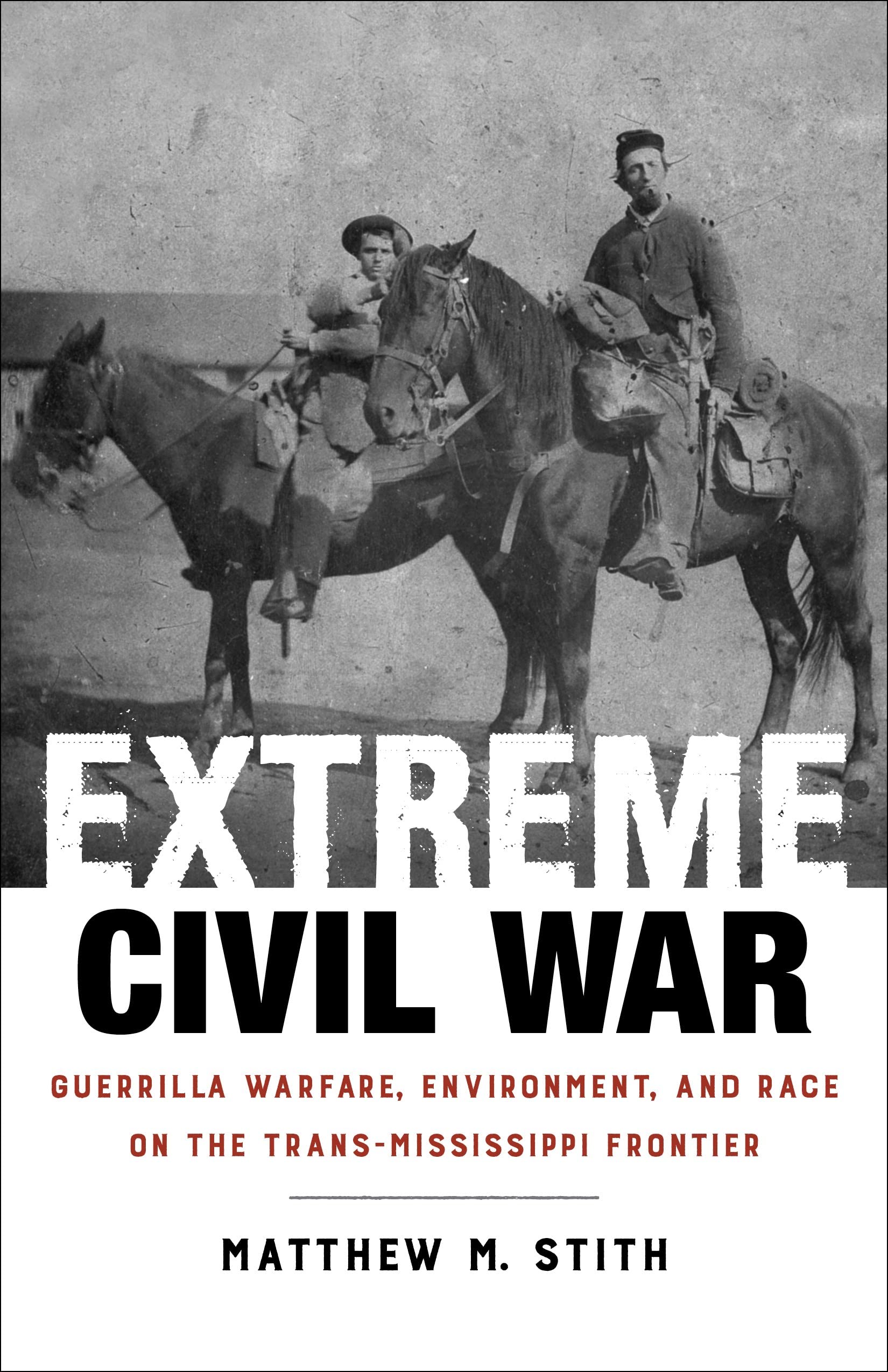
Extreme Civil War: Guerrilla Warfare, Environment, and Race on the Trans-Mississippi Frontier (Conflicting Worlds: New Dimensions of the American
$25.27
by Matthew M. Stith



During the American Civil War, the western Trans-Mississippi frontier was host to harsh environmental conditions, irregular warfare, and intense racial tensions that created extraordinarily difficult conditions for both combatants and civilians. Matthew M. Stith's Extreme Civil War focuses on Kansas, Missouri, Arkansas, and Indian Territory to examine the physical and cultural frontiers that challenged Confederate and Union forces alike. A disturbing narrative emerges where conflict indiscriminately beset troops and families in a region that continually verged on social and political anarchy. With hundreds of small fights disbursed over the expansive borderland, fought by civilians― even some women and children―as much as by soldiers and guerrillas, this theater of war was especially savage. Despite connections to the political issues and military campaigns that drove the larger war, the irregular conflict in this border region represented a truly disparate war within a war. The blend of violence, racial unrest, and frontier culture presented distinct challenges to combatants, far from the aid of governmental services. Stith shows how white Confederate and Union civilians faced forces of warfare and the bleak environmental realities east of the Great Plains while barely coexisting with a number of other ethnicities and races, including Native Americans and African Americans. In addition to the brutal fighting and lack of basic infrastructure, the inherent mistrust among these communities intensified the suffering of all citizens on America's frontier. Extreme Civil War reveals the complex racial, environmental, and military dimensions that fueled the brutal guerrilla warfare and made the Trans-Mississippi frontier one of the most difficult and diverse pockets of violence during the Civil War. "This well-written and engaging book should become required reading for those who persist in disputing whether the Civil War was a total war or not. For those who lived along the frontier where Missouri and Arkansas meet Kansas and Oklahoma, the war experience was of course total, and devastating. Gender, ethnicity, race--all made no difference to those who took advantage of the absence of civilized authority to wage a personal war on their own horrific terms. This work thus provides an insight not only into the brutality of the war years, but also the lingering bitterness that plagued the region for years to come."—Richard B. McCaslin, author of Tainted Breeze: The Great Hanging at Gainesville, Texas, 1862 "Matthew Stith's Extreme Civil War is a concise yet vivid portrayal of the Civil War along the borders of Missouri, Kansas, Arkansas, and Indian Territory. In clear, compelling language, Stith reveals that on the Trans-Mississippi frontier, the war took on a unique character, where civilians, guerrillas, and regular armed forces unceasingly fought for control over the land and its resources, leaving the region a literal 'burned over' district, largely depopulated and left to nature to reclaim. Easy to read, deeply researched, and filled with first-hand accounts, Stith's book is a welcome and unique contribution to Civil War studies."—Lisa M. Brady, author of War upon the Land: Military Strategy and the Transformation of Southern Landscapes during the American Civil War "Here is a book American Civil War scholars have needed for some time. Stith injects the important role of environmental history into one of the Civil War South's vicious guerrilla wars and establishes this as an important area of exploration for future studies of irregulars. Thanks to Stith, the story of the western Trans-Mississippi region during the war of the 1860s will never be the same." --Barton A. Myers, author of Rebels against the Confederacy: North Carolina's Unionists "[ Extreme Civil War's] powerful narrative builds upon a broad range of primary sources. . . .Stith describes the borderland conflict as a 'war in the margins,' and that phrase also provides a fitting illustration of how this synthesis reaches across many subfields of historical study. . . . Its sharp focus and splendid execution make it a welcome addition to the scholarship of the border West." --Jeremy Neely, Missouri Historical Review "Extreme Civil War is a groundbreaking work defining a subject overlooked by historians or overshadowed by other topics . . . . Stith provides a new perspective in the study of guerrilla warfare and the Civil War as a whole. . . . This book will help historians understand how the Civil War might be better defined as a total war, one that pervaded every sphere of society." -- H-Net Reviews "Stith's work is highly recommended for scholars and general readers who seek a more nuanced understanding of the nature and significance of guerrillas in the American Civil War." --William Garrett Piston, Arkansas Historical Quarterly "Stith appropriately ignored this criticism meant to limit scholarly discussion as he struct