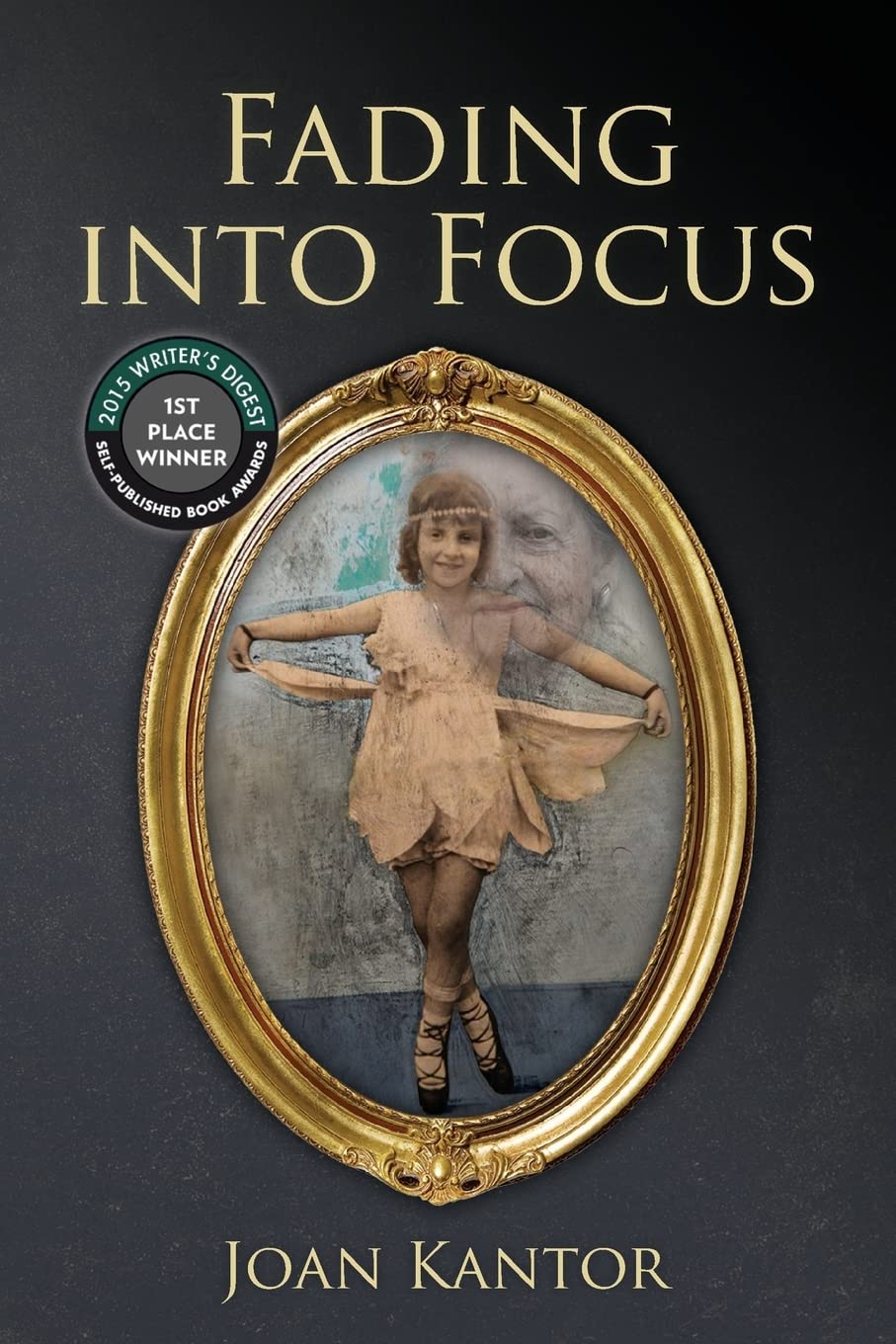
Fading into Focus: Memoir; A Mother, A Daughter, Alzheimer's and a Changing Relationship
$12.00
by Joan Kantor



Nothing strains family relationships like Alzheimer’s. As her mother begins her descent into dementia, Joan Kantor must assume a challenging role. Layers of past and present become a complicated reality that she must untangle for both of them. Fading into Focus is Kantor’s unique memoir of their relationship told through a collection of over fifty poems. Through the flexibility of verse, Kantor dips into different moments and memories, offering raw insights into her frustration, guilt, and confusion as she struggles to understand who her mother is and how that knowledge affects her as a daughter. At its heart, Kantor’s poetry is painfully honest. Rather than tiptoe around past hurts, she reveals that forgiveness doesn’t forget but is instead a choice to value love more than justice. These poems—an encouraging read for anyone caring for a loved one suffering from dementia or dealing with a challenging relationship—offer a foundational hope that frees you to consider your own situation with new, compassionate eyes and experience the peace that accompanies a life of grace. Kantor ( Shadow Sounds , 2010) explores the dreams, dementia, and death of her mother in this memoiristic volume of poetry. Poetry can be a path to closure, and closure is what Kantor seeks in this collection about her mother, Miriam Gants. From the prologue poem, “I Only Saw the Stars,” Kantor reveals that her father was a louder presence in her childhood than her mother. Addressing Miriam, she writes: “Daddy / was excitement, / fear / and fun. // You / were safe.” Yet Kantor sets out to better understand this quieter parent, gleaning what she can of her mother’s life from old family photographs and memories from her own childhood. One affecting poem, “Irony,” tells of how Miriam finally attempted to assert her individuality after the death of her husband. Then come poems dealing with Miriam’s slide into dementia and the strain it put on the mother and daughter’s increasingly one-sided relationship. Grief-filled poems deal with Miriam’s death and Kantor’s attempts to move forward with an honest, loving memory of her mother. Dancing through the book is an image of Miriam’s ballet shoes; an aspiring dancer from early childhood, Miriam forever damaged her feet by spinning on her toes when she was 5. This didn’t keep her from a lifetime love of the art, which she and Kantor would watch together on TV. Her bittersweet passion became a metaphor for the unrealized dreams of her life, and her shoes are now a treasured (if tragic) heirloom for Kantor to pass on to the next generation. Kantor is a minimalist when it comes to verse: plain language, simple syntax, no distracting conceits. A poem, for her, is often the exploration of a single, pared-down image, with no superfluous information or detail. The narrative forms like a necklace of beads, with the truly inspired images shining like gems. In “Back To Before,” dementia-plagued Miriam feels the textured paint of a museum seascape with her fingers: “There’s no point in telling her / not to touch. // Compelled, // she’s rediscovering / the beginning // at the end.” An evocative, concentrated rendering of a complex relationship Judge’s Commentary, 23rd Annual Writer’s Digest Self-Published Book Awards: In FADING INTO FOCUS, Joan Kantor examines her relationship with her mother from childhood through her mother's descent into dementia and her eventual death. Part of what makes these poems such a moving and satisfying read is the restraint with which Kantor describes heartbreaking moments and troubling realizations. The author never gives in to pathos or melodrama, yet pain throbs beneath the surface of her clean, clear-eyed, close-to-the-bone lines. The pieces chronicling the changes in her mother's personality as Alzheimer's took its toll will register with so many readers who have gone through, are going through, or will go through the same thing with aging parents and siblings. This fine work is given an impressive showcase in a beautifully produced volume. The ethereal cover image is a framed photo of a toe-dancing young girl, the child's head superimposed over an elderly woman's face (both are the poet's mother). This connects to the recurring theme in the poems of the mother's early desire to dance, to the point she continued to treasure her ballet shoes even as her disease played havoc with her faculties. In fact, the first poem, "Her Dream," describes this photo, ending with the haunting lines "standing perfectly poised, / she'll be waiting forever." In the final poem, "Forever Graced," Kantor compares her mother's ashes swirling in lake water to the child twirling on her toes. In between, the poet returns to dancing and the ballet shoes, reinforcing the metaphor and layering it with meaning in a way that elegantly links the poems and brings the collection full circle. In FADING INTO FOCUS, Joan Kantor examines her relationship with her mother from childhood through her mother's d