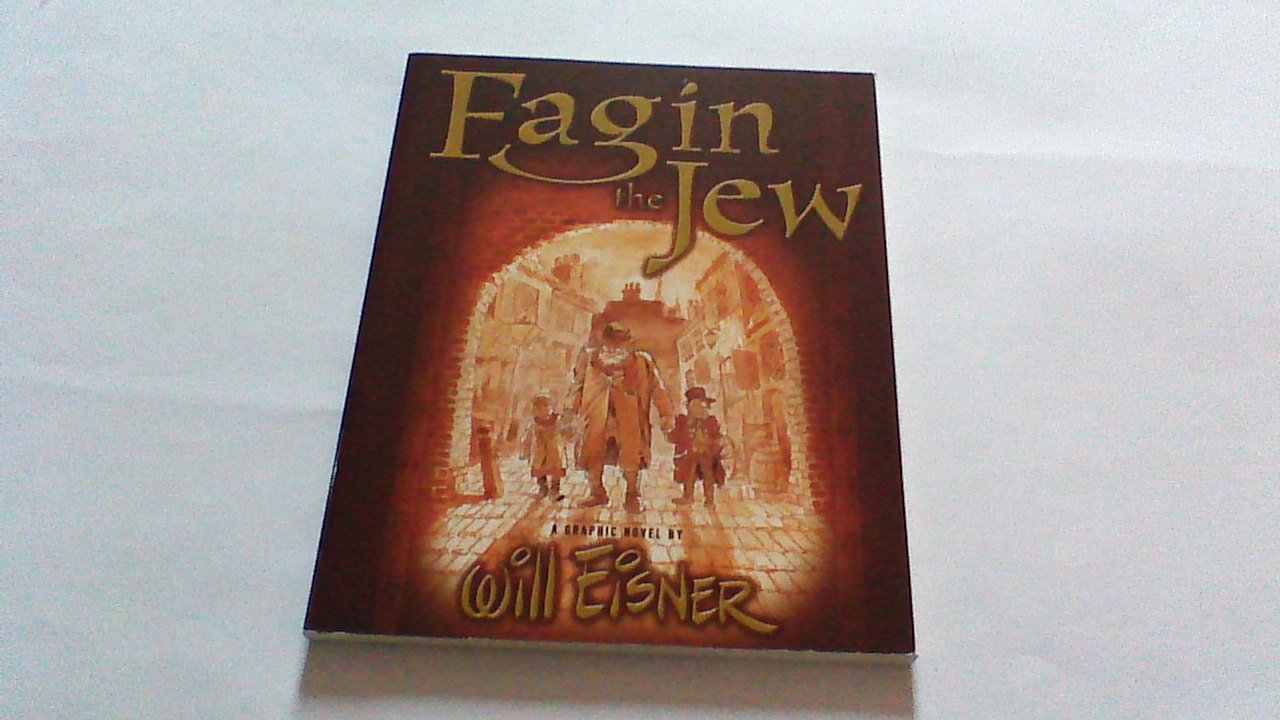



From his early newspaper comics to the sophisticated graphic novels he produces today, Will Eisner has been a pioneering force in comics for more than sixty years. Ron Goulart, writing in Book World, declared, “A shrewd, thoughtful man, Eisner has always had a knack for deftly combining dialogue and images to tell his story,” and fellow graphic novelist Alan Moore simply said, “Eisner is the single person most responsible for giving comics its BRAINS.” And Amazon.com, which called him "the Elvis of comics," said, "It's fair to say that Eisner invented modern comic art." In FAGIN THE JEW, Eisner proves himself to be not only a master of comic storytelling, but also an incisive literary and social critic. This project was first conceived as an introduction to a pictorial adaptation of Oliver Twist , but as he learned more about the history of Dickens-era Jewish life in London, Eisner uncovered intriguing material that led him to create this new work. In the course of his research, Eisner came to believe that Dickens had not intended to defame Jews in his famous depiction. By referring to Fagin as “the Jew” throughout the book, however, he had perpetuated the common prejudice; his fictional creation imbedded itself in the public’s imagination as the classic profile of a Jew. In his award-winning style, Eisner recasts the notorious villain as a complex and troubled antihero and gives him the opportunity to tell his tale in his own words. Depicting Fagin’s choices and actions within a historical context, Eisner captures the details of life in London’s Ashkenazi community and brilliantly re-creates the social milieu of Dickensian England. Eisner's fresh, compelling look at prejudice, poverty, and anti-Semitism lends an extraordinary richness to his artwork, ever evocative and complex. Like the modern classics Maus and The Jew of New York , FAGIN THE JEW blends image and prose in an unforgettable exploration of history. Adult/High School-The father of the graphic novel takes an iconographic character from Charles Dickens's Oliver Twist and gives him a personal history. The scheming but humane criminal depicted in the social novel might have experienced, according to Eisner, a childhood marked by emigration from Germany and the early death of his impoverished parents, a doomed romance, and a sojourn abroad as an indentured prisoner. The foreword explains how these details are historically probable and, indeed, relevant to the literary Jew depicted by Dickens. That Eisner has a mission to explore and redress past stereotyping-his own as well as Dickens's-does not diminish the aesthetic quality of this new telling of a fictional character's life and times. The sepia tones are of course well suited to extending the period mood, while facial and body expressions, costumes, the street scenes, and rooms are all sensuously detailed. This is a work not only for students wanting an alternative view of Oliver Twist, but also for those concerned with media influence on stereotypes and the history of immigration issues. Francisca Goldsmith, Berkeley Public Library, CA Copyright © Reed Business Information, a division of Reed Elsevier Inc. All rights reserved. Comic-book pioneer Eisner, creator of the masked crimefighter the Spirit in the 1940s, recently has made a series of graphic novels portraying Jewish life in America. Now he tackles another aspect of Jewish history--or, more precisely, Jewish fiction--by reinterpreting Oliver Twist and focusing on Fagin, Dickens' sinister ringleader of a band of young thieves. Eisner's Fagin is forced into crime by poverty and prejudice, and Eisner envisions the character's youthful attempts at honesty and self-betterment being repeatedly thwarted by anti-Semitism. Moreover, Eisner appends a redemptive ending for Fagin. In its revisionist view of a classic literary villain, this is the John Gardner Grendel of graphic novels. Eisner's renditions, if livelier and more expressive, are as caricatured as George Cruikshank's original illustrations of Fagin and, of course, eschew offensive nineteenth-century stereotypes. If Eisner's starkly melodramatic, agenda-driven narrative lacks nuance and so relies on coincidence that Dickens himself would blush, his heartfelt apologia for Fagin should be strongly considered for Jewish-studies collections as well as for graphic-novel collections. Gordon Flagg Copyright © American Library Association. All rights reserved From his early newspaper comics to the sophisticated graphic novels he produces today, Will Eisner has been a pioneering force in comics for more than sixty years. Ron Goulart, writing in Book World, declared, ?A shrewd, thoughtful man, Eisner has always had a knack for deftly combining dialogue and images to tell his story,? and fellow graphic novelist Alan Moore simply said, ?Eisner is the single person most responsible for giving comics its BRAINS.? And Amazon.com, which called him "the Elvis of comics," said, "It's f