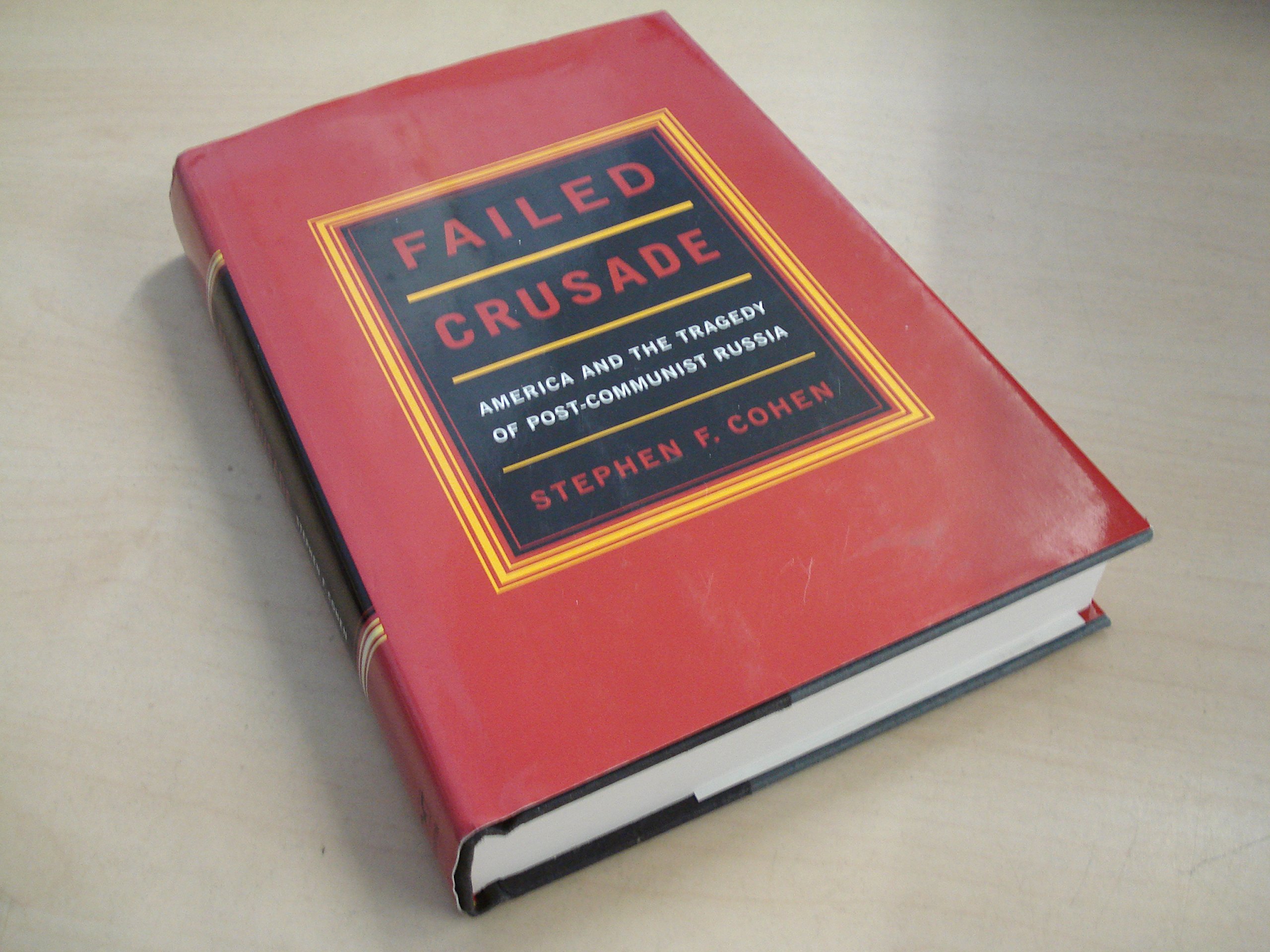
Failed Crusade: America and the Tragedy of Post-Communist Russia
$32.69
by Stephen F. Cohen



Reveals what really happened in Russia following the breakup of the Soviet Union, and the complicity of U.S. policy in a great human tragedy. Cohen (Russian studies and history, New York Univ.) here presents an opinion not held by most U.S. officials and Russian "experts": that the so-called democratization of post-Soviet Russia has been a failure. The author lays out his theories in three parts: he describes how these experts crusaded for a Russia they wanted and, in doing so, managed to overlook what was really taking place in the country. Next, he includes a series of articles he has written since 1992, which further describes the actual political and economic upheaval that has been taking place there. Finally, he presents solutions to remedy Russia's woes and help bring it into the 21st century. Although Cohen is an accomplished author (Bukharin and the Bolshevik Revolution; Sovieticus: American Perceptions and Soviet Realities), his style tends to be gloating and melodramatic. However, this is a good collection that offers varying opinions of modern Russian history. For academic libraries.AJill Jaracz, Chicago Copyright 2000 Reed Business Information, Inc. As a CBS News consultant, New York University professor Cohen is among the more visible Russia watchers. He is also an unapologetic critic of U.S. policy; the disastrous results of that policy are Failed Cru sade's subject. In part 1, Cohen describes the arrogant missionary crusade to impose U.S. political and economic institutions on the former Soviet Union--a crusade led by American policy makers, with journalists and academics as cheerleaders--and the desperate consequences for the Russian people of their elected leaders' acceptance of this program. Part 2 gathers 10 Cohen critiques of this American crusade published between 1992 and 1998; postscripts update each article. In part 3, Cohen urges that the goal of U.S. policy should be to reduce the risk of nuclear disaster by stabilizing this giant nuclear power. This can be accomplished, he argues, only by acknowledging our crusade's failure, providing massive aid and debt relief to allow the Russian people to develop political and economic institutions that serve their needs, and truly cooperating with Russia in its efforts to define its future. Mary Carroll Copyright © American Library Association. All rights reserved An incisive and occasionally caustic critique of American attitudes toward post-Soviet Russia.Russian expert Cohen ( Voices of Glasnost , not reviewed) takes the reader through a decade of American policymaking that he views as nothing less than an unmitigated disaster. Since the fall of the Soviet Union, he argues, the Clinton administration, along with the majority of American scholars and journalists, has embarked on an ideological crusade, preaching the necessity of monetarist, free-market reforms and unflinchingly supporting the Yeltsin administration despite incontrovertible evidence that the reforms and the reformer have driven Russia back into the 19th century. Cohen is especially compelling in demonstrating the parallel between contemporary American "transitionologists" (those who believe Russia is in a period of "transition" to American-style free market democracy) and the Communists themselves-both have proved willing to overlook the poverty, chaos, and misery created by "shock therapy" reforms in the name of a purportedly golden future. While Cohen's argument is effectively laid out, however, it bogs down in the book's middle section, where he reprints a series of articles written since 1992. Cohen's prescience and deep understanding of Russian society are easy to glean from these pieces, but their repetitiveness soon takes on a smirking quality. The final third of the study, in which Cohen outlines a new Russia policy based on respect for Russian realities and the dangers posed by the country's nuclear arsenal, is marred by a different kind of self-importance: perhaps because he studies Russia for a living, Cohen gives it a centrality in his analysis of American policymaking that at times verges on the unbelievable. These are minor flaws, however, in an otherwise thoroughly convincing work.Unafraid to be contentious or to stand accused of nostalgia for the Soviet Union, Cohen offers a blistering, brilliant, and deeply felt critique of America's decade-long daydream of a Russia in transition. -- Copyright © 2000 Kirkus Associates, LP. All rights reserved.